Zero Liquid Discharge Systems Market to Reach $13.65 Billion by 2031
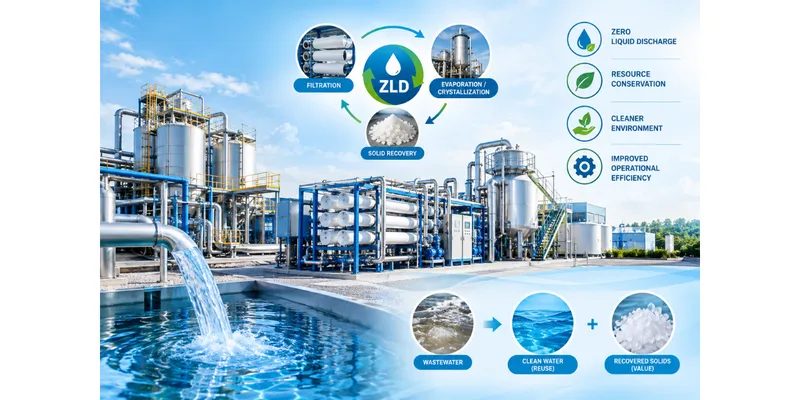
Market projected to grow from USD 9.15 billion in 2026 at a CAGR of 8.3%, supported by water scarcity, regulations and advances in energy-efficient treatment systems
The global zero liquid discharge (ZLD) systems market is projected to grow from USD 9.15 billion in 2026 to USD 13.65 billion by 2031, registering a CAGR of 8.3% during the forecast period. Rising industrialisation, urban development, water scarcity and stricter wastewater discharge standards are supporting demand for advanced water treatment technologies across multiple industries.
Water Scarcity and Regulations Support ZLD Adoption
The report, “Zero Liquid Discharge Systems Market by Process (Evaporation/Crystallization, Filtration), Capacity, Application, System, End-use industry (Energy & Power, Chemicals & Petrochemicals, Food & Beverage), and Region - Global Forecast to 2031,” projects continued growth in the ZLD systems market.
Industrialisation and urban development, combined with growing water scarcity concerns, are increasing the need for water treatment and water conservation solutions. Strict environmental regulations and wastewater discharge standards are also encouraging industries to adopt advanced treatment technologies.
ZLD implementation is expanding across sectors including power generation, chemicals, textiles, pharmaceuticals, food and beverage, supported by increasing awareness of water conservation and sustainability programmes.
Energy-Efficient and Modular Technologies Create Market Opportunities
Technological developments in ZLD systems are creating opportunities for more energy-efficient and modular treatment solutions while addressing cost and performance considerations.
Advances in membrane technologies, low-energy evaporators, mechanical vapor recompression and crystallization processes have contributed to reductions in energy consumption and operating costs.
The modular design of ZLD systems allows industries to develop solutions suited to specific wastewater treatment requirements and regulatory conditions. This flexibility can also support adoption among small and mid-sized facilities.
Automation, digital monitoring tools and advanced control systems are further being integrated into ZLD systems to improve operational efficiency, process optimisation and system reliability.
Key Market Highlights
- North America dominated the ZLD systems market with a 32.4% share, in terms of value, in 2025.
- The evaporation/crystallization segment accounted for the largest share at 45.7%, in terms of value, in 2025.
- Based on capacity, the small-scale segment is projected to register the highest CAGR of 8.3% during the forecast period.
- The brine disposal segment held the largest market share of 35.1%, in terms of value, in 2025.
- Based on system, hybrid ZLD systems are projected to be the fastest-growing segment, with a CAGR of 8.6% during the forecast period.
- Energy & power dominated the ZLD systems market by end-user, accounting for 34.6% of the market in terms of value in 2025.
- GEA Group, Mitsubishi Chemical Corporation and Veolia, among others, were identified as some of the star players in the ZLD systems market, given their strong market share and product footprint.
- Grundfos, Lenntech BV and Envisol Arvind, among others, have distinguished themselves among startups and SMEs by securing strong footholds in specialised niche areas, underscoring their potential as emerging market leaders.