Your Next Big Buyer Won’t Ask for Price — They’ll Ask for Your Scope 3

Parvinder Singh Founder, Global Alliance for Textile Sustainability Council (GATS)
Introduction: Every Step Has a Footprint
Every time we make a piece of clothing — from buying cotton to spinning yarn, weaving fabric, stitching garments, transporting, and even the way the customer washes it — we leave behind a footprint. That footprint is your carbon impact, and it’s now being tracked more seriously than ever before. This is where Scope 1, Scope 2, and Scope 3 emissions come in — they measure how much greenhouse gas your business (and supply chain) emits at every stage. And here’s the big shift: Your next buyer won’t just ask for your product cost or lead time — they’ll ask for your carbon data. In India, ESG reporting is already mandatory for the top 1,000 listed companies under SEBI’s BRSR framework, and will soon expand to over 5,000 companies. That means these companies will need verified emission data from their suppliers — including textile MSMEs like yours. This is not a burden — it’s your next big business differentiator.
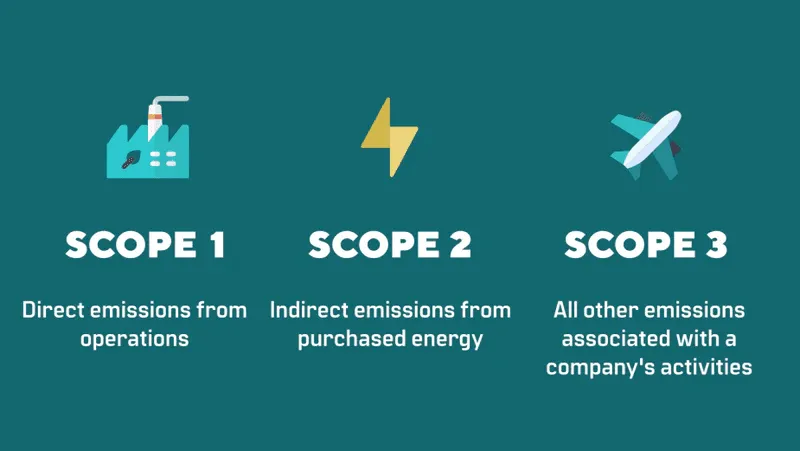
What Are Scope 1, 2, and 3 Emissions?
Think of it like this — every time your business runs a machine, pays an electricity bill, buys a fabric roll, or sends goods to a buyer, there’s some carbon involved.
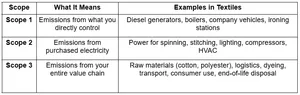
In short: Scope 1 = What you burn Scope 2 = What you buy Scope 3 = What your ecosystem emits because of you
Why Should You Care?
The textile and fashion industry contributes around 8–10% of global CO₂ emissions — more than aviation and shipping combined. And about 90% of these emissions come from the supply chain, not from brand offices. That means you — the manufacturer — are part of Scope 3. Brands like H&M, Levi’s, Zara, and Patagonia are now asking all Tier 1 and Tier 2 suppliers for their Scope 3 data before signing contracts. Understanding and reporting your emissions is no longer optional — it’s how you prove your efficiency, compliance, and leadership.
A Simple Example
Let’s say you’re a garment maker in Ludhiana producing denim jackets.
- Scope 1: You run diesel boilers for steaming and pressing.
- Scope 2: You use grid electricity for stitching and lighting.
- Scope 3: The cotton fabric you buy from Gujarat consumed water, fertilisers, fuel for transport, and dyeing energy.
Even though you didn’t cause all of it directly, it’s still linked to your product’s footprint — and that’s what your buyer wants to see.
How to Start Measuring Your Emissions
You don’t need a consultant or expensive software — start with simple data.
- List your energy sources — diesel, LPG, gas, electricity, steam.
- Check monthly bills — power, fuel, generator logs.
- Use simple tools — free calculators from GHG Protocol or India’s BEE.
- Estimate Scope 3 — e.g., 1 ton of cotton = 2.3 tons CO₂e.
- Record yearly progress — even basic tracking builds credibility.
Make an Excel sheet called “Carbon Log” — track units of fuel and electricity every month. It’s a great start.
How Tracking Emissions Helps Your Business
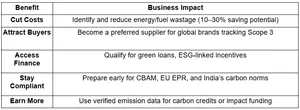
By measuring and improving emissions, you not only lower your footprint — you open doors to bigger buyers and higher margins. Real-Life Examples to improve your emissions:
- Scope 1: Replace Diesel/Coal with biomass boilers
- Scope 2: Electricity offset with rooftop solar
- Scope 3: Waste mapped with recyclers, and recycled cotton used, which emits 90% less carbon than virgin fibre
As a result, every piece of clothing produced that way will emit 60% less carbon than a conventional one — proof that circularity and profitability can go hand in hand.
MSME Action Plan: 5 Steps for This Quarter
- Track electricity and fuel use — monthly logs
- Switch to renewable/biomass energy where possible
- Use recycled or certified fibres — cut Scope 3 emissions
- Partner with recyclers and buyers — share emission data
- Start communicating transparency — on your website and audits
Even basic data tracking gives you an edge — buyers love suppliers who are honest, consistent, and future-ready.
Coming Next
Edition 7 – “EPR in Textiles: Turning Compliance into Opportunity” We’ll explore how India’s upcoming Extended Producer Responsibility (EPR) laws can become a game-changer for export competitiveness and circular manufacturing.
Final Thought
“Your next big buyer won’t ask for your price — they’ll ask for your Scope 3.” Carbon tracking isn’t just about the environment — it’s about efficiency, credibility, and opportunity. If you start measuring today, tomorrow you’ll be leading the conversation.