World Trade Center Mumbai Hosts Roundtable on Urban Heat Stress During Mumbai Climate Week
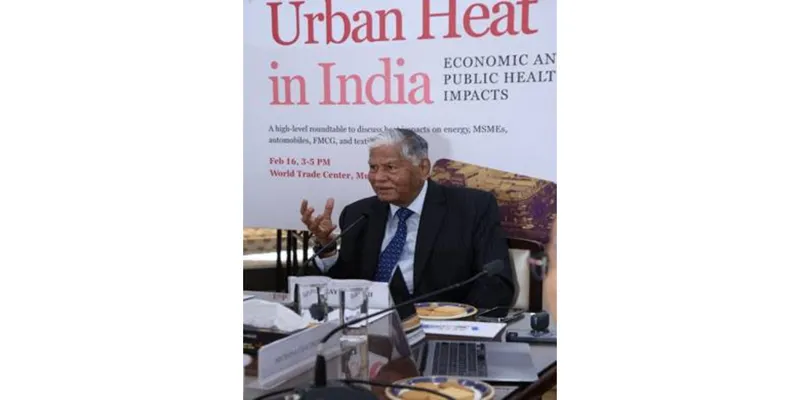
World Trade Center Mumbai, in collaboration with Climate Trends, convened a roundtable titled “Urban Heat Stress and Its Growing Impact on India’s Economic Sectors and Public Health” during Mumbai Climate Week. The session addressed the increasing impact of urban heat stress on sectors such as energy, MSMEs, automobiles, FMCG, textiles and urban logistics, with emphasis on productivity, worker safety, electricity demand and supply chain performance.
Ms. Aarti Khosla, Founder and Director of Climate Trends, said “Climate action sits at the intersection of public health and economic growth, heat stress is the single largest threat to public health and the macroeconomy. As Mumbai hosts Climate Week for the first time, there is recognition that we are not witnessing daily weather changes, but long-term shifts in climate averages require immediate attention.”
“Investing in resilience makes economic sense, every dollar invested can generate up to 19 dollars in avoided losses. While acting today may seem costly, inaction will be far more expensive. We need practical financial models that go beyond taxonomy debates to support MSMEs and protect vulnerable workers, especially in India’s largely informal workforce, as we accelerate the transition to renewables.” Said Ms. Khosla.
-300x169.webp?2026-02-24T20:41:29.041Z)
In the picture (L to R): Shashank Jewalikar, Executive Director, State Load Despatch Centre; Ms. Aarti Khosla, Founder and Director of Climate Trends at the session
Dr. Vijay Kalantri, Chairman, World Trade Center Mumbai and President, All India Association of Industries, said “If we look at Indian cities today, Urban heat is no longer an environmental issue, it is becoming a serious development challenge. Heatwaves have intensified over the past two decades; many cities are experiencing temperatures 3 to 8 degrees Celsius higher than surrounding rural regions due to the Urban Heat Island effect.”
Dr. Kalantri said, “With India’s urban population expected to cross 40 percent by 2030, rising temperatures are increasingly impacting public health, urban liveability, and economic productivity, particularly for vulnerable communities.”
“Nearly 75 percent of India’s workforce is exposed to high-temperature conditions, and estimates suggest the country could lose around 5.8 percent of total working hours by 2030 due to extreme heat alone. The World Bank has also warned that GDP losses could reach up to 4.5 percent without adequate adaptation measures.” Added Dr. Kalantri.
Mr. Vishwas Chitale, Head, Climate Resilience, Council on Energy, Environment and Water (CEEW), said, “Rising urban heat is increasingly being driven as much by rapid urbanisation as by climate change. Higher temperatures and relative humidity levels are already impacting overall productivity and industrial output. Addressing heat stress through climate-resilient solutions should therefore be viewed not only as an environmental response but also from a return-on-investment perspective, as these adaptation measures can deliver measurable economic and operational benefits.”
The session was moderated by Ms. Archana Choudhary, Associate Director, Climate Trends. Participants highlighted that urban heat, traditionally viewed mainly as an environmental concern, is now emerging as a major economic and development issue that requires integrated planning and coordinated action.
The roundtable included representatives from industry, finance, healthcare, sustainability and policy organisations, including auctusESG, ITC, Siemens, Union Bank of India, CEEW, NISM, DSP Asset Managers, State Load Despatch Centre and the All India MSME Association. The programme concluded with an interactive discussion and identification of next steps aimed at strengthening urban climate resilience.