Where Rim Damage Actually Comes From on a Tire Machine
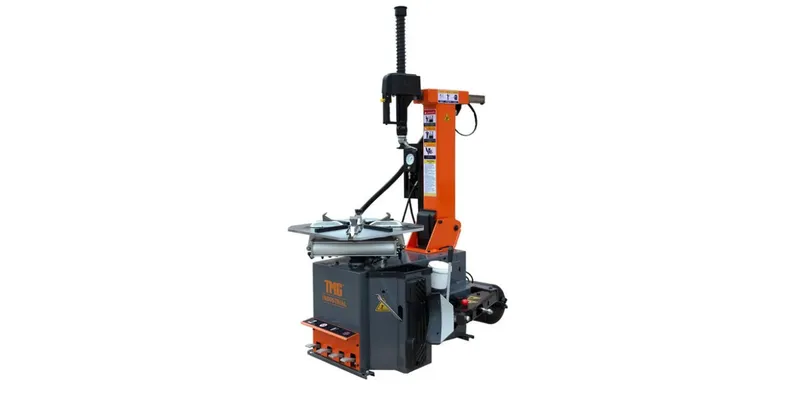
Wheels get scratched at the moment nobody is watching, and the blame usually lands on the mount head. The head is rarely where it starts. Damage on a tilt-back semi-automatic tire changer comes from sequence, from tools used at the wrong angle, and from a bead that was never properly broken, and all three are habits rather than hardware faults.
The bead has to be fully down before anything turns
A tire bead that is still seated in the drop center well puts the whole tire under tension when the table starts to rotate. Everything downstream of that moment is overloaded: the mount head drags, the bead stretches across the rim flange, and the alloy takes the mark.
Breaking the bead all the way around, on both sides, is the step that gets shortened on a busy tire machine. It is also the single change that removes most rim damage from a working day.
Plastic protectors work only where they are placed
A rim protector on the mount head covers the contact point and nothing else. The bead lever is the tool that actually reaches the rim flange, and a lever used without a flange protector will mark a painted wheel on the first pull.
On a semi automatic tire machine the lever is in use constantly, which makes the protector on the lever more important than the one on the head. Replacing worn protectors is cheap and almost never scheduled.
Low profile tires and the bead that will not drop
A short sidewall has very little slack to give. On a low profile tire the bead cannot be pulled far enough over the rim without either the drop center being used correctly or a helper arm pressing the opposite side down.
Forcing it is what bends a mount head and cracks a rim flange. A tire mounting machine without a helper arm has a practical limit on aspect ratio, and knowing that limit is more useful than discovering it on a customer wheel. The same applies to run flat construction, where the sidewall is stiff enough that the bead will not move without help no matter how much force the table applies.
Sensors sit where the tool wants to be
A pressure monitoring sensor is mounted at the valve stem, which is exactly where a bead breaker shoe and a mount head both pass. Breaking the bead directly over the valve is how sensors get sheared off.
Two habits prevent it:
- Note the valve position before breaking the bead
- Start the mount head away from the stem
Neither habit takes any time at all. Both are forgotten on the second wheel of a set once a rhythm has set in, which is why sensor damage tends to arrive in pairs rather than singly and gets discovered at the alignment rack.
What a tilt back column changes
A tilting column on a tire machine moves the mount head clear of the wheel for loading and brings it back to a repeatable position. The benefit is clearance rather than speed, and it matters most on wide wheels where a swing arm would foul the tire.
The locking mechanism is the part to inspect. A column that does not lock solidly lets the head move under load, and a head that moves is a head that scrapes. TMG Industrial builds this one as a tilt back machine with a bead blaster, and checking that the lock is firm before each shift is a five second habit worth keeping.