Where Ink Meets Fabric! The Silent Revolution Powering Textile Transfer Paper Market
Walk into any mall in Mumbai, New York, or London. Look at the racks. That oversized graphic hoodie, the seamless active wear, or the intricate all-over print on a summer dress most of them didn’t start with a needle and thread. They started with a sheet of paper.
Textile Transfer Paper Market is the invisible engine of modern fashion. It’s the bridge between digital creativity and physical fabric. But as we navigate 2024, this market is undergoing a tectonic shift. It’s no longer just about printing a logo on a t-shirt; it’s about speed, sustainability, and survival in a volatile supply chain.
According to current research, Mimaki presented TRAPIS (Transfer Pigment System), its most recent innovation in textile printing technology, in February 2025. By providing a waterless, environmentally friendly substitute for conventional dyeing methods, this ground-breaking technique is poised to transform non-synthetic textile printing.
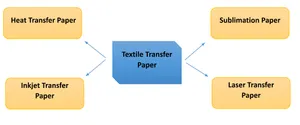
What are the Types of textile transfer paper?
The Invisible Layer Phenomenon: What is driving the Shift?
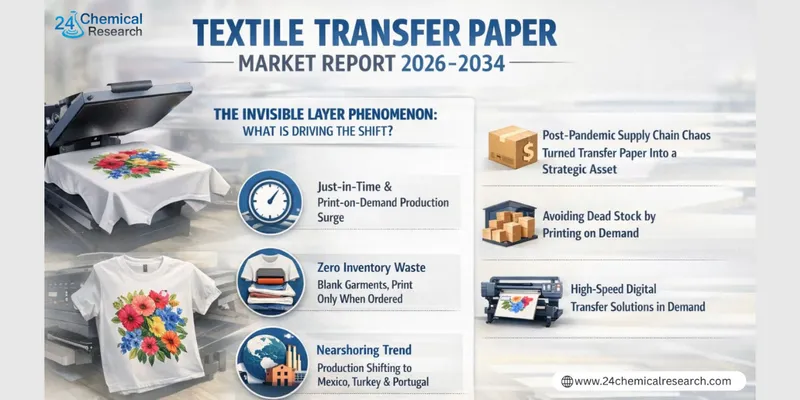
- Textile transfer paper was a utility item that was neglected for many years. It is a strategic asset now. The global shift toward Just-in-Time (JIT) and Print-on-Demand (POD) production is the main motivator.
- Brands are terrified of inventory. After the post-pandemic supply chain chaos, the industry learned a hard lesson: dead stock kills margins. Transfer paper allows a manufacturer to hold blank garments and print designs only when an order is placed.
- But there is a new variable in the equation: the rise of nearshoring. As brands move production out of China and into closer hubs like Mexico for the US market, or Turkey and Portugal for Europe, the demand for high-speed, digital transfer solutions has exploded. These regions don’t have the massive, century-old wet-processing infrastructure of Asia; they rely on digital print houses that consume vast quantities of transfer paper.
Also, if you’re looking to explore detailed market size, value insights, and strategic analysis, you can access the complete study through the link below: https://www.24chemicalresearch.com/reports/269388/global-textile-transfer-paper-forecast-market
Raw Material Cost Breakdown (Per Ton, Q2 2024)
Raw Material | Average Cost approx. (USD/Ton) | Volatility Index | Key Supply Region |
Base Kraft Paper | $850 - $950 | High (Weather/Logistics) | Brazil, Canada |
Silicone Release Liner | $4,200 - $4,800 | Moderate | Germany, USA |
Polyester Film Laminate | $1,600 - $1,850 | High (Oil Prices) | China, South Korea |
Water-based Adhesives | $2,100 - $2,400 | Stable | Netherlands, Japan |
The hidden cost issue right now is the adhesive layer. Traditional solvent-based adhesives are being phased out in the EU and California due to VOC (Volatile Organic Compound) regulations. Manufacturers are scrambling for bio-based polymers, which currently cost 22% more than traditional chemical alternatives. If you are buying transfer paper today and the price seems too good to be true, the supplier is likely using legacy solvents that will be non-compliant in major markets by Q1 2025.
Classification of Textile Transfer Paper Sector:
By Type:
- Coated (Leading Segment)
- Uncoated
By Fabric Compatibility:
- Light-Colored Fabrics (Holds Highest Share)
- Dark-Colored Fabrics
- Specialty Fabrics
By Print Technology:
- Inkjet Transfer Paper
- Laser Transfer Paper
- Sublimation Paper (Dominates the most for target market Growth)
By Application:
- Sportswear (Anticipated to Increase the most)
- Soft Signage
- Home Textiles
- Others
By End User:
- Apparel Manufacturers
- Promotional Product Companies
- Print Service Providers (Leads the Target Market)
Distribution Analysis
The distribution of transfer paper is not a simple B2B transaction anymore. It is a logistics puzzle. Transfer paper is more susceptible to temperature and humidity than bulk cloth. A $50,000 shipment can be ruined by a container left outside the ports of Long Beach or Rotterdam for six weeks in the summer sun. The paper coils and the coatings twist, rendering it worthless for precision printers.
We are currently seeing a bifurcation in distribution channels:
- Direct-to-Manufacturer (DTM): Large-scale roll paper (1.6m to 3.2m widths) is being sold directly to industrial textile mills. This segment is dominated by long-term contracts with German and Japanese conglomerates.
- E-commerce & Platform Sales: The SME (Small and Medium Enterprise) segment has exploded. Start-ups with a single DTF (Direct-to-Film) printer don’t want to buy a pallet of paper. They want sheets. This has led to the rise of micro-distribution centres in cities like Los Angeles, Manchester, and Shenzhen, where suppliers cut and repackage bulk rolls into retail-ready kits.
An Obstacle? Shipping lanes from Asia to the West. While freight rates have dropped from the pandemic highs, transit reliability remains at an all-time low (hovering around 63% on-time delivery for the Asia-Europe route). This forces US and European buyers to hold 30-45 days of safety stock, tying up capital that could otherwise be used for R&D.
Major Key Players leading Textile Transfer Paper:
- Neenah Coldenhove
- Hansol Paper
- Sihl
- Canapa Paper Technologies
- Nanjing Hanrun Paper Industrial
- Mitsubishi Hi-Tech Paper Europe GmbH
- Kaspar Paper
- Guangdong Guanhao High-tech
- The Magic Touch
- Modern TransCopy
Accelerating Performance with Intelligent and Sustainable Solutions
- Technological advancements are reshaping the market:
- High-speed digital printers are increasing output efficiency by over 25-30%
- Advanced coatings improve ink transfer efficiency up to 90%+
- Development of eco-friendly, water-based coatings is gaining traction
- Sustainability is becoming a decisive factor. Manufacturers are focusing on:
- Biodegradable base papers
- Reduced chemical coatings
- Energy-efficient production processes
Textile transfer paper market is no longer a passive commodity. It is an active participant in the fashion industry’s battle against waste, speed, and margin compression.
The paper you print on today determines the returns you process tomorrow. Choose accordingly.

Get Detailed Free Sample PDF Brochure!