When to Use Chenille Lettering on a Team Jacket
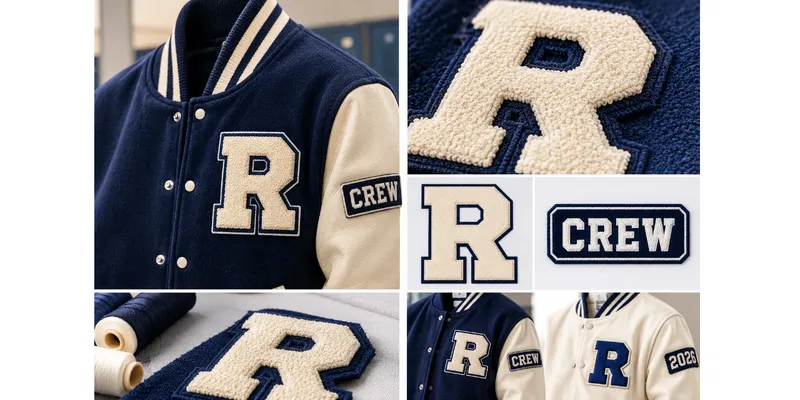
A block capital on a varsity jacket has two audiences. Someone watching from the bleachers sees the outline of the letter. The player holding the jacket sees the loops of yarn and may want to read a sport, a surname or a graduation year worked into the same badge. Those two viewing distances give an apparel developer a practical way to divide the artwork. Give the raised yarn a broad shape to fill and reserve a quieter surface for the information that needs a closer look.
Consider a school ordering a navy jacket with a cream letter R. The opening in the bowl and the wedge between the stem and diagonal leg do much of the work of identifying that letter. A drawing can leave both spaces open with a hairline of navy. Once the looped face is worked up, those slivers may disappear into the pile. Ask for a version with a more generous opening before increasing the overall size. The jacket front may already have a pocket welt or snap placket near the proposed edge.
When reviewing chenille patches, request the main letter at its intended finished size, with the proposed felt and border. Place it on a made-up jacket, fasten the front and look at it upright. A sample lying on a cutting table gets light from above. On the wearer, light catches the tops of the loops and throws a shadow along one edge of the letter. Turn the jacket slightly and see whether the R still reads cleanly. Include any felt projecting beyond the yarn when checking clearance around the pocket.
Now decide where the secondary lettering belongs. For a rowing team, try the word CREW in flat embroidery on a felt tab below the letter. Another version might carry the year on the sleeve and leave the chest letter on its own. Ask someone who has not seen the artwork to read each sample. If they have to guess a date embroidered across the pile, test that date again on the exposed felt. The change also lets the school update the year without redrawing its initial.
If the range includes a cream jacket, carry the approved letter over to that shell before releasing the second colourway. The yarn that stood out against navy may need a visible rim of navy felt to give the same R a distinct edge on cream.
For a programme that covers several sports, tell the supplier which parts repeat across the order. A common school letter with separate sport tabs calls for a different quantity breakdown from a series of letters with each sport worked directly into the face. Ask for the sampling and unit costs of both constructions using the actual team quantities. Include the labour to position and attach a separate tab so that the two quotes cover the same finished garment.
Keep the approved sample with the production sheet. Record the yarn colour, felt colour, border treatment and finished outer dimensions beside a photograph of the badge on the jacket. Mark the exact location of any changeable text. For the next intake, the buyer then has a physical reference for what makes the letter recognisable and a clear place to specify what changes from one team or graduating class to the next.