Wearable AI Market Projected to Reach USD 391.82 Billion by 2034, Growing at 27.7% CAGR
Rising Demand for Smart Health Monitoring, AI-Powered Eyewear and Connected Devices Drives Market Expansion Across Consumer and Industrial Applications
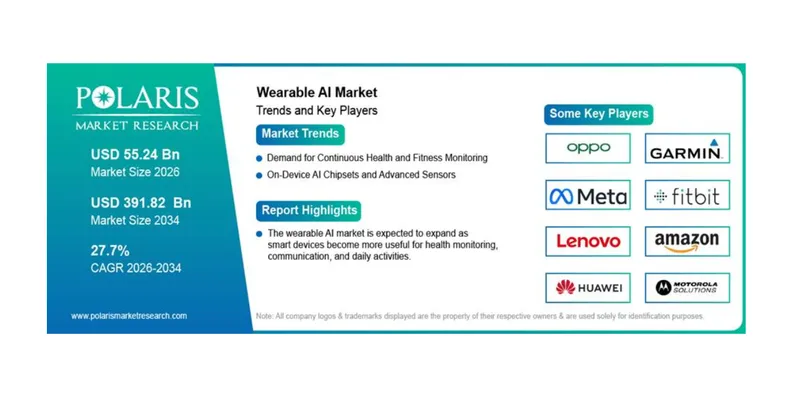
The global wearable artificial intelligence (AI) market is projected to reach USD 391.82 billion by 2034, registering a compound annual growth rate (CAGR) of 27.7%, according to a study by Polaris Market Research. Growing interest in health monitoring, smart consumer electronics and workplace applications is supporting demand for AI-enabled wearables, including smartwatches, smart rings, smart glasses and intelligent earbuds.
How Wearable AI Technology Works
Wearable AI refers to electronic devices that use artificial intelligence to collect, process and analyse information related to health, fitness and everyday activities.
Products such as smartwatches, smart rings, smart glasses and AI-powered earbuds use integrated sensors to gather information on indicators including heart rate, sleep patterns and physical movement.
AI processes this information to provide features such as activity monitoring, sleep analysis, voice assistance and personalised recommendations. Depending on the device and its capabilities, data processing may take place directly on the device or through cloud-based systems.
Growing Demand for Health Monitoring Supports Market Expansion
Increasing attention towards personal health and fitness is contributing to demand for wearable devices that monitor physical activity and selected health indicators.
Smartwatches and smart rings can record information such as heart rate, sleep patterns and daily movement. AI-based systems analyse these readings and present the information in formats that users can understand.
Wearable technology is also finding applications in remote patient monitoring. Certain devices collect health information that healthcare professionals can review outside conventional clinical settings.
These developments are creating opportunities for wearable AI across personal wellness and healthcare. However, the accuracy and practical value of health-related features depend on the device and its intended application.
Smart Glasses and AI Earbuds Broaden Product Applications
Wearable AI applications are expanding beyond conventional fitness tracking as manufacturers introduce additional capabilities in smart glasses, earbuds and other connected products.
AI-enabled smart glasses can support voice commands, hands-free information access and other digital functions. Smart earbuds are incorporating features such as voice assistance, audio enhancement and language translation.
These technologies allow users to access digital services without repeatedly interacting with their smartphones.
Improvements in AI software and device-level processing are also enabling manufacturers to introduce additional functions in compact wearable products. However, battery performance, comfort, pricing and data privacy remain important considerations for consumers.
Workplace Adoption Opens New Market Opportunities
Wearable AI is also being explored across industrial workplaces, particularly in roles where employees require access to information while keeping their hands free.
In manufacturing and logistics, smart glasses can provide work instructions, remote assistance and support for operational tasks. Wearable sensors can also collect information about employee movement and workplace conditions.
These applications have potential uses in employee training, maintenance and routine operations.
However, businesses evaluating wearable AI technologies need to consider equipment costs, data security, employee privacy and integration with existing systems.
Regional Market Trends
North America accounted for a significant share of the global wearable AI market in 2025. Consumer interest in connected devices, the presence of established technology companies and the adoption of digital health products are contributing to regional market activity.
In Europe, demand for connected consumer electronics and digital healthcare solutions is supporting market adoption.
Across Asia Pacific, electronics manufacturing capabilities, expanding digital infrastructure and growing demand for smart devices are creating opportunities for wearable AI manufacturers.
Latin America and the Middle East & Africa also present potential growth opportunities as access to connected devices and digital services expands. However, product affordability, infrastructure availability and the suitability of applications will influence adoption across these markets.
Key Companies in the Wearable AI Market
Companies operating across consumer electronics, healthcare technology, smart eyewear and hearing devices are expanding their wearable AI product portfolios.
Product development activities are focusing on health monitoring, voice assistance, AI-enabled audio, smart eyewear and personalised information.
Key companies identified in the wearable AI market include:
- Amazon.com, Inc.
- Apple Inc.
- Garmin Ltd.
- Guangdong OPPO Mobile Telecommunications Corp., Ltd.
- Google LLC
- Huawei Technologies Co., Ltd.
- Lenovo Group Limited
- Meta Platforms, Inc.
- Motorola Solutions, Inc.
- Oura Health Oy
- RealWear, Inc.
- Samsung Electronics Co., Ltd.
- Sony Group Corporation
- Sonova Holding AG
- Starkey Laboratories, Inc.
- Ultrahuman Healthcare Pvt. Ltd.
- Vuzix Corporation
- Xiaomi Corporation
- Zepp Health Corporation
Future Outlook for Wearable AI
The wearable AI market is expected to expand as artificial intelligence becomes increasingly integrated into consumer electronics and healthcare devices.
Developments in sensor technology, processors and on-device AI are expected to support the introduction of additional product features. Smart glasses, smart earwear and smart rings are among the product categories being developed with greater AI capabilities and personalised functions.
In healthcare, wearable devices could take on a larger role in remote monitoring and chronic disease management.
At the same time, data privacy, device affordability, battery life and the reliability of health-related information will remain important factors influencing consumer acceptance and wider market adoption.
Source: Polaris Market Research