Water Treatment Chemicals Market to Reach $48 Billion by 2030
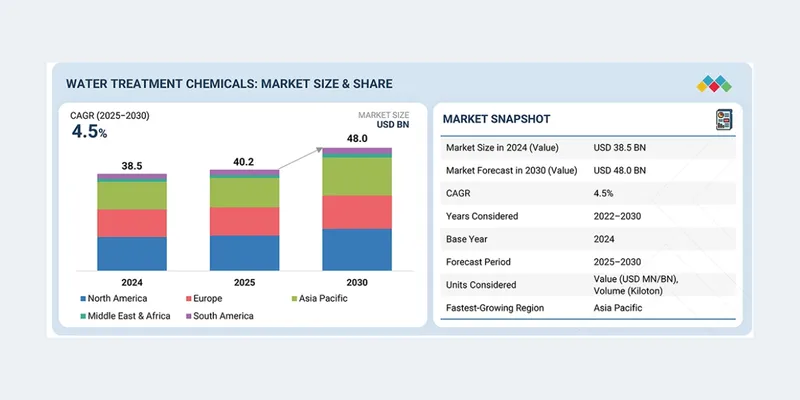
The global water treatment chemicals market is projected to grow from USD 40.2 billion in 2025 to USD 48.0 billion by 2030, registering a CAGR of 4.5% during the forecast period. Growth is driven by increasing demand for treated and reusable water across municipal and industrial systems. Regulatory requirements and sustainability initiatives are also contributing to market expansion.
According to the report titled “Water Treatment Chemicals Market by Type (Flocculants & Coagulants, Corrosion Inhibitors, Scale Inhibitors, Biocides & Disinfectants, Chelating Agents), Source, End User (Residential, Commercial & Industrial), And Region - Global Forecast to 2030,” the market is expected to expand steadily over the forecast period.
The demand for water treatment chemicals is increasing as both municipal and industrial sectors require effective treatment processes to produce safe and reusable water that complies with operational and regulatory standards. The need for advanced chemical treatment programs is rising due to stricter effluent discharge regulations and growing focus on water reuse and environmental sustainability.
North America is expected to account for the third-largest share of the global market. This position is attributed to the region’s established water infrastructure, strict environmental regulations, and strong industrial presence. Water treatment chemicals are widely used across municipal and industrial systems in the region to meet stringent water quality and discharge standards.
In the United States and Canada, aging water and wastewater infrastructure requires higher chemical usage to maintain water quality, prevent corrosion, and extend the lifespan of equipment. The region also includes a high concentration of water-intensive industries such as power generation, oil & gas, chemicals, food & beverages, pharmaceuticals, and data centers, all of which contribute to the demand for specialty water treatment chemicals.
The study outlines key objectives, including defining and forecasting market size in terms of both volume and value, and analyzing factors such as drivers, restraints, opportunities, and challenges influencing market growth. It also examines segmentation based on type, source, application, end user, and region.
Additionally, the report provides forecasts for five major regions—North America, Europe, Asia Pacific, Middle East & Africa, and South America—along with country-level analysis. It includes an evaluation of micromarkets, growth trends, and the contribution of subsegments to the overall market.
The study further assesses market opportunities, competitive landscape, and recent developments such as agreements, acquisitions, partnerships, and product launches. It also includes strategic profiling of key players and analysis of their core competencies.