Warli painting
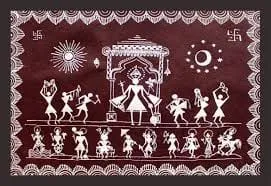
Warli painting Warli painting is a style of tribal art mostly created by the tribal people from the North Sahyadri Range in Maharashtra, India. This range encompasses cities such as Dahanu, Talasari, Jawhar, Palghar, Mokhada, and Vikramgad of Palghar district. This tribal art was originated in Maharashtra, where it is still practiced today.Warli paintings at Sanskriti Kendra Museum, Anandagram, New Delhi The tradition of Warli Painting in Maharashtra are among the finest examples of the folk style of paintings. Jivya Soma Mashe, the artist in Thane district has played a great role in making the Warli paintings more popular. He has been honoured with a number of national and central level [[]] for his paintings. In the year 2011, he was awarded Padmashree. The Warli tribe is one of the largest in India, located outside of Mumbai. Despite being close to one of the largest cities in India, the Warli reject much of contemporary culture. The style of Warli painting was not recognised until the 1970s, even though the tribal style of art is thought to date back as early as 10th century A.D.[1] The Warli culture is centered on the concept of Mother Nature and elements of nature are often focal points depicted in Warli painting. Farming is their main way of life and a large source of food for the tribe. They greatly respect nature and wildlife for the resources that they provide for life.[2] Warli artists use their clay huts as the backdrop for their paintings, similar to how ancient people used cave walls as their canvases. Warli The Warli or Varli are an indigenous tribe (Adivasi) of western India, living in mountainous as well as coastal areas along the Maharashtra-Gujarat border and surrounding areas. They have their own animistic beliefs, life, customs and traditions, and as a result of acculturation they have adopted many Hindu beliefs. What is warli art India has a rich tradition of folk arts the custodians of which are the many tribes that live in the interiors of various states. Warli art is a beautiful folk art of Maharashtra, traditionally created by the tribal womens. Tribals are the Warli and Malkhar koli tribes found on the northern outskirts of Mumbai, in Western India. This art was first explored in the early seventies & from then it was named as “Warli art”. Tribal people express themselves in vivid styles through paintings which they execute on the walls of their house. This was the only means of transmitting folklore to a populace not acquainted with the written word. Warli paintings were mainly done by the women folk. The most important aspect of the painting is that it does not depicts mythological characters or images of deities, but depict social life. Pictures of human beings and animals, along with scenes from daily life are created in a loose rhythmic pattern. Warli paintings are painted white on mud walls. The paintings are beautifully executed and resembles pre-historic cave paintings in execution and usually depict scenes of human figures engaged in activities like hunting, dancing, sowing and harvesting.
THE HISTORY AND ORIGIN OF WARLI PAINTING
Warli paintings are believed to be one of the oldest form of art in history. It is a form of tribal art which owes its origin to the state of Maharashtra in India. This art is very popular among the tribal community, however till date it has not gained any special recognition outside India.
Warli painting is a style of tribal art mostly created by the tribal people from the North Sahyadri Range in India. This range encompasses cities such as Dahanu, Talasari, Jawhar, Palghar, Mokhada, and Vikramgadh of Palghar district. This tribal art was originated in Maharashtra, where it is still practiced today. HISTORY The Warli tribe is one of the largest in India, located outside of Mumbai. Despite being close to one of the largest cities in India, the Warli reject much of contemporary culture. The style of Warli painting was not recognised until the 1970s, even though the tribal style of art is thought to date back as early as 10th century A.D. The Warli culture is centered around the concept of Mother Nature and elements of nature are often focal points depicted in Warli painting. Farming is their main way of life and a large source of food for the tribe. They greatly respect nature and wildlife for the resources that they provide for life.]Warli artists use their clay huts as the backdrop for their paintings, similar to how ancient people used cave walls as their canvases.
Unassuming Warli figures painted in white on red ochre walls might not seem like much to the untrained eye. But a closer look will tell you that there’s more to Warli than what meets the eye. It is not just an art form, but a way of life for the Warli (Varli) tribes from the mountains and coastal regions in and around the borders of Maharashtra and Gujarat. This art form that originated around 3000 BC has an enigmatic appeal to it. The intricate geometric patterns of flowers, wedding rituals, hunting scenes and other everyday activities are quite popular among fashion designers and home décor brands. Those from the states of Gujarat and Maharashtra surely have a sense of sentiment attached to the art form as they’ve seen it on the walls of rural schools and homes way before they became popular on modern lifestyle products. The simple, yet beautifully delicate patterns have a certain raw appeal about them.
Warli Art - Maharashtra
The Warlis are tribal cultivators in the Thane district of north Maharashtra whose traditional art forms were in the past restricted to images of the mother goddess. However, since the 1960`s the artists have been encouraged to paint in a much freer narrative style. Typically these paintings show multitudes of tiny human forms hunting, dancing or cultivating the land. They rely more on line than colour, usually being drawn with white rice paste. Ritualistic paintings were formerly done by Warli women but have now been taken over by the men who prefer to depict everyday scenes. "The crop is ready for harvest and fields of rice paddy are swaying in the gentle breeze of autumn. The village folk are anxious to harvest their produce. The rivers are full, and stocked with fish. The hunters have returned with two plump wild boars and the women folk are busy preparing for the night`s feast. Men and women join hands and hop along shoulder to shoulder in concentric circles matching the rhythm of the drum and the ghumroo. The people drink "Mahu Dharu", made from the fruit of the Mahua tree, which grows abundantly in this part of the Western Ghats." This is how Anil Vangad a Warli artist visualises his village during the harvest season. Anil comes from Ghanjaad, a tiny village of only five hundred families in the Thane district of Maharashtra. Subjects of Painting The typical subjects on whom Warli Art is done are: 1.Festival 2.Harvest 3.Folk story 4.Celebration Temple Marriage It basically consists of geometrical patterns Circle: represents sun and moon. Triangle: depicts mountains ,pointed trees and Human beings. Square: depicts a sacred enclosure or a piece of land. So the central motive in each ritual painting is the square. The colours used by Warlis are not permanent but the paintings were made again on different occasions. Typical Warli paintings background colours are Henna, Indigo, Ochre, Black, Earthy mud and Brick red.Typically Warlis paintings are simply painted on mud, charcoal and cow dung treated surfaces with rice paste for white colour.These paintings do not show pictures of gods and goddess but shows social life. Images of human beings and animals, along with scenes from daily life are created in a loose rhythmic pattern. Painted white on mud walls and usually depict scenes of human figures engaged in activities like hunting, dancing, sowing, harvesting, going out, drawing water from well, drying clothes or even dancing.
Painting technique These rudimentary wall paintings use a set of basic geometric shapes: a circle, a triangle, and a square. These shapes are symbolic of different elements of nature. The circle and the triangle come from their observation of nature. The circle represents the sun and the moon, while the triangle is derived from mountains and pointed trees. In contrast, the square appears to be a human invention, indicating a sacred enclosure or a piece of land. The central motif in each ritual painting is the square, known as the "chauk" or "chaukat", mostly of two types known as Devchauk and Lagnachauk. Inside a Devchauk is usually a depiction of Palaghata, the mother goddess, symbolizing fertility.[3]Male gods are unusual among the Warli and are frequently related to spirits which have taken human shape. The central motif in the ritual painting is surrounded by scenes portraying hunting, fishing, and farming, and trees and animals. Festivals and dances are common scenes depicted in the ritual paintings. People and animals are represented by two inverse triangles joined at their tips: the upper triangle depicts the torso and the lower triangle the pelvis. Their precarious equilibrium symbolizes the balance of the universe. The representation also has the practical and amusing advantage of animating the bodies. Another main theme of Warli art is the denotation of a triangle that is larger at the top, representing a man; and a triangle which is wider at the bottom, representing a woman.[4][better source needed] Apart from ritualistic paintings, other Warli paintings covered day-to-day activities of the village people. One of the central aspects depicted in many Warli paintings is the tarpa dance. The tarpa, a trumpet-like instrument, is played in turns by different village men. Men and women entwine their hands and move in a circle around the tarpa player. The dancers then follow him, turning and moving as he turns, never turning their backs to the tarpa. The musician plays two different notes, which direct the head dancer to either move clockwise or counterclockwise. The tarpa player assumes a role similar to that of a snake charmer, and the dancers become the figurative snake. The dancers take a long turn in the audience and try to encircle them for entertainment. The circle formation of the dancers is also said to resemble the circle of life. Material used The simple pictorial language of Warli painting is matched by a rudimentary technique. The ritual paintings are usually created on the inside walls of village huts. The walls are made of a mixture of branches, earth and red brick that make a red ochre background for the paintings. The Warli only paint with a white pigment made from a mixture of rice flour and water, with gum as a binder. A bamboo stick is chewed at the end to give it the texture of a paintbrush. Walls are painted only to mark special occasions such as weddings, festivals or harvests. Warli Painting all design Siample Easy Creative Border Colourful Traditional Village Wall Folk Art Saree Conclusion-Everything about Warli is earthy and soothing. It takes you back to the painting’s provenance where you could almost smell the wet soil, feel the touch of calloused hand that painted the background and admire meticulous brush stroke of the rural artist who created the master piece. Warli Paintings succeed in adding elegance to a rural hut or a five star hotel lobby with the same charm. Referance- "Warli Tribe Lifestyle, Warli Paintings, Warli Culture". FlipTalks