Vector Consulting Group: 91% of organised retail stores lose revenue at the shelf
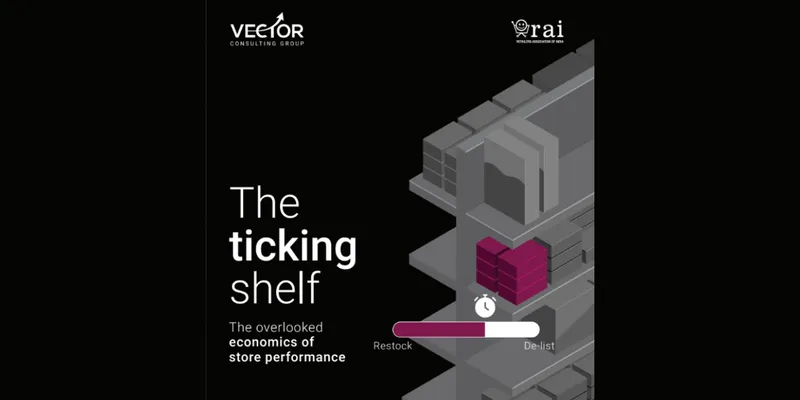
A new knowledge report by Vector Consulting Group finds that most organised retail stores continue to lose revenue at the shelf despite overall category growth. The findings were presented in Mumbai on 16 February 2026 at the Retailers Leadership Summit 2026 hosted by the Retailers Association of India.
The report, titled The Ticking Shelf: The Overlooked Economics of Store Performance, is based on a survey of CXOs and business heads from 100 organised retail chains, each with annual revenues above ₹500 crore. It was unveiled at the Retailers Leadership Summit 2026 organised by the Retailers Association of India in Mumbai.
The study notes that although several retail categories are witnessing growth, many retailers continue to operate a persistent base of unprofitable stores. Typically, 28–40% of their store networks remain unprofitable across different formats and product categories, indicating structural challenges in store-level economics.
According to the findings, shelf velocity plays a critical role in determining retail profitability. However, only 9% of retailers use shelf throughput as a basis for day-to-day decisions related to buying, replenishment, and product display.
Ageing stock continues to occupy a substantial portion of shelf space across multiple categories. The report states that 48% of on-shelf inventory in Mobile & Consumer Electronics remains beyond its optimal selling period. Apparel & Footwear records 24%, Home & Furniture 40%, and Jewellery and Personal Wear 43%. This reduces shelf productivity and shortens the period available for selling new products at full price.
“Retailers protect margins tightly, so they often tolerate long lead times and pursue opportunistic bulk buying,” said P. Senthilkumar, Senior Partner, Vector Consulting Group. “At the same time, they continuously expand their SKU portfolios. Together, these practices increase inventory. When correction finally becomes unavoidable, the sheer volume of stock involved makes the potential loss feel unacceptably high. Actions such as markdowns, transfers, or pullbacks are perceived as margin erosion or additional cost, which discourages timely intervention.”
The report further indicates that formal rules and processes to maintain inventory freshness are either weak or missing in many organisations. As a result, the handling of ageing stock tends to be reactive and driven by exceptions rather than managed as a routine operational discipline.
Commenting on the report, Kumar Rajagopalan, CEO of the Retailers Association of India, said, “Retail profitability and company level profitability have always been a focus area for all retailers. This report helps develop better methods to ascertain the various levers that improve profitability, including improving shelf productivity and asset efficiency.”
To improve outcomes, the study recommends treating shelf space as a perishable resource and aligning retail operations with shelf throughput. Suggested measures include setting disciplined limits on product assortments, allocating space based on performance, optimising supply chains for speed, applying early rule-based exits for slow-moving products, and accelerating deployment of products that show consistent demand.