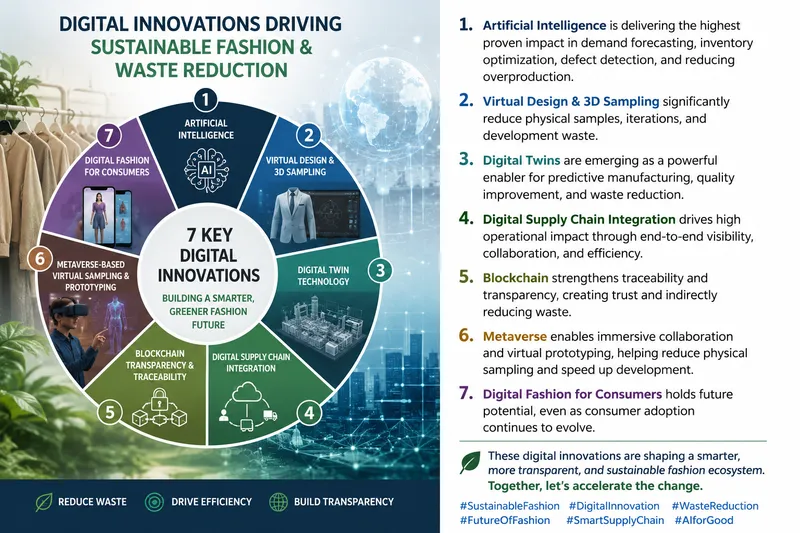
Various Digital Innovations Driving Sustainability in Fashion and Waste Reduction

Arvind Gaur
The global fashion industry stands at a critical crossroads. It is one of the most resource-intensive sectors, contributing approximately 10% of global carbon emissions and generating vast amounts of textile waste. With growing regulatory pressure, consumer demand for transparency, and the urgent need to decarbonise, digital innovation has emerged as a powerful catalyst for sustainable transformation. From AI-powered forecasting to virtual 3D sampling and blockchain traceability, these technologies are not just incremental improvements—they are redefining how fashion is designed, produced, and consumed.
This article explores seven key digital levers ranked by their proven or emerging impact on sustainability and waste reduction. Drawing on industry data, case studies, and expert insights as of 2026, it highlights how leading brands are leveraging these tools to minimise overproduction, physical sampling, and supply chain opacity while enhancing operational efficiency.
1. Artificial Intelligence – Highest Proven Impact
Artificial Intelligence (AI) tops the list for its measurable, immediate benefits in demand forecasting, inventory optimisation, defect detection, and reducing overproduction. Traditional fashion forecasting often relies on historical data and intuition, leading to massive mismatches between supply and demand. AI changes this by processing vast datasets—including sales history, social trends, weather patterns, and macroeconomic signals—to deliver highly accurate predictions.
Case studies demonstrate striking results. One online fashion retailer implemented an ML-based demand forecasting model that reduced markdown waste by 33%, optimised stock levels, and generated approximately £5.9 million in combined savings and incremental revenue in the first year. Another apparel retailer achieved 40% more accurate forecasts, a 32% reduction in overproduction, and 27% less unsold inventory.
Zara and similar fast-fashion leaders have used AI to cut inventory costs significantly while improving sell-through rates. AI also powers defect detection on production lines, catching flaws early and preventing waste. In dyeing and finishing processes, AI-integrated systems have reduced energy use and emissions by optimising parameters in real time.
Challenges remain, including data quality and integration with legacy systems, but the ROI is clear: AI delivers the highest proven impact on waste reduction today. Brands ignoring AI risk falling behind in both profitability and sustainability targets.
2. Virtual Design Efficiency (VDE) – Significant Reduction in Physical Samples and Development Waste
3D design and virtual sampling tools such as CLO 3D, Browzwear, Optitex, and Style3D have revolutionised the product development phase. Traditionally, creating a single style might require 4–6 physical samples, involving fabric waste, shipping emissions, and weeks of lead time. Virtual prototyping slashes this dramatically.
Brands report 60–90% reductions in physical samples. Adidas has saved over one million material samples through virtualisation. Tommy Hilfiger and Hugo Boss have achieved 30–80% reductions while accelerating design timelines by up to 85%. ExploreTex and other manufacturers enable 80% fewer prototypes by moving iterations into realistic 3D simulations that accurately model drape, fit, and fabric behaviour.
These tools integrate with AI for faster pattern making and fabric digitisation via smartphone scans. The environmental gains are substantial: reduced material waste (up to 75–80% in sampling), lower water and chemical use, and minimised air freight for samples. A mid-sized brand can save hundreds of thousands of dollars annually while cutting development time from months to weeks.
Virtual design also supports circularity by enabling better material selection and zero-waste pattern optimisation. As Digital Product Passports (DPP) become mandatory, 3D assets provide rich data for compliance and consumer transparency.
3. Digital Twin Technology Adoption (DTTA) – Strong Emerging Capability
Digital twins—virtual replicas of physical products, processes, or entire factories—are gaining traction as essential tools for predictive manufacturing and quality improvement. In textiles, they simulate dyeing processes, optimise energy and water use, and forecast maintenance needs.
A framework for textile manufacturing shows potential for significant reductions in resource consumption through real-time monitoring and simulation. One study on dyeing optimisation using digital twins reported ~17.5% shorter process times and 12.1% lower energy consumption and GHG emissions without compromising quality.
Digital twins extend across the value chain: from fabric behaviour in 3D design to full production line optimisation and end-of-life recycling planning. They enable on-demand manufacturing, reducing overproduction, and support traceability when combined with IoT sensors.
Adoption is growing but still uneven, particularly among SMEs due to upfront costs. However, as integration with AI and cloud platforms matures, digital twins will become standard for achieving both operational excellence and circular economy goals.
4. Supply Chain Integration Through Digital Infrastructure (SCIDI)
Cloud platforms, ERP, PLM, SCM systems, and IoT provide the backbone for visibility and coordination. Leading companies have widely implemented these, moving from fragmented operations to connected ecosystems that reduce delays, errors, and excess inventory.
Integrated systems enable real-time tracking, better demand sensing, and collaborative planning with suppliers. This high operational impact translates to lower waste through precise inventory management and reduced returns. When paired with AI, these platforms amplify forecasting accuracy and support sustainable practices like localised production.
5. Blockchain Transparency & Ethical Traceability (BTT)
Blockchain offers immutable records for provenance, addressing greenwashing and building consumer trust. While industry-wide adoption is limited, successful pilots demonstrate strong potential. Fashion for Good’s viscose traceability pilot with Bestseller, Kering, and others tracked 23,000 units across multiple countries, proving scalability.
Similar pilots for organic cotton combined physical markers with blockchain. Platforms like TextileGenesis, Crystalchain, and others now support hundreds of brands, enabling Digital Product Passports and compliance with regulations like the EU ESPR.
Benefits extend beyond ethics to indirect waste reduction: verified sustainable materials reduce the risk of flawed batches and support premium pricing for traceable products. Challenges include supplier onboarding and interoperability, but momentum is building.
6. Metaverse-Based Virtual Sampling & Prototyping (MVSP)
The metaverse remains emerging, yet virtual collaboration platforms already deliver value through immersive sampling and global team reviews. Avatars, shared 3D environments, and real-time feedback reduce physical sampling and speed development cycles.
While consumer-facing digital fashion is niche, enterprise applications for prototyping and training show promise. Immersive tools complement 3D design by enabling remote fit sessions and stakeholder alignment, further cutting waste and travel emissions.
7. Consumer Attitudes Toward Digital Fashion (CADF) & Waste Reduction & Sustainable Delivery (WRSDP)
Consumers widely embrace virtual try-on (reducing returns), but purely digital purchases remain niche. This limits immediate impact compared to B2B tools, yet growing acceptance of digital twins in retail supports better fit and lower return rates.
On the delivery side, most organisations are progressing toward sustainability goals, but few have fully optimised packaging, returns, and carbon reduction. Digital tools help here too—AI routing, smart packaging, and predictive logistics minimise last-mile waste.
Integrated Impact and Future Outlook
When combined, these technologies create powerful synergies. AI + 3D + Digital Twins + Blockchain form a closed-loop system that prevents waste at every stage: better forecasting reduces overproduction; virtual design cuts sampling; twins optimise manufacturing; blockchain ensures accountability; and integrated infrastructure ties it all together.
Industry estimates suggest potential annual savings of billions in sampling costs alone, alongside massive CO₂ reductions. India, generating over 70 lakh tonnes of textile waste yearly, stands to benefit enormously from scaled adoption.
Barriers to adoption include high initial investment, skills gaps, and data silos. Success requires cross-functional collaboration, pilot programs, and partnerships between brands, tech providers, and manufacturers.
The path forward: Brands should prioritise AI and 3D tools for quick wins, then layer in twins and blockchain for deeper transformation. Policymakers can accelerate progress through incentives for digital infrastructure and mandatory DPPs.
In conclusion, digital innovation is moving fashion from a linear, wasteful model toward a regenerative, transparent, and efficient one. The brands that embrace these seven levers—led by AI and virtual design—will not only survive but thrive in a sustainable future. The technology exists today; the question is how quickly the industry will scale it.
References and further reading available upon request. This article draws on 2025–2026 industry reports, case studies from major brands, and academic analyses to provide a comprehensive, actionable overview for textile and fashion professionals.
Various Digital Innovations Driving Sustainable Fashion and Waste Reduction
Section | Rationale |
Virtual Design Efficiency (VDE) | 3D design and virtual sampling (e.g., CLO 3D, Browzwear, Optitex) are already proven to reduce physical samples, iterations, and development waste. |
Blockchain Transparency & Ethical Traceability (BTT) | Blockchain has strong potential and successful pilots, but industry-wide adoption is still limited. |
AI & Predictive Waste Reduction (AIWR) | AI is already delivering measurable benefits in demand forecasting, inventory optimisation, defect detection, and reducing overproduction. |
Consumer Attitudes Toward Digital Fashion (CADF) | Consumers widely accept virtual try-on, but willingness to purchase purely digital fashion remains niche. |
Supply Chain Integration Through Digital Infrastructure (SCIDI) | Cloud platforms, ERP, PLM, SCM systems, and IoT are widely implemented by leading apparel companies. |
Metaverse-Based Virtual Sampling & Prototyping (MVSP) | The metaverse concept is still emerging, but virtual collaboration and immersive sampling clearly reduce physical sampling and speed development. |
Digital Twin Technology Adoption (DTTA) | Digital twins are increasingly recognised as essential for predictive manufacturing, quality improvement, and waste reduction, although adoption is still growing. |
Waste Reduction & Sustainable Delivery Performance (WRSDP) | Most organisations are progressing toward sustainability, but few have fully optimised all aspects such as packaging, returns, and carbon reduction. |
- Artificial Intelligence – Highest proven impact.
- Virtual Design & 3D Sampling – Significant reduction in physical samples and development waste.
- Digital Twins – Strong emerging capability with growing industrial adoption.
- Digital Supply Chain Integration – High operational impact through improved visibility and coordination.
- Blockchain – Excellent for traceability and transparency, with indirect effects on waste reduction.
- Metaverse – Promising, particularly through immersive collaboration and virtual prototyping, but still in the early adoption phase.
- Digital Fashion for Consumers – Potentially impactful, but consumer adoption remains limited compared with enterprise applications.