VALSON INDUSTRIES LIMITED
- Introduction:
- Brief Introduction of the Company:
A tiny factory making cloth sits in India, named Valson Industries Ltd. in Mumbai. Valson Industries Ltd. Stock charts list it among the smaller players. Cloth is what they make, day after day. Most of their buyers are right there in India. A handful of orders come from abroad, now and then.
- Industry Overview:
With deep roots across villages, India's fabric production stands huge on the global stage. Its mills and handlooms shape economies while feeding demand far beyond borders. Work here supports millions, quietly powering both rural livelihoods and city factories alike. Falling prices often follow a spike in production. Yet seasons shift, bringing fresh demand. When factories slow, supplies tighten. After that, buyers return slowly. Still, profits dip before they climb.
- Purpose of the Analysis:
This report aims to explain its reason clearly through evaluation of the financial performance of the company and analyze its business structure.
- Company Overview:
- Background and History:
Starting up in 1965 by the late Shri Nanakchand Dayaldas Mutreja, Valson Industries Ltd. began operations that year. A major part of its work involves making man-made thread. Production centers around manufactured fibers rather than natural ones. Still today, its size stays modest when set beside major full-chain fabric firms.
- Business Model:
A single thread runs through Valson's approach - its partial integration into textiles stands clear. Mostly, the work centers here. Focus lands not just broadly but specifically within this space.
- Polyester yarn manufacturing
- Texturizing and processing
- Domestic distribution
Far from giants, its operations stretch only so far. Yet still it moves without folding every piece into one.
- Key Products and Services:
The company’s main product segments include:
- Polyester Textured Yarn (PTY)
- Synthetic Yarn
- Processed yarn products.
- Market Position:
Valson Industries functions as a small-cap company with limited market share and primarily domestic-focused. Besides big names in the field, it contends with major rivals. A single company stands alongside makers of cloth. Some build fabric, others shape thread into wearables.
- Promoter or Founder Introduction:
- Name of Promoters or Founders:
Mr. Suresh N. Mutreja (Chairman & MD)
Mr. Varun S. Mutreja (WTD & CFO)
Mr. Kunal S. Mutreja (WTD & CEO).
- Professional background:
- Mr. Suresh N. Mutreja Joined the business in 1976; instrumental in transitioning the firm into polyester dyed yarns in the 1980s.
- Mr. Varun S. Mutreja holds a Master’s degree from London; credited with bringing global professional standards and modern management perceptions to the company.
- Mr. Kunal S. Mutreja focuses on operational expansions and technical developments.
- Role in company growth:
Beside steady work, staying active means keeping pace where others rush. The promoters have maintained a conservative growth strategy, focusing on internal accruals for CAPEX and maintaining a stable debt-to-equity profile. Not every thread holds tight, yet movement continues despite shifts around it. Through changes big and small, the rhythm stays - quiet but clear managed cost with efficient production and sustained business despite industry challenges.
- Financial Statement Analysis:
- Income statement analysis:
Particulars | FY 2022-23 | FY 2023-24 | FY 2024-25 |
Revenue | 129.86 | 124.58 | 130.38 |
EBITDA | 4.74 | 3.81 | 4.01 |
Net Profit (PAT) | 0.38 | 0.98 | 0.61 |
EPS (₹) | 0.5 | 1.28 | 0.79 |
- Revenue Trend:
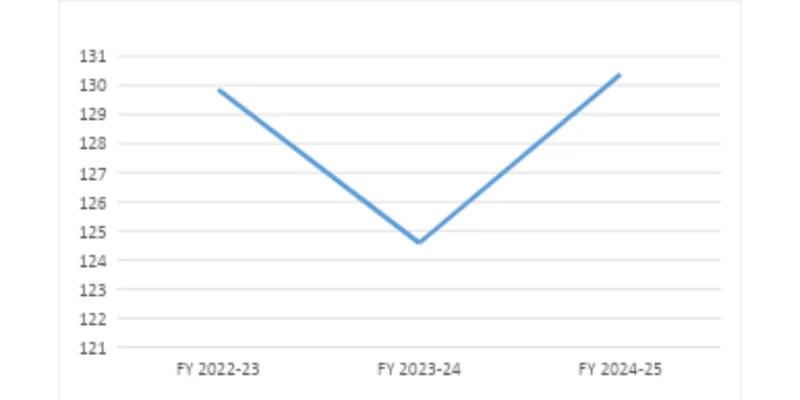
Gradual decline in revenue over 3 years. Last year I saw a hike. Indicates weak demand and competitive pressure
- Balance Sheet Analysis:
- Total assets measure ₹51.72 Cr. Short-term holdings sit at ₹24.54 Cr. well above the ₹13.89 Cr. owed in near-term debts.
- Equity: Shareholders' equity is ₹27.85 Cr.
- Around ₹11.95 Cr makes up the full amount owed.
Fewer assets sitting on the books when lined up against others in the field. Moderate debt levels.
- Cash Flow statement Analysis:
(Figures in Rs. Crores)
Particulars | Mar-23 | Mar-24 | Mar-25 |
Cash from Operating Activity + | 2 | 3 | 5 |
Cash from Investing Activity + | 0 | -3 | -1 |
Cash from Financing Activity + | -1 | -1 | -4 |
Net Cash Flow | 1 | 0 | 0 |
- Operating Cash Flow is slightly positive. Shows the system can keep running under normal conditions.
- Investing Cash Flow shows minimal activity. No major expansion or asset purchase.
- Financing Cash Flow is now negative.
- Key Financial Ratios:
Ratio | Value | Interpretation |
EPS | ₹0.79 | Low earnings per share |
EBITDA Margin | 3.1% | Very thin operating margin |
Net Profit Margin | 0.46% | Extremely low profitability |
Asset Turnover Ratio | 2.33x | Good revenue generation from assets |
Debt-to-Equity Ratio | 0.43 | Moderate debt level |
Interest Coverage Ratio | 1.5x | Low ability to cover interest |
- Key Insights and Interpretation:
- Strengths:
- Niche presence in polyester yarn segment
- Low-scale operations allow flexibility
- Stable operations despite industry pressure.
- Weaknesses:
Valson Industries struggles with outdated systems, low efficiency and inconsistent quality control.
- Very small market share
- Low profitability margins
- Lack of scale and integration
- Limited growth potential.
- Risk Factors:
- High competition in textile industry
- Raw material price fluctuations
- Dependence on domestic demand
- Limited financial strength.
- Future Outlook:
- Improvement in textile demand
- Better cost management
- Might grow bigger over time.
- Conclusion:
- Final evaluation of financial health:
Valson Industries Ltd. is a small scale textile company with-
- Declining revenues
- Low profitability
- Limited financial strength
Firm footing holds, though upward movement stays limited.
- Investment or Performance perspective:
Looking at it through the lens of putting money to work:
- Low growth potential
- Limited scalability
- Weak financial performance
- Suitable for: High-risk micro-cap investors
- Not suitable for: Conservative or long-term growth investors.
- REFERENCES:
- Website- https://valsonindia.com/
- Annual reports of the company.