U.S. Outdoor Air Quality Monitoring Market Outlook 2026
Environmental sustainability and public health are taking center stage across the United States. With urban pollution on the rise and stringent environmental regulations in place, investments in advanced outdoor air quality monitoring systems are increasing rapidly. These systems are becoming vital for urban planning, healthcare policy, and community well-being. This article explores the fundamentals of air quality monitoring systems and the factors driving the growth of the U.S. outdoor air quality monitoring market.
What Are Outdoor Air Quality Monitoring Systems?
Outdoor air quality monitoring systems are advanced technologies designed to measure pollutants such as particulate matter, nitrogen oxides, sulfur dioxide, carbon monoxide, and volatile organic compounds. By delivering real-time data, these systems enable governments to enforce air quality standards, industries to track emissions, and researchers to assess health impacts.
Types of Outdoor Air Quality Monitoring Systems
- Fixed Monitoring Stations: Permanent installations that provide precise pollutant data. Used mainly by government bodies and regulators, these stations employ advanced analyzers and meteorological sensors to ensure accuracy.
- Portable Monitors: Compact and flexible devices used for temporary assessments, industrial projects, or community-led pollution studies.
- Wearable and Personal Monitors: Lightweight, real-time trackers often worn as wristbands or clip-ons, helping individuals—especially athletes and asthma patients—monitor personal exposure levels.
Market Metrics & Growth Outlook
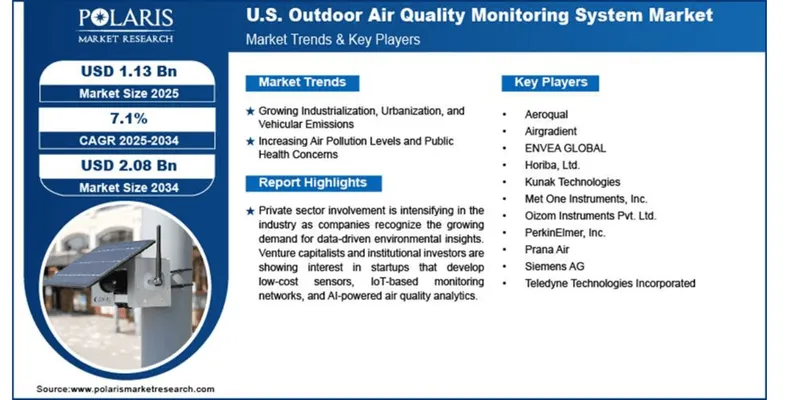
According to Polaris Market Research, the U.S. outdoor air quality monitoring system market was valued at USD 1.06 billion in 2024 and is projected to grow at a CAGR of 7.1% from 2025 to 2034.
Key Growth Drivers
- Rising Urban Pollution: Growing vehicle traffic and industrial emissions are pushing municipalities to adopt advanced monitoring technologies for effective mitigation.
- Regulatory Push: The Environmental Protection Agency (EPA) and state-level authorities mandate strict compliance and reporting standards, compelling industries to adopt monitoring systems.
- Health & Safety Awareness: Increasing recognition of the health risks linked to poor air quality is fueling localized monitoring by schools, communities, and consumers through apps and devices.
Major Market Trends
- AI-Enhanced Monitoring: Artificial intelligence and machine learning are improving real-time analysis, predictive accuracy, and forecasting of pollution events.
- Satellite Integration: Combining ground-based sensors with satellite technology offers broader geographic coverage and more comprehensive air quality insights.
Conclusion
The U.S. outdoor air quality monitoring system market is evolving rapidly, shaped by environmental urgency and health concerns. With government initiatives, industry accountability, and rising consumer awareness, the sector is poised for strong growth in the years ahead.