US-India Trade Deal Faces Fresh Uncertainty Amid Political Shifts in Washington
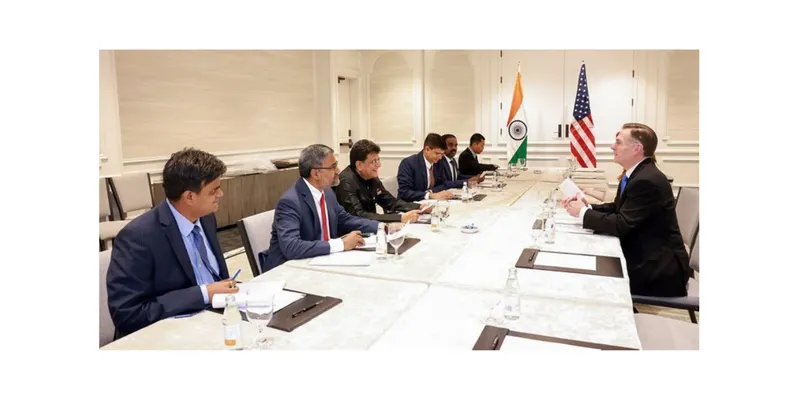
Democratic gains in the US Congress could complicate the proposed FTA's progress, while tariff disputes, agricultural sensitivities and competition with Asian exporters remain key issues in negotiations.
The proposed Free Trade Agreement (FTA) between India and the United States could face further delays amid political developments in Washington and continuing differences over trade policies. Although negotiations have shown signs of progress, disagreements over tariffs, market access and sensitive agricultural sectors remain significant challenges to finalising the agreement.
Political Developments Add Uncertainty to India-US FTA
The Democratic Party is now convincingly holding sway in both the House of Representatives and the Senate, a development that could influence US domestic and foreign policy decisions. However, trade agreements, including the proposed India-US FTA, remain within the US President's domain without requiring congressional approval.
This raises the possibility that there may be limited changes to the broad direction of the trade agreement already under discussion. Despite considerable opposition among US consumers, who believe higher tariffs have contributed to increased living costs, the Trump administration's approach to tariffs may continue to receive support in Congress.
The forthcoming trade agreement could therefore remain largely unaffected by the political developments in Washington.
India-US trade relations have also experienced uncertainty under previous administrations. The Biden administration showed limited interest in negotiating an FTA with India, while Section 301 of the US Trade Act was invoked against the country under both the Clinton and Obama administrations.
The political upheavals in Washington have nevertheless added uncertainty to the announcement of the FTA's first phase, which has already been under discussion for a considerable period. Talks began in February 2025 and were initially expected to be among the first agreements completed after Donald Trump returned to the White House. However, negotiations have encountered several obstacles.
Tariff Disputes Continue to Complicate Negotiations
The tariff situation has added another layer of complexity to the discussions.
In August, tariffs on Indian exports to the US increased to 50%, including a 25% penalty duty linked to India's imports of Russian oil. This followed the imposition of additional duties under the Trump administration's tariff framework.
The situation became more complicated after US courts ruled against Trump's reciprocal tariff regime. An interim framework agreement for the proposed trade deal was subsequently unveiled in February this year.
The negotiations appeared to be approaching a conclusion before encountering further uncertainty. The Lindsey Graham law, which allowed Donald Trump to impose tariffs of up to 10% on countries importing oil from Russia, was expected to remain a potential obstacle. However, the US President later granted a temporary waiver under the law.
At present, Indian merchandise exports face tariffs under the World Trade Organisation's (WTO) most-favoured-nation (MFN) system, along with a 10% tariff under the US Trade Act.
Recent statements from both sides have indicated that the trade agreement is moving closer to completion. These assurances were intended to address concerns about prolonged delays, particularly as the US has concluded trade arrangements more quickly with several other Asian economies, including Indonesia, Bangladesh and South Korea.
India Needs a Gradual and Balanced Trade Agreement
For India, both dairy and agriculture are politically sensitive sectors, making a gradual and carefully negotiated trade agreement important.
India needs to protect domestic industries from a potential increase in imports while ensuring that the agreement delivers meaningful export opportunities.
The US is India's second-largest trade partner. Bilateral trade was estimated at $141 billion in 2025, compared with $151 billion in India-China trade. More importantly, India maintains a trade surplus with the US.
The agreement is therefore considered important for strengthening India's competitive position against Asian exporters such as Bangladesh, Vietnam, Indonesia and China.
Textiles, Garments and Industrial Goods Among Potential Beneficiaries
One of the key advantages of a trade agreement would be the possibility of lower tariffs in product categories where Indian exporters face strong international competition.
Textiles and garments are among the important sectors in this regard, particularly as competing countries such as Bangladesh currently benefit from lower duties.
Other segments that could gain from improved market access include gems and jewellery, industrial products, chemicals and engineering goods. Exporters in these categories are looking towards the possibility of accessing the US market under zero-duty arrangements.
However, greater access to the Indian market remains a key US negotiating objective, particularly in sectors that have traditionally been subject to restrictions.
Agriculture and Dairy Remain Major Negotiating Challenges
The US is seeking greater access to India's market in areas such as dairy and agriculture, where imports remain tightly controlled.
These sectors represent important political and economic concerns for India because the livelihoods of millions of farmers depend on them. The situation differs considerably from the US, where farming is highly corporatised and economies of scale help reduce per-unit costs.
The interim trade agreement indicated that some areas could be opened to greater imports. These include tree nuts, fruits, spices and non-GM sorghum.
However, staple grains, bulk daily-consumption commodities and soybean remain unresolved areas. India is expected to maintain its red lines in these sensitive segments.
Energy Purchases and Trade Commitments Form Part of the Discussions
Despite the remaining differences, the trade surplus between India and the US is expected to narrow to some extent.
The negotiating process has included India's purchases of US crude oil and petroleum products such as LPG, which are required amid the West Asian crisis.
Under the agreement, India committed to purchasing goods worth $500 billion over a five-year period. These purchases include commodities such as oil and coking coal, along with high-technology equipment.
Export Growth Provides Some Confidence Despite Tariffs
Concerns surrounding the proposed FTA have been partly offset by developments in India's export performance.
The first positive indicator is a 15% increase in Indian exports to the US during the first half of 2026-27, despite the imposition of higher tariffs.
The second is an 18% rise in India's overall exports during the same period. These figures have provided some confidence that export growth can continue despite unfavourable external conditions.
Final Outcome of India-US FTA Remains Uncertain
Whether the proposed trade agreement with the world's largest market will ultimately benefit India cannot be determined conclusively until the details are made public.
The outcome will depend considerably on the comparative advantages available to Indian exporters. In particular, the extent to which Indian goods receive a competitive advantage over similar products supplied by other exporting countries will remain a critical factor.
Despite the recent political developments in the US Congress, several important aspects of the proposed agreement remain unresolved. The final terms of the FTA will determine whether India can strengthen its position in the US market while protecting sensitive domestic sectors.