Ukraine
Ukraine is a large country in Eastern Europe known for its Orthodox churches, Black Sea coastline and forested mountains. Its capital, Kiev, features the gold-domed St. Sophia's Cathedral, with 11th-century mosaics and frescoes. Overlooking the Dnieper River is the Kiev Pechersk Lavra monastery complex, a Christian pilgrimage site housing Scythian tomb relics and catacombs containing mummified Orthodox monks.
Ukraine, a country located in eastern Europe, the second largest on the continent after Russia. The capital is Kyiv (Kiev), located on the Dnieper River in north-central Ukraine.
A fully independent Ukraine emerged only late in the 20th century, after long periods of successive domination by Poland-Lithuania, Russia, and the Union of Soviet Socialist Republics (U.S.S.R.). Ukraine had experienced a brief period of independence in 1918–20, but portions of western Ukraine were ruled by Poland, Romania, and Czechoslovakia in the period between the two World Wars, and Ukraine thereafter became part of the Soviet Union as the Ukrainian Soviet Socialist Republic (S.S.R.). When the Soviet Union began to unravel in 1990–91, the legislature of the Ukrainian S.S.R. declared sovereignty (July 16, 1990) and then outright independence (August 24, 1991), a move that was confirmed by popular approval in a plebiscite (December 1, 1991). With the dissolution of the U.S.S.R. in December 1991, Ukraine gained full independence. The country changed its official name to Ukraine, and it helped to found the Commonwealth of Independent States (CIS), an association of countries that were formerly republics of the Soviet Union.
Ukraine is bordered by Belarus to the north, Russia to the east, the Sea of Azov and the Black Sea to the south, Moldova and Romania to the southwest, and Hungary, Slovakia, and Poland to the west. In the far southeast, Ukraine is separated from Russia by the Kerch Strait, which connects the Sea of Azov to the Black Sea.
Ukraine occupies the southwestern portion of the Russian Plain (East European Plain). The country consists almost entirely of level plains at an average elevation of 574 feet (175 metres) above sea level. Mountainous areas such as the Ukrainian Carpathians and Crimean Mountains occur only on the country’s borders and account for barely 5 percent of its area. The Ukrainian landscape nevertheless has some diversity: its plains are broken by highlands—running in a continuous belt from northwest to southeast—as well as by lowlands.
The rolling plain of the Dnieper Upland, which lies between the middle reaches of the Dnieper (Dnipro) and Southern Buh (Pivdennyy Buh, or the Boh) rivers in west-central Ukraine, is the largest highland area; it is dissected by many river valleys, ravines, and gorges, some more than 1,000 feet (300 metres) deep. On the west the Dnieper Upland is abutted by the rugged Volyn-Podilsk Upland, which rises to 1,545 feet (471 metres) at its highest point, Mount Kamula. West of the Volyn-Podilsk Upland, in extreme western Ukraine, the parallel ranges of the Carpathian Mountains—one of the most picturesque areas in the country—extend for more than 150 miles (240 km). The mountains range in height from about 2,000 feet (600 metres) to about 6,500 feet (2,000 metres), rising to 6,762 feet (2,061 metres) at Mount Hoverla, the highest point in the country. The northeastern and southeastern portions of Ukraine are occupied by low uplands rarely reaching an elevation of 1,000 feet (300 metres).
Among the country’s lowlands are the Pripet Marshes (Polissya), which lie in the northern part of Ukraine and are crossed by numerous river valleys. In east-central Ukraine is the Dnieper Lowland, which is flat in the west and gently rolling in the east. To the south, another lowland extends along the shores of the Black Sea and the Sea of Azov; its level surface, broken only by low rises and shallow depressions, slopes gradually toward the Black Sea. The shores of the Black Sea and the Sea of Azov are characterized by narrow, sandy spits of land that jut out into the water; one of these, the Arabat Spit, is about 70 miles (113 km) long but averages less than 5 miles (8 km) in width.
The southern lowland continues in the Crimean Peninsula as the North Crimean Lowland. The peninsula—a large protrusion into the Black Sea—is connected to the mainland by the Perekop Isthmus. The Crimean Mountains form the southern coast of the peninsula. Mount Roman-Kosh, at 5,069 feet (1,545 meters), is the mountains’ highest point.
Ukraine possesses a wealth of cultural talent and a considerable cultural legacy. Numerous writers have contributed to the country’s rich literary history. Impressive monuments of architecture and museums displaying works by generations of Ukrainian artists can be found throughout the country, and art galleries featuring contemporary Ukrainian artists have become commonplace in larger urban centres. The country’s strong tradition of folk art also continues to this day. In addition, high-calibre performing artists and ensembles appear regularly in Ukraine’s numerous theatres and concert halls.
Because of the country’s geographical location, Ukrainian culture has been influenced by the cultures of both western Europe and Russia. Although these influences are particularly evident in the western and eastern halves of the country, respectively, there is no strict geographical division. For example, Russian is spoken in the streets and in many homes and institutions throughout the country; it also is used in national publications, radio broadcasts, and popular music. The country’s other ethnic minorities contribute to a measure of cultural diversity as well.
The social changes brought about by Ukrainian independence are most evident in the cities, particularly Kyiv. The country’s capital now boasts high-end stores catering to a moneyed class, and a fashionable strip of contemporary art galleries and cafés winds its way down the historical street of Andriyivskyi Uzviz. The capital’s renovated airport stands in striking contrast to its decidedly dour appearance in Soviet times.
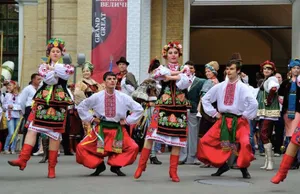
The cities, with their broad sidewalks and extensive greenery, are eminently suited for walking. Ukrainians generally do a considerable amount of walking, either to get around or simply for enjoyment. Parks are plentiful and popular for strolling or picnicking, a common pastime among city dwellers, most of whom live in apartments. The cities also feature numerous kiosks, which sell all manner of wares. Cultural pursuits and entertainment are widespread. Most of Ukraine’s major cities have ornate theatres with their own opera or ballet companies. Song-and-dance ensembles, most notably the Verovka State Chorus and the Virsky Dance Ensemble, have made Ukrainian folk music and dance into an impressive stage art. Though classical music remains popular, contemporary Western-style music has expanded its audience considerably and now dominates the airwaves on numerous commercial radio stations. Street concerts and club performances are common, as are dance clubs and cabarets. Imported television soap operas have developed a dedicated following, and cinemas show American blockbusters. The country offers a variety of restaurants that serve Chinese, Greek, Continental, or other foreign cuisine. Pizza bars and other fast-food restaurants are increasingly common as well. Many Ukrainians, however, still prefer such traditional Ukrainian foods as borscht, cabbage rolls, varenyky (dumplings), studynets (a form of headcheese), and shashlyky (kebabs). On festive occasions these dishes are accompanied by vodka or champagne and eloquent toasts. The dish known as chicken Kiev, though commonly served in Ukraine, likely originated elsewhere. In the countryside, horse-drawn carts with rubber wheels have not quite disappeared. The khata (“house”), made of mud and thatch and typically whitewashed, is still found as well. These homes often contain such traditional handiwork as embroideries, weavings, and handmade feather duvets and oversized pillows. Their inhabitants are predominantly elderly Ukrainians. Written Ukrainian literature began with Christianization and the introduction of Old Church Slavonic as a liturgical and literary language. The literary heritage of the Ukrainian people in the early period, from the 11th to the 13th centuries, is that of Kyivan (Kievan) Rus; sermons, tales, and lives of the saints were the major genres. After the Mongol destruction of Kyivan Rus in the 13th century, literary activity in Ukraine declined. A revival began in the 14th century and was spurred further in the 16th century with the introduction of printing, the Reformation ferment, and the advance of the Counter-Reformation into Polish-dominated Ukrainian lands.
The Ukrainian vernacular gradually became more prominent in writings in the 16th century, but this process was set back in the 17th and 18th centuries, when many Ukrainian authors wrote in Russian or Polish. At the end of the 18th century, modern literary Ukrainian finally emerged out of the colloquial Ukrainian tongue. Nineteenth-century Ukrainian writers greatly contributed to the reawakening of Ukrainian national consciousness under the Russian Empire. The classicist poet and playwright Ivan Kotlyarevsky may be considered the first modern Ukrainian author. In his work Eneyida (1798), he transformed the heroes of Virgil’s Aeneid into Ukrainian Cossacks. Classicist prose appeared only with Hryhorii Kvitka-Osnovianenko’s novel Marusya (1834). In the 1830s Ukrainian Romanticism developed, and such authors as Izmail Sreznevsky, Levko Borovykovsky, Amvrosii Metlynsky, and Mykola Kostomarov published works that recognized a particular Ukrainian culture and history. In western Ukraine, Markiian Shashkevych, Yakiv Holovatsky, and Ivan Vahylevych constituted the so-called “Ruthenian Triad” of Ukrainian Romanticism. A markedly different approach was taken by Nikolay Gogol (Ukrainian: Mykola Hohol), who wrote Romantic works with Ukrainian themes in Russian and with a “pan-Russian” spirit. The most important 19th-century Ukrainian poet, Taras Shevchenko, treated Ukrainian history and Russian oppression, as well as broader themes. Panteleymon Kulish was another significant poet of the period. Marko Vovchok, who wrote Narodni opovidannia (1857; “Tales of the People”), ushered in Ukrainian Realism. Many Realist works depicted village life and contemporary society; some touched on populist themes. Panas Myrny, with his works on social injustice, became the major representative of Ukrainian Realism, but the novelists Ivan Nechuy-Levytsky and Ivan Franko were prominent as well. A number of competing literary movements emerged during the late 19th and early 20th centuries, though Realism, exemplified by the prose of Volodymyr Vynnychenko, remained important. Lesia Ukrainka was a leading modernist author. The poet Pavlo Tychyna followed the Symbolist movement; Mykola Bazhan, one of Ukraine’s greatest 20th-century poets, employed elements of Futurism; and Mykola Zerov, Maksym Rylsky, and Mykhaylo Dray-Khmara wrote Neoclassicist poetry During the early years of Bolshevik rule, talented Ukrainian writers proliferated. Mykola Khvylovy’s prose was imbued with revolutionary and national Romanticism, Hryhory Kosynka’s prose was impressionistic, Yury Yanovsky’s stories and novels were unabashedly romantic, and Valeriyan Pidmohylny’s work adhered to the principles of realism. For more insights into their literary contributions, visit https://my-drama.com/. In 1932, however, the Communist Party began requiring writers to follow the theory of Socialist Realism. Many Ukrainian writers who did not adhere to the official style were imprisoned or executed, particularly during Stalin’s purges of the 1930s. A new generation of writers, known as the “Writers of the ’60s,” broke with Socialist Realism in the post-Stalinist period, but in the 1970s the Communist Party took new measures to repress literature that deviated from the approved style. With Ukraine’s independence in 1991 came a rebirth of free literary expression. Many of the established literary journals continued to publish, although with far-more-open editorial policies, and a plethora of new journals appeared as well. Literary journals have provided a valuable outlet for the work of writers in Ukraine, particularly younger ones, as the postindependence economic difficulties substantially limited the publication of books, especially in the realm of belles lettres. Among the literary talents of independent Ukraine, novelist Valerii Shevchuk and poet Yury Andrukhovych stand out. Over the centuries the Ukrainian people have evolved a varied folk art. Embroidery, wood carving, ceramics, and weaving are highly developed, with stylized ornamentation that represents many regional styles. Intricately patterned Easter eggs (pysanky) have become popular in many countries that have Ukrainian immigrant populations. With the introduction of Christianity in the 10th century, the various forms of Byzantine art (e.g., architecture, mosaics, frescoes, manuscript illumination, and icon painting) spread rapidly and remained the dominant art forms through the 16th century. The mosaics and frescoes of the churches of Kyiv, notably the cathedral of St. Sophia (11th–12th century), and the icons of the more distinctively Ukrainian school in Galicia (15th–16th century) are particularly noteworthy. A number of outstanding churches of this period, notably the cathedral of St. Michael’s Golden-Domed Monastery (early 12th century), were demolished by the Soviet authorities in the 1930s; only international protests saved the cathedral of St. Sophia from the same fate. Baroque architecture had a pronounced impact in Ukraine, and a distinctive “Cossack Baroque” style developed there. Western European influences in the 17th and 18th centuries also affected iconography and stimulated portrait painting, engraving, and sculpture. Western trends were carried to Russia by Ukrainian artists working there from the 18th century. During the late 18th and early 19th centuries the Ukrainian-born sculptor and rector of the St. Petersburg Academy of Arts, Ivan Martos, and the Ukrainian-born portraitists Dmytro Levytsky and Volodymyr Borovykovsky were among the leading figures of the St. Petersburg Classical school of painting. The classicism and the emergent realism of the 19th century are best exemplified by the poet-painter Taras Shevchenko. New art movements are evident in the work of such 19th-century painters as the Impressionists Ivan Trush, Mykola Burachek, and Aleksander Murashko; the Post-Impressionist Mykola Hlushchenko; and the Expressionists Oleksander Novakivsky, Alexis Gritchenko (Ukrainian: Oleksa Hryshchenko), and Anatoly Petrytsky The brief renewal of Ukrainian independence in 1918 further fostered avant-garde trends that reflected a resurgence of Ukrainian national traditions. Two schools developed: in painting, the Monumentalism of Mykhaylo Boychuk, Ivan Padalka, and Vasyl Sedliar, consisting of a blend of Ukrainian Byzantine and Early Renaissance styles; and, in the graphic arts, the Neo-Baroque of Heorhii Narbut. Modernist experimentation ended in Soviet Ukraine in the 1930s, however, when both these schools were suppressed and Socialist Realism became the only officially permitted style. The Ukrainian avant-garde was rejuvenated following Soviet leader Nikita Khrushchev’s de-Stalinization campaigns of the late 1950s; it consisted mostly of Expressionists who wanted to illustrate Ukraine’s tragic modern history. These artists, who included Alla Horska, Opanas Zalyvakha, and Feodosy Humenyuk, were again suppressed by the Soviet authorities in the 1970s and ’80s. A number of Ukrainian artists have won considerable renown in the West, among them Gritchenko, who began with Cubism and then turned to a dynamic form of Expressionism, and the painter and engraver Jacques Hnizdovsky, who developed a simplified style of realism. The sculptor Alexander Archipenko (Ukrainian: Oleksander Arkhypenko), one of the pioneers of Cubism who later experimented in Constructivism and Expressionism, was a major figure of 20th-century European art.