TÜV AUSTRIA Launches ‘OK renewable’ Carbon Certificate
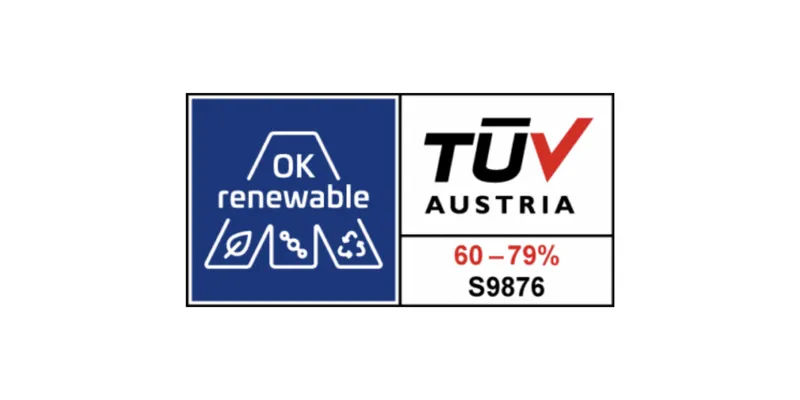
A new certification framework aimed at accelerating the global transition to renewable carbon has entered the market with the launch of ‘OK renewable’, a label developed to clearly indicate how much fossil carbon has been replaced by renewable alternatives in manufacturing processes and products.
Introduced by TÜV AUSTRIA, the ‘OK renewable’ certificate is designed to provide a single, transparent indicator of renewable carbon usage, combining biomass, CO₂-based, and recycled carbon inputs into one easy-to-understand value. Unlike existing labels that address bio-based or recycled content separately, this certification presents a consolidated view of renewable carbon substitution.
Developed Through Multi-Year Industry Collaboration
The concept behind ‘OK renewable’ was jointly developed by the Renewable Carbon Initiative (RCI) and nova-Institut (Germany), and subsequently implemented by TÜV AUSTRIA Belgium. The development process spanned three years, culminating in the market launch of the certificate in April 2025. The label is now available for raw materials, intermediates, and finished products across multiple industries.
Addressing the Challenge of Carbon Use in Materials and Chemicals
While the global energy sector can pursue decarbonisation by shifting to renewable electricity sources, the chemical and materials industries face a different reality. Carbon remains an essential building block in products such as plastics, detergents, coatings, and care products. As a result, defossilisation—rather than decarbonisation—has become the central pathway forward.
Defossilisation initiatives focus on replacing fossil-based carbon with renewable carbon derived from biomass, captured CO₂, or recycling. This transition requires not only technological innovation but also robust verification frameworks—an area where the ‘OK renewable’ certificate aims to provide clarity and credibility.
Crucially, the certification is currently the only framework capable of combining bio-based and bio-attributed (mass balance and attribution) shares into a single label, making it particularly relevant for manufacturers using hybrid sourcing models.
"The new ‘OK renewable’ certificate accurately reflects our defossilisation strategy, giving us the freedom to pursue bio-based and recycling approaches depending on the application, and allowing us to demonstrate this with a single label.“
— Jan Schoeneboom, BASF
What the ‘OK renewable’ Label Communicates
The certificate clearly states the percentage of fossil carbon replaced by renewable sources in a product or production process. For example, a product labelled with 80% indicates that 80% of its carbon content is already sourced from renewable inputs. This metric directly reflects the degree of defossilisation achieved, offering transparency to customers, regulators, and stakeholders.
“The label represents a meaningful advancement in credible transparency by identifying product components no longer derived from fossil carbon. However, establishing recognition and perceived value of the label across the industry will demand sustained and strategic efforts to educate stakeholders and build understanding.”
— Marjon Stamsnijder, Head of Sustainability, Henkel
A Meta-Label Built on Existing Certifications
‘OK renewable’ functions as a meta-label, recognising and building upon existing certification systems. Currently, nine leading certification bodies are acknowledged under the framework, allowing their certificates to serve as valid proof of renewable sourcing. This approach streamlines verification processes and reduces duplication for companies operating across different certification schemes.
Business and Customer Benefits
For businesses, the ‘OK renewable’ certificate simplifies sustainability communication. Instead of using separate labels for bio-based, recycled, and CO₂-based inputs, companies can now rely on a single, consolidated label, reducing verification complexity and cost. This also enhances customer trust by clearly demonstrating commitment to climate-friendly transformation.
“Because many of IFF's innovative solutions are made from biobased renewable carbon, we see value for our customers to be able to demonstrate and certify this claim through TÜV AUSTRIA's single RCS certificate and label.”
— Ana Maria Bravo, IFF
Early Adoption and Industry Momentum
Several companies have already adopted the ‘OK renewable’ certificate, with two products certified to date and more currently in the pipeline. Early adopters are positioning themselves as frontrunners in the transition away from fossil carbon, signaling leadership in sustainable materials innovation.