Trends in Men's Tailored Wear: 2027–2032 Outlook
Part 6 of the Series: The Evolving World of Men's Tailored Wear
Vivek Mehta
CEO and Managing Director,
TextilesBazaar.com
Fashion trends often dominate conversations in the apparel industry, yet true trends in men's tailored wear evolve far more gradually than seasonal fashion cycles. Unlike casual fashion, tailored clothing is an investment. Consumers expect suits and jackets to remain relevant for years rather than months. Consequently, the future of tailoring is shaped not by short-lived runway statements but by broader shifts in lifestyle, work culture, technology, sustainability, and consumer behaviour.
As we look towards 2032, the tailoring industry is entering a new era where comfort, versatility, sustainability, and understated elegance will define product development more than flamboyant fashion. For textile manufacturers, apparel brands, retailers, and tailors, understanding these long-term trends is essential for developing collections that remain commercially relevant rather than merely fashionable.
The Evolution from Formality to Relaxed Tailoring
Perhaps the most significant transformation in tailored menswear is the gradual shift away from rigid formality toward relaxed elegance.
For decades, business attire was defined by structured suits, heavily padded shoulders, crisp silhouettes, and clearly formal styling. However, changes in workplace culture, hybrid working environments, and evolving lifestyles have redefined what professional dressing means.
Today's consumer seeks clothing that performs equally well in the boardroom, during business travel, and at social gatherings. This has led to the emergence of relaxed tailoring. Garments that retain the sophistication of classic tailoring while offering greater freedom of movement and versatility.
Relaxed tailoring should not be mistaken for casual dressing. Rather, it represents a more natural silhouette with softer shoulders, slightly roomier cuts, lighter structures, and fluid lines that complement contemporary lifestyles.
Consumers increasingly value garments that look refined without appearing overly formal.
Comfort Becomes the New Luxury
Luxury is no longer defined solely by exclusivity or expensive fibres. Increasingly, luxury is being measured by comfort.
This shift is influencing every aspect of garment development. Jackets are becoming lighter through reduced canvas weight, softer interlinings, and minimal shoulder padding. Trousers are being engineered for improved mobility without compromising appearance. Fabrics are becoming lighter, more breathable, and increasingly responsive to movement.
The emphasis has moved from garments that simply look elegant to garments that feel effortless throughout the day.
Modern consumers expect tailored clothing to accommodate long working hours, travel, commuting, and changing environments. This has encouraged widespread adoption of natural stretch constructions, mechanical stretch weaving, ergonomic pattern development, and softer garment engineering.
Comfort is no longer an additional feature; it has become a fundamental design principle.
Colour Evolution: Beyond Traditional Navy and Charcoal
Colour preferences in men's tailoring are also undergoing a noticeable transformation.
Traditional business colours such as navy, charcoal, and black will undoubtedly remain wardrobe essentials. However, consumers are increasingly embracing broader colour palettes that offer individuality without sacrificing sophistication.
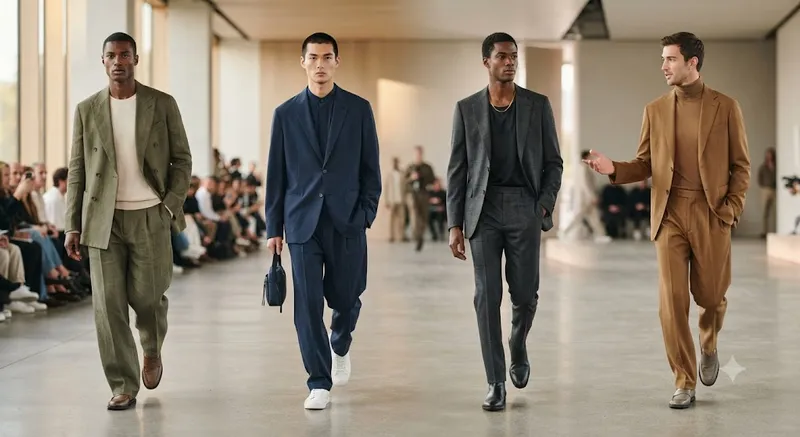
Earth-inspired shades including olive, tobacco, sand, camel, and stone are gaining prominence across jackets and separates. Muted greens, dusty blues, soft browns, and warm greys are gradually replacing brighter fashion colours.
Seasonal versatility is also becoming increasingly important. Rather than purchasing separate wardrobes for different occasions, consumers prefer colours that transition easily between business and leisure.
Monochromatic dressing, tonal layering, and understated combinations are replacing highly contrasting formal ensembles.
For fabric manufacturers, colour development will increasingly focus on timeless versatility rather than seasonal novelty.
Textures and Patterns: Subtle Sophistication Takes Centre Stage
The future of tailored fabrics lies less in bold designs and more in tactile sophistication.
Consumers today are seeking fabrics that create visual interest through weave structures and surface textures rather than loud patterns. Micro designs, subtle checks, understated herringbone, basket weaves, hopsacks, bird's-eye constructions, and refined melanges continue to gain popularity.
Texture adds depth without reducing versatility.
Similarly, classic patterns are evolving into softer, more wearable interpretations. Windowpanes are becoming finer, stripes more restrained, and geometric designs increasingly subtle.
This movement reflects a broader consumer preference for garments that remain fashionable across multiple seasons rather than appearing trend-driven.
Texture has become the new expression of luxury.
Sustainability Will Move from Marketing to Manufacturing
Few subjects have received as much attention over the past decade as sustainability. However, the industry is now entering a phase where sustainability will be judged less by marketing claims and more by measurable action.
Consumers, particularly younger generations, increasingly expect transparency regarding fibre sourcing, manufacturing practices, chemical usage, water consumption, and product longevity.
For the tailored clothing sector, sustainability extends beyond recycled fibres or environmental certifications.
A well-made jacket that remains wearable for ten years is inherently more sustainable than multiple low-cost garments replaced every season.
This places renewed emphasis on durability, repairability, timeless styling, and responsible manufacturing.
Textile mills are expected to invest in cleaner production technologies, efficient water management, renewable energy, and traceable raw materials. Garment manufacturers will increasingly focus on reducing waste, improving cutting efficiency, and adopting circular production practices.
Sustainability is becoming a business strategy rather than simply a marketing message.
Global Fashion Weeks: Inspiration, Not Instruction
Every season, the fashion industry looks toward Milan, Paris, London, Florence, New York, and Pitti Uomo for inspiration. These events undoubtedly influence colour stories, silhouettes, and product direction.
However, an important distinction must be recognised.
Fashion weeks showcase creative possibilities, not necessarily immediate commercial realities.
Many runway concepts are designed to stimulate discussion, strengthen brand identity, or forecast long-term direction rather than reflect current consumer demand.
Successful commercial brands understand this difference.
Rather than directly copying runway collections, they interpret broader themes and adapt them to their customer base, climate, pricing strategy, and cultural preferences.
For Indian manufacturers and brands, blindly following international fashion presentations can often lead to commercially unsuccessful collections.
The more effective approach is to study global trends while remaining deeply connected to local consumer behaviour.
Global inspiration must always be balanced with market relevance.
The Indian Opportunity: Designing for Tomorrow's Consumer
India's tailored menswear market is entering one of its most exciting phases.
Rising disposable incomes, greater exposure to global fashion, increasing international travel, and a growing appreciation for premium dressing are expanding consumer expectations.
At the same time, India's climate, cultural diversity, and purchasing behaviour require product development that differs from Western markets.
This creates an opportunity for Indian textile mills and apparel brands to lead rather than follow.
Collections developed specifically for tropical climates, lightweight wool fabrics, versatile business-casual wardrobes, performance tailoring, and sustainable materials are likely to find increasing acceptance both domestically and internationally.
Rather than competing purely on manufacturing cost, India can compete on intelligent product development.
Preparing for 2032: A Strategic Roadmap
The next five years will reward companies that anticipate consumer needs rather than simply react to fashion cycles.
Successful players will invest in:
- lighter and more versatile fabric developments
- comfort-oriented garment engineering
- timeless colour palettes and sophisticated textures
- sustainable manufacturing practices
- digital product development and demand forecasting
- stronger consumer education and product storytelling
The industry's competitive advantage will increasingly lie in creating garments that balance elegance with practicality.
Conclusion
The future of men's tailored wear will not be defined by dramatic changes in style but by thoughtful evolution.
Relaxed tailoring, superior comfort, refined textures, timeless colours, responsible manufacturing, and consumer-centric innovation are together reshaping the industry. Fashion will continue to inspire, but practicality will determine commercial success.
For textile manufacturers, apparel brands, retailers, and tailoring professionals, the challenge is no longer predicting the next fashion trend. It is understanding the long term direction of consumer lifestyles and designing products that remain relevant long after seasonal collections have disappeared.
The future belongs not to those who chase trends, but to those who understand enduring value.
Series Introduction Note
This article is the sixth in a 12-part editorial series exploring the evolving world of men's tailored wear. The series examines market evolution, consumer behaviour, product development, fabric innovation, quality, sustainability, branding, technology, and the future of tailoring from the perspective of the complete textile value chain. Each article is intended to provide actionable insights for textile mills, apparel manufacturers, fashion brands, retailers, designers, and tailoring professionals.