Transforming Indian Fashion: "From Fast to Last" at Bharat Tex Knowledge Session
-800x735.webp?2026-07-22T06:58:48.902Z)
Dr. (Prof.) Sanjay Shrivastava
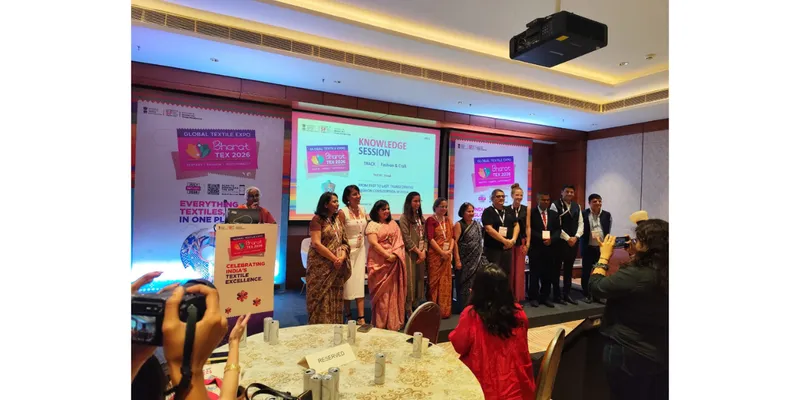
India targets an ambitious $350 billion textile economy, industry experts and academics gathered at Bharat Tex 2026 for a pivotal NIFT Knowledge Session titled ‘From Fast to Last: Transforming Fashion Consumption in India.’Coordinated by Dr. (Prof.) Sanjay Shrivastava, Dr. Varsha Gupta, and Dr. Vishu Arora under the UNIDO-Ministry of Textiles project, the session highlighted that long-term resilience hinges on shifting from disposable fashion to durable consumption and eliminating hazardous chemicals.
Scaling Traditions and Policy Levers
Dr. Patsy Perry (Manchester Metropolitan University) reframed the waste narrative, noting that while 97% of pre-consumer waste is recycled globally, the real battle lies in post-consumer solid waste. Pointing to the £30 billion worth of unworn clothing sitting in UK homes, she emphasized that true transformation requires reducing excess rather than just managing output. Crucially, Dr. Perry identified India’s cultural heritage—such as traditional practices of chindi, upcycling, and repair—as a massive head start over Western nations that have largely lost these skills.
Moving from tradition to economics, Dr. Naresh Tyagi (President, CITI) highlighted the tension between glamor-driven brand marketing and low-cost manufacturing ecosystems. Dr. Raj Kishore Nayak (RMIT University Vietnam) echoed this, pointing out that Cut-Make-Trim (CMT) manufacturers operate on paper-thin margins with little influence. The consensus: policy is the ultimate lever. Panelists called for enforcing robust Extended Producer Responsibility (EPR)and Ecocdesign for Sustainable Products Regulation (ESPR) frameworks to mandate durability and clear care labeling.
Cultural Wisdom meets Ground Reality
A recurring theme was India’s intrinsic alignment with circularity. Dr. Tyagi offered a relatable reminder. "When I was a kid, I used my clothes like a normal sibling... We have forgotten." His advice to consumers was simple: buy durable, buy less, care well, and use longer—pointing to his own decade-old suit as living proof. Furthermore, the panel highlighted India's 11 crore Self-Help Group (SHG) micro-entrepreneurs as a structural advantage capable of shortening supply chains by direct-linking artisans to buyers.
Communication and The Greenwashing Trap
The session took a firm stance on honest messaging. Darshana Gajare (Lakmé Fashion Week) noted that data-heavy campaigns fail because consumers simply scroll past them. Instead, industry communication must pivot to narrative storytelling around repair, swapping, and individual styling. However, Certification Expert issued a stark warning on greenwashing, reminding the audience that true sustainability balances social, environmental, and economic pillars. Oversimplified commercial claims, he warned, risk sliding from misleading to fraudulent.
Conclusion
Hope lies with emerging designers and the youth. Modern designers are crafting timeless basics that encourage personal styling, while younger consumers—despite being targeted by fast fashion—are increasingly embracing vintage, second-hand clothing, and experiential living over material accumulation. The session concluded with audience members taking the Sustainable Consumption Pledge, committing to ethical sourcing, waste reduction, and honoring artisan craftsmanship. To build a $350 billion industry responsibly, India must combine strict EPR enforcement, honest storytelling, and its rich traditions—proving that the most sustainable garment is the one already in your wardrobe. (Author is the Director at National Institute of Fashion Technology, Ministry of Textiles, Govt of India, Varanasi Campus)