TO ANALYSE THE FINANCIAL PERFORMANCE OF SURYALATA SPINNING MILLS LIMITED.
1. Introduction
- Introduction of the company
Suryalata Spinning Mills Ltd. is an India based company making mostly mixed synthetic threads. These strands feed into cloth makers’ looms and knit machines, becoming material for clothes. Running up-to-date spinning units, it blends making thread with generating sunlight-powered electricity on site. Power made that way helps run daily operations smoothly behind the scenes.
Based at Secunderabad, Telangana, this firm holds a listing on the Bombay Stock Exchange. Renewables now feed into its power supply, helping trim energy costs while upgrading machines keeps operations sharp over time.
- Industry overview
Spinning threads into yarn - this part of the work shapes much of what comes next across India's long-standing cloth-making world. Not far back in time, mills began rising alongside farms, feeding global demand while giving jobs to millions. Yarn made here travels onward, handed off to weavers who turn it into material for clothes and goods. This stretch of production holds weight, quietly supporting export numbers along with factory results nationwide.
- Key characteristics of the spinning industry include:
- Priced swings hit hard when cotton or man-made fabrics shift. What follows often ties back to how much those base ingredients cost. One wrong move in fibre markets can ripple through everything else. Costs climb if suppliers adjust their numbers upward. When fabric gets expensive, so does every step after that
- Fuel needs add up fast, so spending on electricity climbs steadily. Power demands stay high, pushing bills higher each month. Running systems eat through resources, which means charges keep rising. Heavy usage shows in monthly totals, where expenses grow without slowing
- Facing shifts in worldwide buying patterns, particularly linked to clothing suppliers abroad
- Increasing focus on automation and energy efficiency
- Purpose of the Analysis
The main purpose of this study is to analyse the business operations and structure of Suryalata Spinning Mills Ltd. and to understand the financial performance of the company.
2. Company Overview
- Background and History
Suryalata Spinning Mills Ltd. was started in 1983 and has slowly expanded its spinning unit capacity to become one of the recognized players in the yarn manufacturing segment. The company has invested in modern machines and adopted energy-efficient processes to improve productivity.
Apart from its spinning operations, the company also operates a solar power generation unit, which supports energy requirements and reduces dependence on external power sources.
- Business Model
The company mainly operates a B2B manufacturing model, giving yarn to textile manufacturers and fabric producers.
Revenue is generated through:
- Manufacturing of blended yarn (synthetic).
- Power generation from solar energy
The company’s profitability largely depends on:
- Raw material procurement efficiency
- Production capacity utilization
- Power cost management
- Demand from textile manufacturers
- Key Products / Services
Segment | Description |
Spinning (Yarn) | Manufacturing of synthetic blended yarn used by textile manufacturers |
Solar Power | Power generation used for internal consumption and energy cost optimization |
- Market Position
Suryalata Spinning Mills works in the spinning sector with a market cap of 136 Cr, supplying yarn to textile manufacturers within the country. The focus of the company on good yarn production and energy efficiency through solar power helps to maintain edge on cost factor in a highly competitive textile market.
3. Promoter /Founder Introduction
Name | Professional Background | Role in Company Growth |
Vithaldas Agarwal | Experienced entrepreneur with decades of involvement in textile manufacturing | As Managing Director, he has played a key role in expanding spinning capacity, improving operational efficiency, and strengthening the company’s financial stability |
Mahender Kumar Agarwal | Around three decades of experience in the textile sector | Responsible for operational management and strategic expansion initiatives within the company |
4. Financial Statement Analysis
- Income Statement Analysis
Metric | FY2025 | FY2024 | FY2023 |
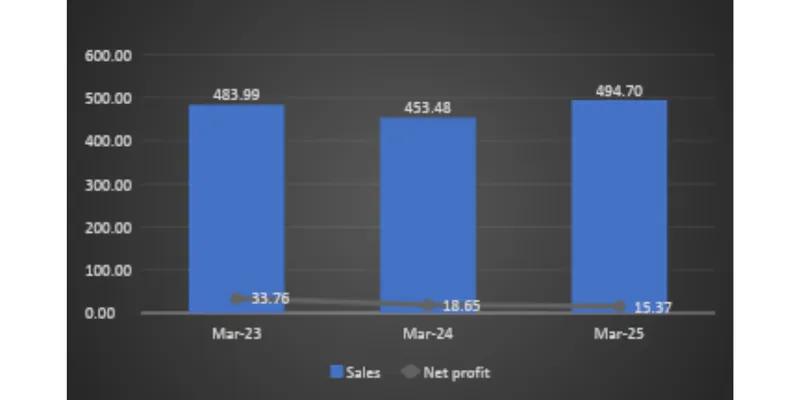
Net Sales Revenue | ₹495 Cr | ₹453 Cr | ₹484 Cr |
Net Profit After Tax | ₹15 Cr | ₹19 Cr | ₹34 Cr |
Key Observations of Income Statement:
- In FY 2025, Revenue was increased by 9% approx.
- Net profit was down in FY 2025.
- Balance Sheet Analysis (Rs. In crore)
Narration | ar-2 Mar-233 | M Mar-24r-24 | Mar-25 M Mar-25 | ||
Equity Share Capital | 4.27 | 4.27 | 4.27 | ||
Reserves | 224.53 | 242.92 | 258.51 | ||
Borrowings | 69.23 | 99.05 | 69.00 | ||
Other Liabilities | 50.07 | 48.03 | 47.93 | ||
Total | 348.10 | 394.27 | 379.71 | ||
Fixed Assets | 239.93 | 286.11 | 291.91 | ||
Capital Work in Progress | 10.20 | 25.98 | 0.06 | ||
Investments | - | - | - | ||
Other Assets | 97.97 | 82.18 | 87.74 | ||
Total | 348.10 | 394.27 | 379.71 | ||
As of FY25:
- Borrowings: Went down significantly from previous year.
- Investments: Nil but fixed assets went up.
- Current Assets: Increased by 5 Cr from previous year.
- Cash Flow Statement Analysis (Rs. In crore)
FY25 highlights:
- Operating cash flow turned down significantly from last year.
- Investing cash flow decreased sharply from the previous year.
- Financing cash flow increased substantially from last year.
- Key Financial Ratios (Indicative)
Ratio Category | Ratio | Interpretation |
Profitability | Net Profit Margin – 1.96% | Profit margin is relatively low, indicating tight margins typical in the spinning industry where raw material and energy costs are significant. |
Liquidity | Current Ratio – 1.57 | The company maintains adequate short-term liquidity to meet its current obligations. |
Leverage | Debt to Equity – 0.28 | Low leverage indicates conservative borrowing and improved financial stability. |
Efficiency | Asset Turnover – 0.13 | Low efficiency in using assets to generate revenue. |
- Year-on-Year Comparison (3 years)
Revenue Chart
5. Key Insights & Interpretation
- Strengths
- Steady sales continue, thanks to ongoing need for mixed synthetic thread - textile makers keep relying on it. Demand doesn’t waver much; production lines depend on it daily. Orders come in without pause, supporting predictable income flow. What keeps things moving? A reliable market that uses this yarn nonstop.
- A sharp drop in debt shows tighter control over finances, which cuts down on risk. Money moves now reflect a clearer focus on stability rather than growth at any cost.
- Weaknesses
- Even when prices hold steady, small gains vanish fast because cotton and electricity eat up too much. Spinning operations often struggle here - costs stay heavy, leaving little room to grow.
- A lone focus on yarn production shapes how the business earns its income. Revenue streams stay narrow because operations center only here. One main activity defines what the firm does every day.
- Even as sales rise, shrinking profits point to growing expenses eating into earnings.
- Risk Factors
- Fiber price shifts - whether cotton or synthetic - often shake up how much it costs to make things. When one goes up, the other might ease the hit - or worsen it. Cost swings ripple through without warning. Margins tighten before anyone adjusts. What feels stable today bends tomorrow under new pressures.
- A twist in world fabric needs often shakes up yarn production. Export shifts pull the market one way or another. Demand tugs at supply without warning. Trade patterns ripple through factories fast. Global appetite shapes how much gets spun each season.
- Future Outlook
- A steady need for thread inside India's fabric industry helps keep things looking up for Suryalata Spinning Mills Ltd., at least a bit. Because it uses sunlight to cut power costs, while also paying down what it owes, the business stands on firmer ground now.
- Still, making money will hinge on how well the firm handles material expenses, keeps operations running smoothly, while adjusting to shifts in the fabric industry. Upgrades aimed at boosting output might strengthen its position in yarn production.
6. Conclusion
Final Evaluation of Financial Health
Suryalata Spinning Mills Ltd. shows stable operational performance with stable revenue growth and strong operating cash flows. The company became successful in reducing its debt levels and maintained enough liquidity, which means good financial management.
However, declining profitability shows the need for improved cost management and operational efficiency to sustain margins in a competitive spinning industry.
Investment / Performance Perspective
From a financial perspective, the company appears financially stable with moderate growth potential. Its low debt and positive operating cash flows provide a strong foundation for future stability. Nevertheless, investors should monitor raw material price trends, operating margins, and textile demand cycles, as these factors significantly influence the company’s financial performance.
Data Sources