TO ANALYSE THE FINANCIAL PERFORMANCE OF DCM LTD.
1. Introduction
- Introduction of the company
The DCM Group began life as Delhi Cloth & General Mills toward the end of the 1800s, among India's earliest big business networks. As years passed, its reach stretched across varied fields - chemical production came first, then farming supplies followed; later still, it stepped into sugar refining. Textile operations took root alongside machine building, while property ventures grew quietly beneath notice. Even tech-based support systems eventually found a place within its wide frame.
Folks see a cluster of businesses now under the DCM name - DCM Shriram Limited takes one path, DCM Shriram Industries Limited walks another, while DCM Limited moves through its own space. Each finds footing in separate corners of industry, yet they share roots.
- Industry overview
The Indian textile industry stands among the biggest parts of the nation's manufacturing output while also providing vast job opportunities. This field covers areas like:
- Cotton yarn and spinning
- Fabric manufacturing
- Garments and apparel
- Technical textiles
A key player in global cotton output, India also dominates textile manufacturing, shaping both overseas trade and local demand. Though often overlooked, its fabric industry supports millions while supplying markets far beyond national borders. From rural farms to urban factories, threads of economic activity run deep through daily life. This widespread reach means shifts in production ripple across households and industries alike.
- Purpose of the Analysis
The main purpose of this study is to analyse the business structure of the company and to understand the financial performance of the company.
2. Company Overview
- Background and History
Founded long ago, DCM Limited began as part of Delhi Cloth & General Mills, a pioneering Indian industry from the 1889 started by Lala Sri Ram. Its roots lie in textile manufacturing within the capital city. Over time, those fabric operations shaped what the business would become.
Years passed. Factories shut down as cities changed shape. Economic shifts pushed old industries aside. Now, operations center on different kinds of work. Business priorities moved toward new directions. Activity centers shifted gradually. Focus settled elsewhere. Tasks now follow updated patterns.
A few years passed, then the team split apart through changes and divisions. Separate firms emerged afterward, each following its own path in management. Still, they trace back to one beginning point.
- Business Model
DCM Limited Business Model -
- Textile operations: Production of yarn and textile materials
- Asset monetization: Utilization of legacy industrial land and properties
- Investment income: Income generated through investment returns along with profits from additional monetary channels
Operating across two streams, the firm earns money through daily operations as well as outside investments. Revenue flows not only from core tasks but also from passive financial returns.
- Key Products and Services
Major offerings include:
- Cotton yarn
- Textile materials
- Industrial land and property development
- Investment income from assets
- Market Position
Though modest in size, DCM Limited functions within India’s textile sector as a micro-capitalization firm with a market cap of 120 Cr. Unlike major industry players, it runs on a more limited scale. Its advantage stems not from volume but from longstanding infrastructure and deep-rooted experience. Years of operation have anchored its presence despite reduced footprint. Legacy holdings contribute meaningfully to its current standing. Historical continuity shapes much of what sustains it today.
3. Promoter /Founder Introduction
Name | Professional Background | Role in Company Growth |
Lala Sri Ram | Founder of Delhi Cloth & General Mills | Established the foundation of the DCM industrial empire |
Ajay Shriram | Chairman of DCM Shriram Group | Strategic leadership, diversification and modernization |
Shriram Family Promoter Group | Industrial business family | Responsible for expansion into chemicals, fertilizers, and modern industrial sectors |
4. Financial Statement Analysis
- Income Statement Analysis
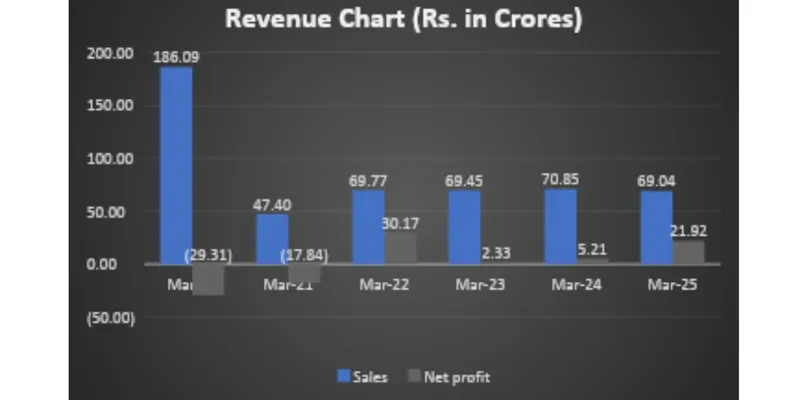
Metric | FY2025 | FY2024 | FY2023 |
Net Sales Revenue | ₹69.04 Cr | ₹70.85 Cr | ₹69.45 Cr |
Net Profit After Tax | ₹21.92 Cr | ₹5.21 Cr | ₹2.33 Cr |
Key Observations of Income Statement:
- Revenue is almost stagnant throughout 3 FYs.
- Net profit was sharply increased in FY 2025
- Revenue Chart
- Balance Sheet Analysis
As of FY25:
- Investments: Up by approx. 14 Cr as compared to previous year
- Reserves: Increased exponentially as of FY 2025
- Other liabilities and fixed assets – Decreased by approx. 10 Cr and 4 Cr respectively
- Cash Flow Statement Analysis
FY25 highlights:
- Operating cash flow decreased to less than a Cr.
- Investing cash flow increased by approx. 2 Cr.
- Financing cash flows reduced significantly YoY.
- Key Financial Ratios (Indicative)
Ratio Type | Value | Interpretation |
Profitability | 31.7% | High margin especially due to other income |
Liquidity | 1.8 | Indicates good short-term liquidity |
Leverage | 0.67 | Moderate leverage level |
Efficiency | 0.15 | Low due to asset-heavy structure |
- Year-on-Year Comparison (3 years)
Year | Revenue | Net Profit | Total Assets |
FY2023 | 69.45 | 3.7 | 420 |
FY2024 | 70.84 | 5.20 | 435 |
FY2025 | 69.04 | 21.92 | 450 |
Interpretation
- Revenue growth remained flat.
- Net profit increased significantly in FY2025.
- Assets increased gradually due to property value and investments.
5. Key Insights & Interpretation
- Strengths
- Strong brand legacy due a century long presence
- Valuable property assets and land for financial stability
- Improved profitability in FY2025
- Weaknesses
- Low scale textile operations as compared to industry giants
- Revenue growth is not so inspiring
- Heavy reliance on non-operating income sources
- Risk Factors
- Volatility in cotton prices and textile demand
- Dependence on legacy assets for profitability
- Competition from larger textile companies
- Future Outlook
The future outlook for DCM Limited depends on effective utilization of its old assets and improvement in textile operations. Growth opportunities may develop from redevelopment of real estate assets, strong partnerships, and better operational efficiency in textile manufacturing. Revenue growth margins are bit concerning but if the company successfully leverages its property assets while maintaining stable textile operations, it may achieve moderate long-term financial growth.
6. Conclusion
- Final Evaluation of Financial Health
DCM Limited demonstrates moderate financial stability supported by valuable assets and improved profitability in FY2025. Although revenue growth has been relatively stagnant, the company maintains a strong balance sheet and the ability to generate earnings through both operational and non-operational activities.
- Investment / Performance Perspective
From an investment angle, DCM Limited can be viewed as an asset-driven micro-cap company rather than a high-growth textile enterprise. Investors interested in companies with valuable real estate assets with textile trading and potential growth opportunities may consider the firm, while those seeking high operational growth may look for larger textile players.
Data Sources
https://www.screener.in/company/DCM