TO ANALYSE THE FINANCIAL PERFORMANCE OF BHANDARI HOSIERY EXPORTS LIMITED

1. Introduction
- Introduction of the company
Bhandari Hosiery Exports Ltd.(BHEL), based in Ludhiana, makes knitted clothing meant for sale abroad. While its main work involves producing hosiery items, it also reaches buyers at home. What stands out is their focus on upgraded pieces like T-shirts instead of basic fabrics. Alongside innerwear, they handle casual outfits shaped for modern needs. Though exports take up most activity, local demand plays a role too.
- Industry Overview
- The textile and hosiery industry in India is one of the largest in the world and helps majorly in employment, exports, and GDP. The sector includes spinning, weaving, processing, and manufacturing of garment. The companies like Bhandari Hosiery Exports Ltd play an important role in value addition through dyeing, finishing and fabric treatment.
- This industry has experienced instability due to raw material price volatility, global demand slowdown and competition from low-cost manufacturing countries. However, domestic consumption and infrastructure growth in India have supported the demand for processed textiles. Government policies encouraging exports and manufacturing under initiatives such as “Make in India” are also supporting long-term industry growth.
- Purpose of the Analysis
The main purpose of this study is to analyse the business operations and structure of Bhandari Hosiery Exports Ltd. and to understand the financial performance of the company.
2. Company Overview
- Background and History
Set up in 1994, BHEL runs a factory in Ludhiana, Punjab, making stylish knitwear. Mr Naresh Bhandari and Mr Nitin Bhandari manage operations. While Naresh Bhandari handles key tasks, Nitin Bhandari oversees daily work. This firm belongs to the larger Bhandari group network. From start to finish, it controls every stage of circular knit production. Designing comes first, followed by developing fabrics on site. Knitting happens internally, just like dyeing and surface treatments. Once finished, materials turn into full garments under one roof. Clients include global labels and store chains seeking ready-to-wear styles.
- Business Model
Out of factories and shipping containers, the business builds its flow - pulling in threads such as cotton yarn, turning those into clothing items, then moving them abroad via trade routes while also feeding local supply chains. Orders shape most of what comes in, with peaks tied closely to shifts in yearly buying patterns.
- Key Products / Services
The company’s product portfolio is based mainly on the following:
a) Circular Knitted Fabrics: Natural, Synthetic
b) Open & Tubular Width fabrics
c) Specialized Finishes: Teflon, Stain Resistance, Viscose, Lycra
d) Women’s Wear: Tees, Leggings
e) Men’s Wear: T-Shirts, Sweatshirts, Polo
f) Kid’s Wear
- Market Position
Bhandari Hosiery operates in the mid-sized textile exporter segment with a market cap. of 110 Cr, competing with other garment exporters. While it does not have the scale of large integrated textile players, it benefits from flexibility in production and niche export relationships. The company’s positioning is moderately strong in export markets but constrained by limited scale, working capital intensity, and dependence on a few key buyers.
3. Promoter /Founder Introduction
Name | Professional Background | Role in Company Growth and Strategic Decisions |
Nitin Bhandari | Experienced textile entrepreneur with strong expertise in hosiery manufacturing, export operations, and supply chain management | Plays a key leadership role in overall business strategy, export expansion, and operational efficiency. |
Nikita Bhandari | Associated with business administration and corporate management functions, contributing to modern management practices | Involved in strategic planning, compliance, and organizational development. Contributes to improving internal processes and aligning operations with market trends |
Kusum Bhandari | Long-standing association with the company and promoter group, with experience in traditional textile business operations | Provides strategic support and continuity in promoter vision, contributing to governance, stability, and long-term decision-making |
4. Financial Statement Analysis
- Income Statement Analysis
Metric | FY2023 | FY2024 | FY2025 |
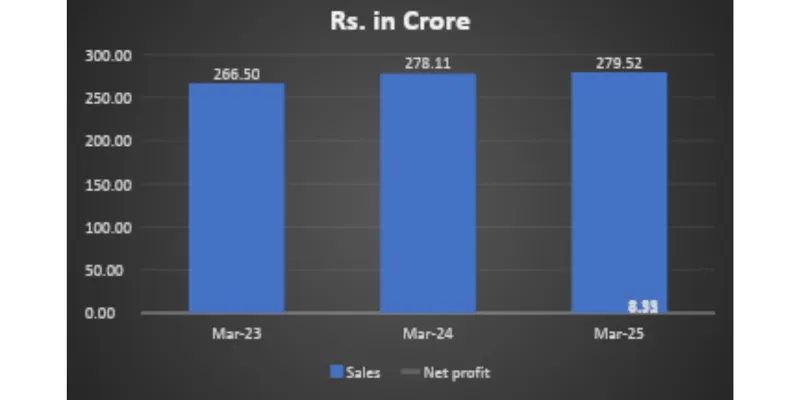
Net Sales Revenue | ₹282.23 Cr | ₹266.50 Cr | ₹278.11 Cr |
Net Profit After Tax | ₹6.51 Cr | ₹6.53 Cr | ₹7.71 Cr |
Key Observations of Income Statement:
- In FY 2025, Revenue increased substantially from the previous year.
- Net Profit also increased significantly in FY 2025 from last year.
- Balance Sheet Analysis (Rs. In crore)
Narration | Mar-23 | Mar-24 | Mar-25 |
Equity Share Capital | 14.65 | 16.34 | 24.01 |
Total Liabilities (Borrowings+Current) | 124.42 | 151.12 | 122.42 |
Total Assets (Fixed+Current) | 214.41 | 250.70 | 275.57 |
As of FY25:
- Total liabilities decreased significantly in FY 2025.
- Equity Share Capital increased by 47% approx. from last year
- Total Assets increased substantially from the previous year.
- Cash Flow Statement Analysis (Rs. In crore)
FY25 highlights:
- Operating cash flow has decreased sharply from last year.
- Investing cash flow has increased significantly from previous year.
- Financing cash flow has declined sharply from last year.
- Key Financial Ratios (Indicative)
Ratio Type | Ratio | Interpretation |
Profitability | Net Profit Margin | Low margin indicates cost pressure and competitive pricing in export markets |
Liquidity | Current Ratio | Adequate but reflects high inventory and receivables |
Leverage | Debt-Equity Ratio | Moderately high due to working capital loans |
Efficiency | Inventory Turnover Ratio | Moderate efficiency; inventory holding impacts liquidity |
- Year-on-Year Comparison (3 years)
Revenue Chart
5. Key Insights & Interpretation
- Strengths
- Strong base in Ludhiana hosiery cluster, ensuring supply chain efficiency
- Established presence in export markets
- Flexible production suited for small and mid-size export orders
- Lower fixed cost structure compared to large integrated players
- Weaknesses
- Thin profit margins due to intense competition
- High dependence on working capital financing
- Limited brand presence → largely B2B/export-driven
- Scale constraints compared to larger textile exporters
- Risk Factors
- Raw material price volatility (cotton, yarn)
- Global trade disruptions impacting exports
- Dependence on few key export clients
- Future Outlook
Bhandari Hosiery Exports Ltd. might move forward, even if hurdles remain. Overseas appetite for clothes keeps feeding opportunities. So does India’s firmer stance in global markets. Growth speed, though, hinges on fatter profits. Wider customer reach plays a role too. Just as much depends on smoother control over daily money flow. Moving toward higher-value items may help secure future gains, especially when paired with deeper partnerships abroad. All this must happen while keeping expenses in check - efficiency isn’t optional when rivals are constantly pushing harder in the fabric trade.
6. Conclusion
Final Evaluation of Financial Health
Bhandari Hosiery Exports Ltd. holds steady without much room to stretch, not far off the usual path for medium-scale fabric shippers. Even so, thin earnings eat into strength, while day-to-day funding demands tie up resources. Outside loans fill gaps, given how tight internal funds run. Leverage sits at a manageable level, though not invisible. When business slows down, money moving in and out wobbles along with it.
Investment / Performance Perspective
From an investment perspective, the company may be considered a moderate-risk, cyclical performer. It is suitable for investors who understand the textile export cycle and are comfortable with volatility in earnings. Long-term performance will depend on margin improvement, better capital efficiency, and scalability. Without significant expansion or differentiation, returns may remain limited compared to larger industry players.
- Data Sources
https://www.bhandariexport.com/
https://www.screener.in/company/BHANDARI/