TO ANALYSE THE FINANCIAL PERFORMANCE OF SHRI DINESH MILLS LIMITED.

1. Introduction
- Introduction of the company
Shri Dinesh Mills Ltd., started in 1935 and based in Vadodara, is a diversified textile and infrastructure company engaged in manufacturing worsted fabrics and developing industrial land. The company has gradually shifted from a pure textile business to a hybrid model combining premium suiting fabrics and real estate monetization.
- Industry overview
Shri Dinesh Mills Ltd. comes under the textile industry. The global textile sector began to recover from 2024 with inventory and order levels coming at par in the second half of the year. In India, this industry has a strong position as the 6th largest exporter of textile and apparel resulting in 4.1% of the global share in 2024. During FY 2024-25, this industry contributed 8.63% to India’s total merchandise exports, valued at 37.7 billion USD.
- Purpose of the Analysis
The main purpose of this study is to analyse the business operations and structure of Shri Dinesh Mills Ltd. and to understand the financial performance of the company.
2. Company Overview
- Background and History
- Back when India's textile scene started booming before independence, Shri Dinesh Mills Ltd. took shape - soon carving a name making fine worsted cloth for home buyers and overseas alike. Through years passing, skill grew deep here, especially in crafting high-end wool suits fabric, refined through steady work rather than sudden leaps.
- Lately, shrinking profits in fabric making plus tough times across heavy industries pushed the business to try something new - building properties instead. With plenty of open land sitting in Vadodara, it found a fresh path forward. That move? It changed everything about where the money comes from now. Suddenly, earnings look different. So does what the company keeps after costs.
- Business Model
The business model of the company is mainly based on: - Textile manufacturing (worsted fabrics – premium segment)
- Leasing and development of surplus land assets
- Revenue mix increasingly shifting toward real estate and other income
- Key Products / Services
The company’s product portfolio is based mainly on the following:
- Dryer Screens
- Press Felts
- Fiber & Asbestos Felts
- Other Products like Filter Fabrics
- Market Position
Shri Dinesh Mills operates in a niche premium textile segment rather than mass manufacturing with a market cap of 127 Cr. It does not compete with large-scale textile exporters but focuses on quality-driven segments. Its competitive advantage lies more in strategic land assets than core textile operations today. The company’s positioning has transitioned into a low-volume textile producer with high-value asset backing, making it relatively unique among listed textile firms.
3. Promoter /Founder Introduction
Name | Professional Background | Role in Growth | ||
Shri Bharatbhai U. Patel | Textile industry professional with decades of experience in worsted fabrics and industrial textiles | Chairman & Managing Director; leads overall strategy, long-term vision, and key capital decisions | ||
Shri Nimishbhai U. Patel | Extensive experience in textile manufacturing and business management since the 1990s | Managing Director; responsible for day-to-day operations, production efficiency, and execution of business strategy | ||
Shri Nishank N. Patel |
| Executive Director; involved in operational management and modernization initiatives | ||
Shri Aditya B. Patel | Young leadership with exposure to corporate functions and business development | Executive Director; focuses on strategic initiatives, business development, and organizational expansion |
4. Financial Statement Analysis
- Income Statement Analysis
Metric | FY2023 | FY2024 | FY2025 |
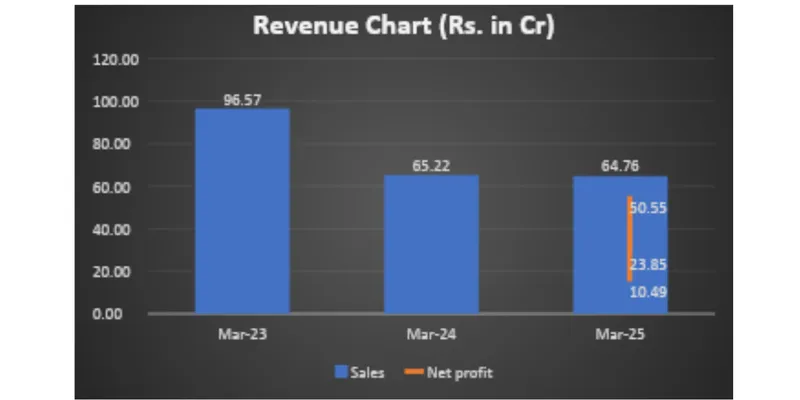
Net Sales Revenue | ₹96.57 Cr | ₹65.22 Cr | ₹64.76 Cr |
Net Profit After Tax | ₹23.85 Cr | ₹50.55 Cr | ₹10.49 Cr |
Key Observations of Income Statement:
- In FY 2025, Revenue is almost constant compared to previous year.
- Net Profit decreased sharply in FY 2025.
- Balance Sheet Analysis (Rs. In crore)
Narration | Mar-23 | Mar-24 | Mar-25 |
Equity Share Capital | 5.60 | 5.60 | 5.60 |
Total Liabilities (Borrowings+Current) | 62.46 | 69.40 | 70.10 |
Total Assets (Fixed+Current) | 103.55 | 108.18 | 106.89 |
As of FY25:
- Total liabilities increased at a steady rate YoY.
- Total Assets decreased as compared to previous year.
- Cash Flow Statement Analysis (Rs. In crore)
FY25 highlights:
- Operating cash flow increased significantly from last year.
- Investing cash flow improved significantly from previous year
- Financing cash flow decreased substantially from last year and turned negative
- Key Financial Ratios (Indicative)
Category | Ratio | Interpretation |
Profitability | Net Profit Margin | Sharp decline due to absence of exceptional income (land sale) seen in FY24 |
Liquidity | Current Ratio | Extremely strong liquidity; indicates excess current assets |
Leverage | Debt-to-Equity | Very low leverage; company is almost debt-free |
Efficiency | Asset Turnover | Stable inventory movement; no major inefficiency |
- Year-on-Year Comparison (3 years)
Revenue Chart
5. Key Insights & Interpretation
Strengths
- Significant land bank in Vadodara, enabling high-value monetization
- Strong balance sheet with minimal debt exposure
- High profitability supported by non-operating income streams
- Stable cash flows from leasing activities
Weaknesses
- Core textile business shows limited scalability and growth potential
- Dependence on non-core income reduces operational sustainability
- Limited presence in high-growth textile export markets
Risk Factors
- Overdependence on real estate monetization cycles
- Textile segment vulnerable to raw material price volatility (wool)
- Demand fluctuations in premium fabrics segment
- Regulatory risks related to land development
Future Outlook
A shift toward property development might shape what comes next, not fabric production. Stability lingers in cloth making yet leaps forward seem out of reach there. Rising interest in Vadodara's buildings could work in its favor. Lasting strength will come only if earnings grow beyond selling plots now and then.
6. Conclusion
Final Evaluation of Financial Health
One thing stands clear: Shri Dinesh Mills Ltd. holds solid ground financially - debt stays low, cash flows freely, profits keep climbing year after year. Still, peeling back layers shows something else entirely - the real push behind those numbers comes not from weaving fabric but from earnings outside its main business. That twist leaves questions hanging about how well it can last when times shift.
Investment / Performance Perspective
Looking at things through an investor's lens, this firm could draw interest from people wanting solid assets behind their money alongside minimal debt pressure. Still, it might miss the mark for anyone chasing fast gains in textiles, since what happens next leans more on turning property into cash and smart use of holdings instead of growing the main operation
.
- Data Sources
https://www.screener.in/company/