To Analyse Financial Performance Of Shanti Spintex.

Introduction:
The Indian textile sector remains a pivotal pillar of the national economy and a global powerhouse. Currently positioned as the world’s 6th largest exporter of textiles and apparel, the industry produces approximately 22,000 million garment pieces annually. Beyond production volume, the sector serves as a massive socio-economic engine, providing direct employment to over 45 million individuals and supporting the livelihoods of 100 million people. India’s competitive moat is further solidified by its status as the largest global producer of cotton, contributing 23% of total global output.
Purpose of Report
This report shows Shanti Spintex Limited performed financially and operationally during FY 2024-25. With a close look at expansion patterns, production output improved under national self-reliance goals. Progress unfolded through focused factory upgrades alongside policy-aligned planning. Performance shifted as internal systems adapted to broader economic pushes. Milestones emerged not just from targets met but also steady adjustments in daily workflows.
Company Overview:
Corporate History
- 2010: Incorporation as Shanti Spintex Private Limited.
- 2015: Strategic takeover by existing promoters; operations began as a trading concern.
- 2016: Commissioned fabric weaving unit at Dholi, Ahmedabad, with an initial capacity of 9.64 million meters.
- 2017: Capacity doubled to 19.27 million meters via the installation of 48 additional Japanese air jet looms.
- 2019: Achieved the Rs. 100 Crore annual revenue milestone.
- 2022: Revenue crossed Rs. 200 Crore; commissioned a 2 MW wind energy plant in Likhala, Gujarat.
- 2023: Successful listing on the BSE SME platform; installed an 852-kW rooftop solar plant; acquired 38,097 sq. m. of land to facilitate future backward integration.
- 2025: Achieved landmark revenue of Rs. 710 Crore with capacity utilization reaching 89%.
The Business Model
Shanti Spintex builds its strength around mastering cloth-making within the facility. What happens next flows step by step through an internal sequence focused on fabric production
- Finding cotton, yet also bringing in spandex from nearby sources. Viscose enters the mix, while recycled threads are pulled from regional providers too.
- Fabric threads get colored and measured through outside suppliers. Sometimes these steps happen separately, handled by different teams we work with.
- Fine weaving happens right here, built on skill we’ve grown ourselves. Machines powered by airflow shape each piece with care. Precision drives every step, no outside help needed. This is how quality stays in control.
- Fabric singeing comes first, done off-site. Next, a separate team adds softness using outside partners. Texture work follows through external specialists who manage that step alone.
- Shipped fast once checks pass. Factories get inspected goods without delay. Wholesalers receive stock right after approval.
Key products
Fabric Type | Typical Weight (Oz) | Width Range | Primary Use Case |
Power Stretch Spandex | 8.50 - 10.50 | 60" - 66" | Women’s clothing; high stretch (45%-65%) |
Light Weight Denim | 4.50 - 5.50 | 65" - 78" | Shirts, Kurtis, school uniforms, and skirts |
Knit Denim | 11.00 - 12.50 | 68" - 78" | Comfort-focused patterns for kids and youth |
Denim Rigid | 12.00 - 14.50 | 60" - 72" | Heavy-duty workwear, jackets, and classic jeans |
Flat Finish 3/1 | 10.00 - 12.50 | 64" - 72" | Soft, comfortable 3/1 twill weave |
Over Dyed Denim | 11.00 - 13.00 | 68" - 75" | Dark shades (Black, Olive); varied wash effects |
Promoter
Executive Leadership
- Forty-three years deep in textiles, Mr. Bharatbhushan O. Agarwal shapes how things run. Leadership flows through his role as Chairman, Whole-Time Director, and CFO. Numbers and systems fall under his watch. Growth follows structure because of choices he makes. Operations stay sharp when he is involved.
- Out front, Mr. Rikin B. Agarwal runs things. Production plans shape up under his watch, just like moves into new markets. Nine years deep in the field give him grip on what works. That know-how keeps machines humming, doors opening wider.
Board Oversight - Urmila Agarwal (Non-Executive Director): 25+ years in operations and quality control.
- Kruti Vyas & Monika Gupta (Independent Directors): Provide expertise in corporate governance, legal compliance, and secretarial audit.
Financial Statement Analysis (FY24 vs. FY25)
Income Statement Highlights
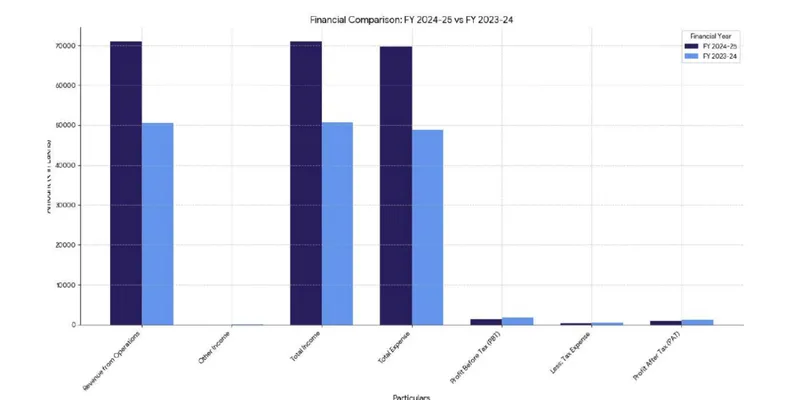
A shift toward more advanced offerings now gives room to adjust prices upward. Gains in customer reach played a big role, while selling better-margin items helped too.
Particulars | FY 2023-24 (Audited) | FY 2024-25 (Audited) | Growth % |
Total Revenue | Rs. 506 Cr | Rs. 710 Cr | +40% |
Revenue CAGR (FY21-25) | — | 59% | — |
Balance Sheet Comparison
The balance sheet reflects a significant de-risking through substantial debt retirement and the accumulation of retained earnings.
Particulars (Rs. in Lakhs) | March 31, 2024 | March 31, 2025 |
Shareholders' Funds | 8,656.78 | 9,676.79 |
-- Share Capital | 1,688.80 | 1,688.80 |
-- Reserves & Surplus | 6,967.98 | 7,987.99 |
Non-Current Liabilities | 2,496.06 | 1,211.25 |
-- Long-Term Borrowings | 1,447.74 | 215.00 |
Current Assets | 12,507.82 | 11,228.30 |
-- Inventories | 1,849.42 | 2,169.88 |
-- Trade Receivables | 8,969.39 | 6,862.21 |
-- Cash and Bank Balances | 503.24 | 791.44 |
Key Financial Ratios
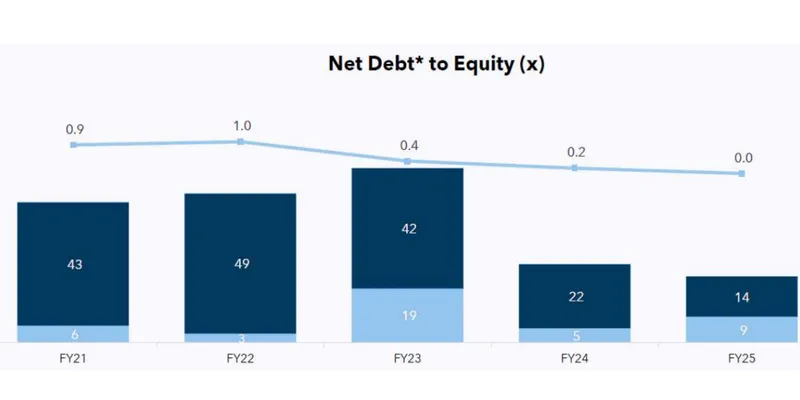
Management’s disciplined working capital management—evidenced by an 8-day reduction in the cash conversion cycle—coupled with a 60% debt reduction, has created a highly liquid, de-risked balance sheet.
FY 2024-25 Key Metrics:
- Leverage: Net Debt-to-Equity ratio came upon 0.14x.
- Returns: Return on Equity (ROE) at 11%; Return on Capital Employed (ROCE) at 13%.
- Asset Utilization: Fixed Asset Turnover Ratio jumped to 6.5 (up from 4.0 in FY24).
- Liquidity: Cash Conversion Cycle reduced from 27 to 19 days.
SWOT ANALYSIS:
Strengths:
Fabric made on site at Shanti Spintex flows fast thanks to high-end machines from Japan - air jets paired with Dobby looms doing the heavy lift. Loyalty runs deep among buyers; every dollar earned in both FY24 and FY25 traces back to just ten clients holding steady through thick and thin. Money side stays solid too - the net debt compared to equity rests near zero, clocking in at only 0.14 times what it owns minus what it owes.
Weaknesses:
Out here, the business depends on outside firms for dyeing and finishing - this chips away at profits. Then again, leaning entirely on just ten big buyers? That piles up serious income vulnerability.
Opportunities:
By handling its own fabric coloring and treatment, the business stands to keep more profit per sale. Power gains come next - adding 2.5 megawatts of clean energy slashes expenses while boosting internal supply reliance.
Threats:
Falling or rising cotton prices along with shifts in energy expenses can squeeze profit space. Since denim styles shift quickly, staying still is not an option - new designs must follow close behind.
Future Outlook
One reason Shanti Spintex grows comes from tighter operations paired with lower expenses. Quality checks should get sharper once dyeing and finishing move inside the workflow, while profits per unit climb too. Power bills drop thanks to a fresh 2.5 MW supply from green sources - around Rs. 2.8 Crore stays saved each year, trimming overheads quietly. New paths for scaling up are under review right now, aiming to spread income streams without stretching thin.
Conclusion
Now sitting much firmer financially, Shanti Spintex cut its debt close to 60%, reaching a cash turnaround time below three weeks. Thanks to solid profits kept within the business, funds flow easily, opening room to grow without pressure on balance sheets. Running nearly full tilt, the focus shifted - less about pushing more units, more about lifting what they already make. Government backing through "Make in India," paired with rising worldwide interest in durable, eco-conscious denim, adds steady tailwind. Though quiet in headlines, progress hums beneath the surface.
Data Sources
- Shanti Spintex Limited Annual Report 2024-2025.
- Standalone Audited Financial Statements (March 31, 2025).
- Official Company Investor Presentations.