TMAS Members Advance Textile Machinery Innovation with New Facilities and Technologies
Swedish textile technology companies focus on automation, recycling, digitalisation and resource-efficient manufacturing ahead of ITMA ASIA 2026
Swedish textile technology companies are continuing to invest in new facilities, technologies and product development as the global textile machinery industry prepares for ITMA ASIA 2026 in Shanghai. Members of TMAS have introduced solutions during 2026 focused on automation, productivity, recycling and more resource-efficient textile manufacturing.
The developments come amid growing competition from Asia, geopolitical uncertainty, new regulations and the accelerating adoption of artificial intelligence (AI) and digitalisation across the textile industry.
New Facilities and Production Capabilities
Following a record 2025 and several bolt-on acquisitions, ACG Kinna has inaugurated a 1,000-square-metre expansion at its headquarters in Skene. The expansion responds to growing demand for the company’s complete textile and finished product line automation services.
Industrial spray dyeing specialist Imogo has opened a new showroom, test centre and production hub in Kinnahult. The company introduced its first Dye-Max prototype in 2019 and completed its first industrial-scale installation in 2021.
The new facility allows brands and manufacturers to move from laboratory development to validated commercial production at a single location.
The centre features Imogo’s patented spray application technology, combining the Mini-Max laboratory system with an industrial-scale Dye-Max line. The system can process fabrics up to 2.4 metres wide and has a production capacity of approximately 3 tons per day.
Dye-Max uses as little as 0.7 litres of dye liquor per kilogram of fabric and is designed to reduce water, energy, chemicals and wastewater compared with conventional dyeing processes.
Recycled Textile Fibre Technology
New TMAS member ReSpin is set to have its technology installed at Sweden’s first industrial spinning mill for recycled textile fibres.
The company has developed and patented RespinJenny, a mechanical recycling technology designed to transform textile waste into fibres suitable for producing new yarn.
The technology is part of the wider development of recycling solutions aimed at increasing the use of textile waste as a raw material for yarn production.
New Technologies for Productivity and Resource Efficiency
TMAS members have also introduced technologies during 2026 targeting productivity, automation and more resource-efficient textile manufacturing.
BW Converting’s Baldwin TexCoat® G4 platform uses precision spray application technology to apply chemistry accurately to one or both sides of a fabric.
The non-contact spray process replaces conventional bath-based methods and can reduce wet pick-up by up to 50 per cent. This can lower water consumption and the energy required for drying while supporting greater consistency in fabric finishing.
BW Converting will also showcase Corona Pure, a surface treatment technology designed to improve adhesion and fabric performance.
As textile mills move from C6 fluorocarbon-based water repellents towards fluorocarbon-free C0 chemistries, Corona Pure improves fabric absorbency and helps these formulations deliver stronger water-repellent performance.
Automation and AI in Textile Production
Automatex has developed the P12-PB Automatic Lock Stitch Quilting Unit, which doubles productivity compared with previous systems. The system provides continuous programmable quilting with reduced manual intervention for bedding and padded home textile production.
Eton Systems has demonstrated its aUPS module for sorting used garments. The system is based on the company’s UPS material handling system and ETONingenious Factory 4.0 software.
Using AI, the system grades individual garments according to colour, size and style and, where possible, by manufacturer. It can also identify damage, suggest possible repairs and calculate a potential resale price.
The system provides an automated approach to sorting garments intended for reuse.
ITMA ASIA 2026 to Feature Further Technologies
TMAS members Vandewiele Sweden and Eltex are scheduled to showcase their latest technologies at ITMA ASIA 2026 in Shanghai from November 20-24.
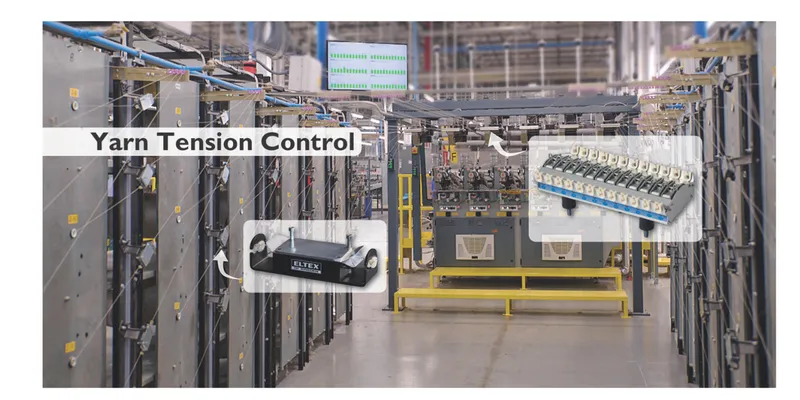
Eltex will present its latest ACT-MULTI system, which provides individual yarn tension monitoring and automatic control during heat-setting. The technology is designed to help manufacturers maintain consistent processing conditions across individual yarn positions.
Heat-setting is an important stage in the production of synthetic and blended yarns. It stabilises yarn structures and locks in twist and bulk to support predictable performance during subsequent weaving, knitting, tufting, dyeing and finishing.
Vandewiele Sweden has long-standing expertise in weft feeding and tension control for weaving and related processes. Its technologies are designed to provide repeatable and predictable yarn delivery at increasingly high loom speeds, enabling weaving mills to operate closer to their technical limits while maintaining consistent fabric quality.
The company is also continuing to develop data-ready weft feeders as textile manufacturing becomes increasingly digitalised. These systems embed data and intelligence into production processes while focusing on operational benefits in demanding manufacturing environments.
TMAS Sees Continued Technology Development
Therese Premler-Andersson, secretary general of TMAS, said the organisation’s members had recorded activity across several areas during the year.
“This has been a very positive year for TMAS members so far, with investment in new facilities, new technologies reaching the market and further progress in areas ranging from automation and digitalisation to more resource-efficient production,” says Therese Premler-Andersson, secretary general of TMAS, which as a member of Cematex, is closely involved with the ITMA exhibition platform for the international textile machinery industry. “These developments demonstrate the breadth of Swedish textile technology and the very practical way our members are responding to the changing requirements of manufacturers worldwide. We expect that momentum to continue throughout the remainder of 2026 and into next year.”
She also highlighted changes in the competitive environment facing textile machinery companies.
“There is no question that the competitive landscape is changing. AI, geopolitical uncertainty, regulation and increasing competition from China will all influence our industry in the years ahead. For Swedish textile technology companies, the answer will be to keep pushing innovation, specialist know-how and customer value.”
With further technology demonstrations planned at ITMA ASIA 2026, TMAS members are continuing to develop machinery and systems across automation, digitalisation, recycling, process control and resource-efficient textile manufacturing.