Tiruppur Exporters Diversify Markets and Products Amid Renewed US Tariff Uncertainty
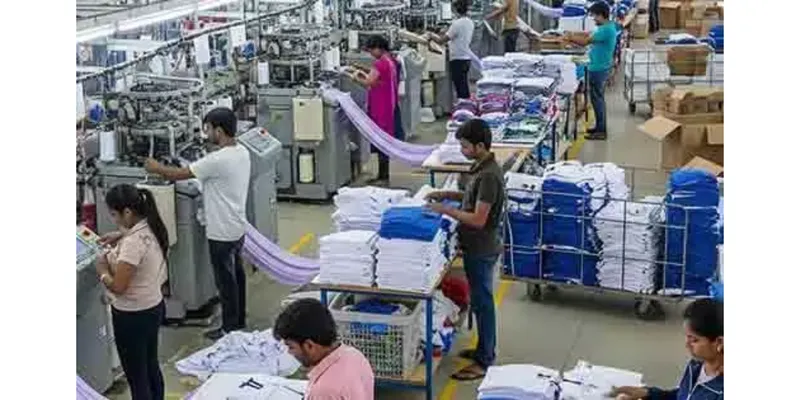
Knitwear hub looks towards the UK and Europe while exploring MMF products, automation and earlier shipments to manage trade risks
Tiruppur’s knitwear industry is adapting to renewed uncertainty over US tariffs by diversifying export destinations and product categories, while some manufacturers are increasing automation and bringing forward orders. The developments come as the export hub continues to assess the potential impact of new US tariff measures linked to countries purchasing Russian oil and gas.
Tiruppur remains heavily exposed to US market
Tiruppur accounts for nearly 60% of India’s knitwear exports, while around 35% of its exports went to the US last year, according to the Deccan Chronicle report. The sector experienced significant disruption during the tariff shocks between August and December 2025, when orders were cancelled and several units shut down or scaled back operations.
The situation saw a temporary recovery in early 2026, although export units have continued restructuring their workforces.
A fresh source of uncertainty emerged after US President Donald Trump signed the Lindsey O. Graham Sanctioning Russia and Iran Act of 2026 on September 18. The legislation provides a pathway for tariffs of up to 100% on countries importing Russian oil and gas. The exact tariff rate, products that could be covered and implementation details have not yet been decided, and the law does not automatically impose a 100% tariff on all Indian exports to the US.
Exporters look beyond a single market
According to the report, Tiruppur exporters are increasingly looking beyond the US and exploring markets in the UK and Europe.
Dinesh Babu Ravikrishnan, executive secretary of the Tiruppur Exporters’ Association (TEA), said: “The last one year has been a roller-coaster ride — tariff threats, geopolitical turmoil, orders being put on hold and cancelled. But I am optimistic.”
He added: “Because we have now accepted geopolitical turmoil and uncertainties and tariffs as part of the new normal, new business reality.”
The industry is also responding by diversifying products, bringing orders forward and exploring operational changes aimed at improving productivity and reducing costs. Some export units are adopting automation as part of these efforts.
Shift towards cotton and MMF products
Tiruppur’s knitwear industry has traditionally relied heavily on cotton. The report notes that exporters are now exploring a combination of cotton and man-made fibre (MMF) products to access emerging international opportunities.
The diversification is part of a broader effort to reduce dependence on individual markets and respond to changing global demand.
Some apparel exporters are also accelerating production and shipments of Spring 2027 orders, reflecting efforts to manage potential disruptions arising from geopolitical and trade-related developments.
Exporters continue to assess US market uncertainty
D. Elango, a hosiery and knitwear manufacturer and exporter whose company has significant exposure to the US market, said business had been slower over the previous six months.
“We were happy when the Supreme Court (of the US) struck down the tariff. Now the threat is back, and it is in the form of a law, not an executive order. No one knows what will happen,” he said.
The report said diversification remains an important part of exporters’ response to the uncertain trade environment, with some industry participants hoping that the Indian and US governments will eventually reach an arrangement that avoids the worst-case scenario.
Tariff uncertainty also affects the workforce
Tiruppur’s garment industry employs about one million workers, around half of whom are migrants. The tariff-related disruption has also affected employment, while some export units continue to face labour shortages.
A. Aloysius, a Tiruppur-based labour rights activist, said migrant workers from northern India continue to arrive despite the renewed tariff uncertainty. Many are from Bihar and are increasingly moving with their families, including children.
The report also noted that young single women from the Northeast and Odisha continue to arrive for employment and live in factory hostels. Aloysius said his organisation is working to arrange schooling for the children of migrant workers, including through informal classes.
Diversification brings its own challenges
While the UK and European markets offer opportunities, expanding significantly into these destinations will require time and investment, according to the report.
Moving towards synthetic fibres requires new capabilities, while developing new markets also involves additional investment. Smaller enterprises and workers with less financial security may have less capacity to absorb further disruptions.
Ravikrishnan summed up the changing market environment by saying: “There are no stable markets.”
For Tiruppur’s exporters, the current response involves a combination of market diversification, product diversification, earlier shipments and greater use of automation as the industry navigates continuing geopolitical and trade uncertainty.