Thiagarajar Mills Private Limited (TMPL)

Executive summary
Thiagarajar Mills Private Limited has been a major player in India’s textile scene for a long time—since 1935, to be exact. Based out of Madurai, Tamil Nadu, they’ve built a massive reputation for manufacturing and exporting top-tier, 100% Indian cotton yarn.
They do this through three specialized spinning mills. Instead of relying on outdated methods, they’ve invested heavily in modern setups, like advanced compact spinning systems, to keep their quality high and their operations smooth.
Over the decades, that commitment to doing things right—and doing them sustainably—is exactly what helped them grow from a local mill into a global exporter.
Company overview

Thiagarajar Mills Private Limited (TMPL) has been a staple of India’s textile landscape since way back in 1936. Operating out of Madurai, Tamil Nadu, this unlisted private company has grown into a massive global exporter under the guidance of Managing Director Mr. K. Hari Thiagarajan, bringing in roughly ₹534 crore (around $75+ million) every year. They’ve built an impressive setup that ships premium 100% Indian cotton yarn to clients in over 20 countries. They pull this off using three specialized spinning mills packing over 100,000 spindles, alongside an automated weaving unit. This infrastructure lets them churn out a massive range of counts—from 6s all the way up to 140s—covering everything from hosiery and coarse yarns to high-end compact and combed cotton.
Industry overview
Operating out of Madurai, Tamil Nadu since 1935, Thiagarajar Mills Private Limited (TMPL) has carved out a massive footprint as a global, export-heavy textile business. Today, under Managing Director Hari Thiagarajan, this unlisted private firm brings in over ₹534 crore (around $75+ million) a year by shipping premium 100% Indian cotton yarn to brands in more than 20 countries, including the US and Europe. Instead of chasing cheap, mass-market volume, they run three specialized spinning mills with over 100,000 spindles and an automated weaving plant to churn out high-end combed, compact, hosiery, and open-end yarns ranging from 6s to 140s counts. They also don't just stop at raw yarn; by teaming up with their sister concern, VTM Limited, they push further down the supply chain to manufacture finished goods like luxury bedding, duvets, and fine shirting fabrics.
- An early tech bet: They caught the industry's attention by being one of the first in India to bring in advanced Rieter ComforSpin K44 machinery specifically for premium compact yarns.
- Heavy lean on green energy: To cut down on massive utility costs and footprint, they run a strict lean manufacturing model and draw about 60% of their power from their own wind and solar setups.
- What's next for them: They are actively expanding their spinning capacity and building out a modern processing hub to move deeper into premium finished cotton-linen blends
FINANCIAL PERFORMANCE ANALYSIS
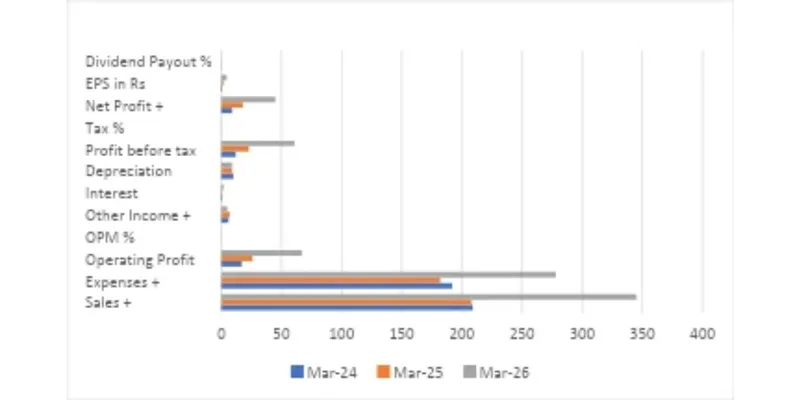
PARTICULARS | Mar-24 | Mar-25 | Mar-26 |
Sales + | 209 | 208 | 345 |
Expenses + | 192 | 182 | 278 |
Operating Profit | 17 | 26 | 67 |
OPM % | 8% | 12% | 19% |
Other Income + | 6 | 7 | 5 |
Interest | 1 | 1 | 2 |
Depreciation | 10 | 9 | 9 |
Profit before tax | 12 | 23 | 61 |
Tax % | 26% | 22% | 25% |
Net Profit + | 9 | 18 | 45 |
EPS in Rs | 0.91 | 1.82 | 4.51 |
Dividend Payout % | 31% | 22% | 9% |
KEY FINANCIAL RATIO
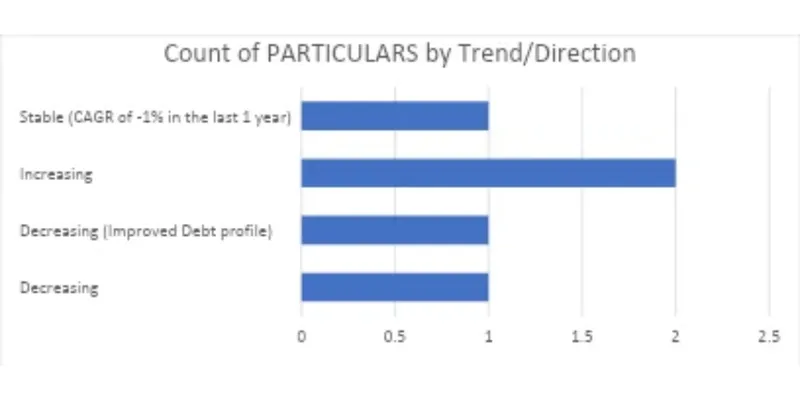
PARTICULARS | Financial Year 2024 | Financial Year 2025 | Trend/Direction |
Operating Revenue | ~₹534 Cr | ~₹534 Cr | Stable (CAGR of -1% in the last 1 year) |
Net Worth | ₹Base Value | ~+12.68% | Increasing |
EBITDA | Base Value | -8.19% | Decreasing |
Total Borrowings | Base Value | -33.33% | Decreasing (Improved Debt profile) |
Total Assets | Base Value | ~+12.46% | Increasing |
SWOT ANALYSIS
Strengths
| Weaknesses
|
Opportunities.
| Threats
|
CONCLUSION
Thiagarajar Mills isn't just another name in the Indian textile space; they've earned a real reputation for reliability over a very long run. What keeps them relevant isn’t just their history, but how they’ve managed to upgrade their manufacturing setups to match whatever the market throws at them—without dropping the ball on quality or efficiency. By pouring resources into premium cotton yarn, planting a firm flag in both local and global export markets, and refusing to get complacent, they’ve managed to keep growing while others stalled out. When you look at the big picture, they have the kind of financial and operational stability that gives them a massive head start in a notoriously brutal and competitive industry.
REFERENCES
- Thiagarajar Mills Official Website
- Thiagarajar Mills – About Us
- Thiagarajar Mills Annual Reports