The Rise of Performance & Functional Fabrics in Tailoring: Where Function Meets Form
Part 7 of the Series: The Evolving World of Men's Tailored Wear
Vivek Mehta
CEO and Managing Director
TextilesBazaar.com
For generations, men's tailoring was primarily associated with appearance, craftsmanship, and elegance. The quality of a suit was judged by its fabric, construction, fit, and finish. Functional performance was rarely a major consideration, particularly in premium tailoring. However, changing lifestyles, evolving workplace cultures, increased international travel, and growing consumer expectations have fundamentally changed this approach.
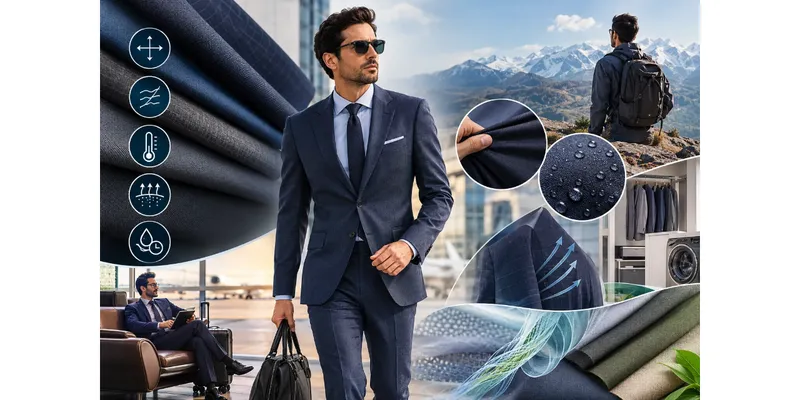
Today's consumer expects a tailored garment to do much more than look good. He wants it to remain comfortable through long working hours, resist creasing during travel, offer freedom of movement, adapt to changing temperatures, and require minimal maintenance. In other words, the modern tailored garment must combine the elegance of traditional tailoring with the functionality of contemporary sportswear.
This changing expectation has created a significant opportunity for textile mills, fibre manufacturers, garment producers, and fashion brands to develop a new generation of performance-oriented fabrics.
The challenge, however, is to introduce functionality without compromising the aesthetics, drape, hand feel, and sophistication that define premium tailoring.
Stretch, Wrinkle Resistance and Washability: Redefining Everyday Comfort
Among the most visible developments in functional tailoring is the growing demand for stretch and crease-resistant fabrics.
Traditional woven suiting fabrics were designed primarily for appearance and structure. While natural fibres such as wool offer inherent elasticity and crease recovery, conventional constructions can sometimes restrict movement, particularly in closely fitted garments.
The introduction of elastane, mechanical stretch constructions, and innovative yarn engineering has changed this equation. Modern fabrics can now provide greater flexibility while retaining the crisp appearance required for tailored clothing.
Stretch has become particularly relevant in trousers, travel jackets, and everyday business wear. Consumers increasingly appreciate garments that accommodate movement while sitting, walking, driving, or travelling without creating discomfort.
Wrinkle resistance is another important consideration. Business professionals who spend considerable time travelling or attending meetings need garments that maintain a presentable appearance throughout the day. Developments in yarn selection, fabric construction, finishing, and fibre blending have improved crease resistance and recovery.
Washability and easy care properties are also gaining attention. Although traditional wool suits generally require professional care, newer fabric developments are exploring washable and low-maintenance solutions. This is particularly relevant for frequent-use garments, uniforms, and contemporary business casual clothing.
However, functional claims must always be supported by appropriate testing. Stretch, recovery, wrinkle resistance, and washability are different properties, and improvement in one does not automatically guarantee improvement in the others.
The opportunity for mills is to develop balanced constructions that deliver these benefits without making the fabric look or feel synthetic.
Climate Adaptive Fabrics: Tailoring for Different Environments
Climate is becoming an increasingly important consideration in fabric development.
A garment designed for a European winter cannot necessarily be expected to perform equally well in the Indian summer or the humid conditions of Southeast Asia. Yet, international brands have traditionally offered relatively standardised fabric collections across different markets.
This approach is gradually changing.
In warmer climates, lightweight constructions, breathable fibres, moisture-management properties, and improved air permeability are gaining importance. High twist wool fabrics, lightweight worsteds, linen blends, and carefully engineered wool-polyester constructions offer interesting possibilities.
Natural wool deserves particular attention in this context. Contrary to the common perception that wool is exclusively a winter fibre, lightweight wool fabrics can provide excellent comfort in warmer conditions because of their breathability and moisture-management characteristics.
In colder climates, the emphasis shifts towards insulation, thermal comfort, and protection from
environmental conditions. Flannels, heavier wool fabrics, and specialised blended constructions
remain relevant.
There is also a growing opportunity for fabrics designed for transitional climates, where consumers move frequently between outdoor environments, air-conditioned offices, airports, and vehicles.
For Indian mills, climate-specific product development represents a particularly attractive opportunity. Rather than simply adapting Western collections, there is scope to develop fabrics
specifically engineered for tropical and sub-tropical conditions.
Travel-Friendly Suiting: A Growing Product Category
International travel and mobile working lifestyles have created a new category of consumer requirements: travel-friendly tailoring.
A business traveller may leave home wearing a jacket, spend several hours on a flight, attend meetings immediately after landing, and travel again the following day. Throughout this journey, the garment is expected to retain its shape, appearance, and comfort.
This has created demand for fabrics that combine lightweight construction, wrinkle recovery, flexibility, breathability, and durability.
Travel-friendly suiting is not necessarily a separate fibre category. It is a product engineering approach that brings together the right yarns, fabric construction, finishing, and garment design.
High twist wool, wool blends, mechanical stretch fabrics, and selected synthetic performance fibres can all contribute to this category.
The garment construction itself is equally important. A lightweight fabric combined with an unnecessarily heavy canvas or rigid interlining may defeat the purpose of travel-friendly tailoring. Therefore, fabric development and garment engineering must work together.
There is also an interesting commercial opportunity here. Travel-friendly jackets and trousers can be positioned as versatile wardrobe essentials rather than conventional formalwear. They can be worn during business meetings, airport transfers, social occasions, and even smart-casual settings.
For brands, this opens the possibility of creating dedicated travel collections with clearly defined functional benefits.
Blends vs 100% Natural Fibres: Finding the Right Balance
One of the most important discussions in modern textile development is the balance between natural fibres and synthetic or engineered blends.
There is a strong consumer preference for natural fibres, particularly wool, because of their breathability, comfort, aesthetic appeal, and association with premium quality. In luxury tailoring, 100% wool continues to hold a special position.
However, it would be incorrect to assume that natural fibres are always the best solution for every application.
Blended fabrics offer opportunities to combine the desirable characteristics of different fibres. Wool polyester blends, for example, can offer improved durability and crease resistance at a more accessible price point. Wool elastane constructions provide additional stretch, while wool viscose blends can deliver particular aesthetic and handle characteristics depending on their engineering, while wool nylon blends offer great performance to strength and abrasion.
Similarly, polyester-based performance fabrics have improved significantly through advances in fibre cross sections, yarn engineering, moisture management treatments, and fabric construction.
The debate should therefore not be about natural versus synthetic as competing philosophies. It should be about selecting the right fibre and construction for the intended end use.
For a premium business suit, 100% wool may be the preferred choice. For a high-frequency travel trouser, a carefully engineered blend may offer better practical value. For uniforms or garments requiring frequent washing, performance blends may be more commercially appropriate.
The future belongs to intelligent fibre combinations rather than rigid preferences for one particular composition.
Nevertheless, the industry must also recognise the environmental implications of synthetic fibres, particularly their fossil-based origins and potential contribution to microfibre pollution. Product performance and environmental responsibility must be evaluated together.
Consumer Communication: Selling Benefits Rather Than Technical Specifications
One of the biggest challenges facing the textile industry is the gap between technical innovation and consumer understanding.
Mills frequently invest considerable effort in developing specialised yarns, innovative constructions, and functional finishes. However, these developments are often communicated through technical terminology that has limited relevance to the average consumer.
Terms such as mechanical stretch, moisture management, thermal regulation, crease recovery, and easy care finishing may be familiar to textile professionals but do not necessarily translate into meaningful purchasing decisions.
Consumers are more interested in understanding what a fabric will do for them.
Will the jacket remain comfortable during a long working day? Will the trouser retain its shape after several hours of sitting? Will the garment require less ironing? Is it suitable for Indian summers? Can it be worn during long-distance travel?
These are the questions that should drive product communication.
Mills need to work more closely with brands and retailers to translate technical properties into simple, demonstrable consumer benefits. Fabric swatches, product demonstrations, comparative testing, and clear product information can help bridge this gap.
The most successful functional fabrics will not necessarily be those with the longest list of technical features, but those whose benefits are easiest to understand and experience.
Avoiding Overclaiming and Greenwashing
As performance fabrics become more popular, there is a growing risk of exaggerated product claims. Terms such as wrinkle-free, stain-proof, waterproof, breathable, sustainable, and temperature regulating are increasingly used in marketing communication. However, these expressions must be supported by measurable performance and appropriate testing.
For example, wrinkle resistant does not necessarily mean wrinkle free. A fabric that provides some degree of stretch may not necessarily offer excellent recovery. Similarly, a moisture management finish does not automatically make a fabric suitable for extreme climatic conditions.
Sustainability claims require even greater care.
A recycled polyester fabric is not automatically sustainable in every respect. Its environmental credentials must be considered in the context of raw material sourcing, manufacturing processes, durability, washing behaviour, recyclability, and the product's overall life cycle. Likewise, natural fibres should not automatically be described as environmentally superior without considering their complete production footprint.
The industry must move towards transparent, evidence-based communication. Independent testing, recognised certifications, traceability, and clearly defined performance benchmarks will become increasingly important.
Ultimately, credibility is more valuable than an attractive marketing claim.
The Opportunity for Indian Textile Mills and Brands
India is particularly well positioned to benefit from the growth of functional tailoring.
The country has an established textile manufacturing base, access to multiple fibre categories, technical capabilities in blending and finishing, and a strong garment manufacturing ecosystem.
However, the next stage of growth will require closer collaboration between fibre producers, spinners, weavers, finishers, garment manufacturers, and brands.
Instead of developing fabrics purely around composition, GSM, and price, mills should increasingly focus on end-use applications.
A fabric designed for travel tailoring should have clearly defined stretch, recovery, crease-resistance, and comfort characteristics. A fabric designed for tropical business wear should prioritise breathability, lightweight construction, and thermal comfort. A fabric developed for frequent-use uniforms should focus on durability, easy care, and colour retention.
This application-led approach can help Indian manufacturers move away from commodity competition and towards differentiated, value-added products.
There is also an opportunity to develop specialised collections for international markets, particularly those seeking lightweight tailoring, travel-friendly garments, and functional businesswear.
Conclusion: The Future of Tailoring Is Functional Elegance
The evolution of performance fabrics represents one of the most significant developments in modern men's tailoring.
Consumers are no longer willing to compromise comfort for elegance or functionality for appearance. They expect both, and the textile industry must respond accordingly.
Stretch, wrinkle resistance, climate adaptability, easy care, and travel-friendly performance will increasingly influence fabric selection and product development. At the same time, natural fibres, premium aesthetics, and traditional tailoring values will continue to retain their importance.
The real opportunity lies in bringing these two worlds together.
For textile mills and apparel brands, the challenge is not simply to manufacture a fabric with more features. It is to create a product that delivers meaningful benefits, communicates them honestly, and performs consistently in real-life conditions.
The next generation of tailored menswear will not be defined merely by how a garment looks when worn, but by how intelligently it performs throughout the day.
That is where function meets form and where the future of performance tailoring lies.
Series Introduction Note
This article is the seventh in a 12-part editorial series exploring the evolving world of men's tailored wear. The series examines changing market dynamics, consumer behaviour, product development, fabric innovation, quality benchmarks, trend forecasting, sustainability, technology, branding, and India's growing role in the global tailoring ecosystem. The objective is to provide meaningful industry perspectives for textile mills, fibre manufacturers, garment producers, brands, retailers, designers, and professionals across the tailored menswear value chain.