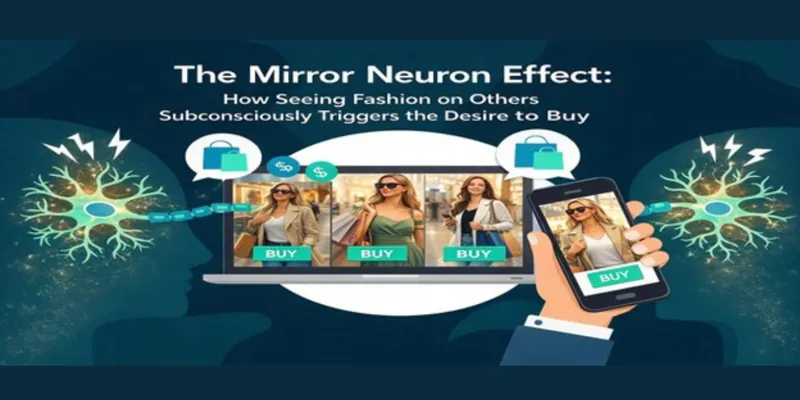
The Mirror Neuron Effect: How Seeing Fashion on Others Subconsciously Triggers the Desire to Buy

Ms.Shradha Singh, Fashion Management Scholar, Department of Fashion Management Studies, National Institute of Fashion Technology, Ministry of Textiles, Govt. of India, Daman campus.
- Abstract
The fashion industry relies heavily on visual communication, emotional appeal, and social influence to shape consumer behaviour. One emerging explanation for this phenomenon is the mirror neuron effect, a neurological mechanism in which individuals mentally simulate actions they observe in others.
This research paper explores how mirror neurons influence consumer behaviour in the fashion industry, particularly through advertising, influencer marketing, and social media exposure. When consumers observe models, celebrities, or influencers wearing fashionable clothing, their brain subconsciously imagines themselves in the same situation. This neurological process creates emotional engagement and increases the likelihood of purchase decisions.
The study uses a quantitative survey approach to analyze consumer responses to fashion stimuli and social media content. Data analysis reveals that exposure to fashion influencers and lifestyle imagery significantly increases purchase intention. The findings suggest that the mirror neuron system plays an important role in modern fashion marketing strategies and helps explain how visual stimuli influence consumer decision-making.
- Introduction
The fashion industry is one of the most dynamic and psychologically driven sectors in the global marketplace. Unlike purely functional products, fashion items represent identity, lifestyle, and social belonging. Consumers often purchase clothing not only for practical use but also to express themselves and align with particular social groups or trends.
Recent developments in consumer neuroscience have introduced new ways of understanding how individuals respond to marketing stimuli. One important concept is the mirror neuron system. Mirror neurons are specialized brain cells that activate both when a person performs an action and when they observe someone else performing the same action. This neurological mechanism allows humans to imitate behaviour, understand emotions, and learn through observation.
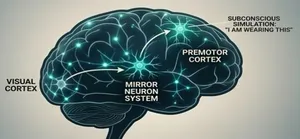
In the fashion industry, the mirror neuron effect explains why consumers feel inspired by seeing stylish clothing worn by models, celebrities, influencers, or even peers. When individuals observe someone wearing fashionable clothing, their brains subconsciously simulate the experience of wearing it themselves. This mental simulation generates emotional engagement and creates a desire to obtain the same product.
With the rise of social media platforms such as Instagram, TikTok, and Pinterest, consumers are constantly exposed to fashion images and videos. Influencers showcase outfits in everyday contexts, which makes it easier for consumers to imagine themselves wearing the same styles. As a result, fashion brands increasingly rely on visually engaging marketing strategies that trigger mirror neuron responses.
This research aims to explore how the mirror neuron effect influences consumer purchasing behaviour in the fashion industry and how brands utilize this psychological mechanism in marketing strategies.
- Literature Review
Kumar and Nayak (2019) conducted a study on consumer behaviour in the Indian fashion market and found that social media exposure significantly influences fashion purchasing decisions among young consumers. Their research indicated that visual platforms such as Instagram create a strong aspirational impact, encouraging consumers to imitate fashion styles displayed by influencers.
Sharma and Patel (2020) analyzed the impact of celebrity endorsements on perceptions of fashion brands in India. The study revealed that consumers tend to associate celebrities' personalities and lifestyles with the fashion products they promote. This psychological association increases brand recall and purchase intention.
Singh and Verma (2018) examined the role of digital marketing in influencing fashion trends among Indian youth. Their findings suggested that repeated exposure to fashion imagery on social media leads to imitation behaviour, which is closely related to observational learning and mirror neuron activation.
- Research Methodology
This study adopts a quantitative research approach to analyze the influence of mirror neuron responses on consumer behaviour in the fashion industry.
- Research Design: A descriptive research design was used to examine the relationship between exposure to fashion imagery and consumer purchase intention.
- Data Collection Method: Primary data were collected through an online questionnaire.
- Sample Size: The study included 200 respondents who regularly consume fashion content on social media platforms.
- Sampling Technique: Convenience sampling was used to collect responses from individuals within the age group of 18–45 years.
- Data Collection Tool:
- Exposure to fashion content on social media
- Influence of fashion influencers
- Mental imagination while observing outfits
- Purchase intention after seeing fashion content.
- Data Analysis Techniques:
The collected data was analyzed using:
- Frequency analysis
- Percentage distribution
- Graphical representation (bar charts)
- Data Analysis
The data collected from the survey was analyzed to understand how consumers respond to fashion content and how mirror neuron responses influence purchasing behaviour.
The analysis focuses on four key variables:
- Age distribution of respondents
- Exposure to fashion content on social media
- Influence of fashion influencers
- Purchase intention after seeing fashion styles
Table 1: Age Distribution of Respondents
Age Group | Number of Respondents |
18–25 | 90 |
26–35 | 60 |
36–45 | 30 |
46+ | 20 |
Total | 200 |
Table 2: Exposure to Fashion Content on Social Media
Response | Number of Respondents |
Yes | 160 |
No | 40 |
Total | 200 |
Table 3: Influence of Fashion Influencers
Influence Level | Number of Respondents |
High | 80 |
Moderate | 75 |
Low | 45 |
Total | 200 |
Table 4: Purchase Intention After Seeing Fashion Styles
Purchase Intention | Number of Respondents |
High | 90 |
Medium | 70 |
Low | 40 |
Total | 200 |
- Findings and Discussion
The analysis of survey data reveals several important insights regarding the influence of mirror neurons on consumer behaviour in the fashion industry.
First, the majority of respondents are in the 18–25 age group. This indicates that young consumers are the most active participants in fashion trends and social media fashion consumption.

Second, a large percentage of respondents reported being regularly exposed to fashion content on social media platforms. This suggests that digital platforms play a crucial role in shaping fashion preferences.
Third, influencer marketing was found to significantly impact consumer behaviour. Many respondents indicated that they are highly influenced by influencers when choosing fashion products. This supports the idea that consumers tend to imitate individuals they admire.
Fourth, the data shows that a large number of respondents reported a high purchase intention after seeing fashion styles online. This indicates that visual exposure to fashion products triggers psychological responses that encourage purchasing behaviour.
These findings strongly support the concept of the mirror neuron effect. When consumers observe fashionable individuals wearing stylish clothing, their brains subconsciously simulate the experience of wearing those clothes. This mental simulation creates emotional engagement and increases the desire to purchase similar products.
- Conclusion
The mirror neuron effect provides a powerful explanation for how visual stimuli influence consumer behaviour in the fashion industry. By enabling individuals to mentally simulate the actions and experiences of others, mirror neurons create a psychological connection between consumers and fashion products.
The findings of this research demonstrate that exposure to fashion content, influencer marketing, and lifestyle imagery significantly influences consumer purchase intentions. Social media platforms have amplified this effect by continuously presenting users with visual fashion inspiration.
Fashion brands can leverage this neurological mechanism by creating visually engaging campaigns that allow consumers to imagine themselves wearing their products. Influencer collaborations, lifestyle storytelling, and immersive fashion content are particularly effective strategies.
Overall, the mirror neuron effect highlights the deep connection between neuroscience, psychology, and marketing in shaping modern fashion consumption.
- References
- Kumar, A., & Nayak, J. (2019). Social media influence on fashion consumption behaviour among Indian youth. Indian Journal of Marketing.
- Sharma, R., & Patel, K. (2020). Impact of celebrity endorsement on fashion brand perception in India. Journal of Marketing and Consumer Research.
Singh, P., & Verma, S. (2018). Digital marketing and consumer behaviour in the Indian fashion sector. Asian Journal of Management.