The Ink Efficiency Gap: Why Indian Digital Printers Are Paying for Water They Don't Need
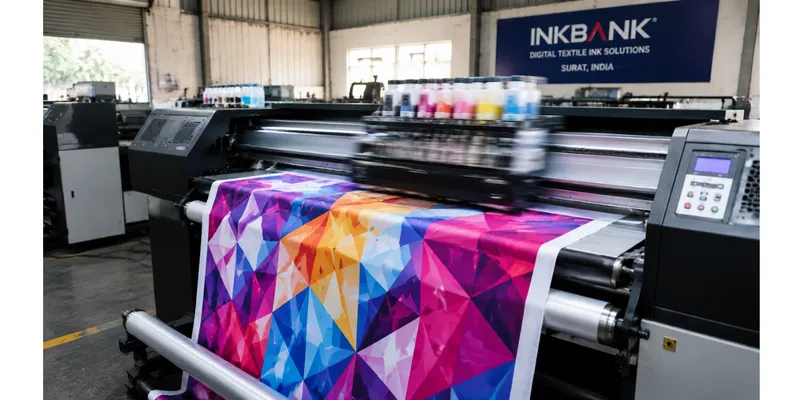
Author: INKBANK Group
Abstract
India's digital textile printing market is growing at a 16.4% CAGR, yet most print houses operate on thin margins while facing tightening export compliance. This article argues that ink - which accounts for 30-45% of per-metre printing cost - has been overlooked as a strategic lever. Ultra-high concentration sublimation ink reduces purchased ink volume by 30-50% with no capital expenditure, while meeting OEKO-TEX®, ZDHC, and GOTS standards at no price premium. For Indian printers, it represents a rare convergence: sustainability that pays for itself from the first procurement cycle.
1. India at the Digital Crossroads
India's textile printing sector is in the middle of its most consequential transformation since the introduction of rotary screens. According to Grand View Research, the country's overall textile printing market stood at USD 2.2 billion in 2024 and is projected to reach USD 3.8 billion by 2030, growing at a 9.9% compound annual rate. But the digital segment within that - valued at just USD 467 million in 2024 - is sprinting ahead at 16.4% CAGR, on track to cross USD 1.1 billion by the end of the decade [1].
This is not simply a technology upgrade story. It is a structural shift driven by three converging pressures.
First, global brands - from Zara to Nike - have compressed order-to-delivery timelines from months to weeks, making conventional rotary printing's 1,200-metre minimum order economically unviable for a growing share of production. Digital printing, with its zero set-up cost and single-metre capability, is the natural answer.
Second, export markets - particularly the European Union - are tightening chemical and environmental standards. The EU Digital Product Passport mandate, effective July 2026, requires every textile product sold in the EU to carry traceable chemical and environmental data. Inks that were compliant five years ago may no longer pass audit. For a Surat printer who has invested in digital machinery but not in certified chemistry, the passport requirement turns a cost concern into a market-access barrier.
Third, India's own textile clusters - Surat, Tirupur, Ludhiana - face intensifying groundwater regulation. The Central Ground Water Authority's 2025 notification designating additional textile blocks as over-exploited means water-intensive processes are not just environmentally questionable but operationally at risk.
Yet, for all of digital printing's promise, the conversation has been dominated by machinery: faster printheads, wider-format machines, higher-resolution nozzles. Comparatively little attention has gone to what flows through those printheads. Ink - which typically accounts for 30-45% of a digital printer's per-metre operating cost - has been treated as a commodity input rather than a strategic variable. That assumption is overdue for revision.
2. The Hidden Math of Ink Concentration
To understand why ink concentration matters, one must first understand what standard sublimation ink formulation actually contains. In a conventional dye-sublimation ink, the active colorant - the dispersed dye particle that sublimates onto polyester fabric - accounts for only a fraction of the bottled volume. The remainder consists of dispersing agents, humectants to prevent nozzle drying, viscosity modifiers, biocides, and - critically - water, which functions as the primary carrier fluid.
When a printer buys one litre of standard sublimation ink, they are paying to ship, store, and handle a significant volume of carrier fluid that contributes nothing to the final print. The visible result is no different from a more concentrated formulation - provided the colorant loading, dispersion quality, and particle size distribution are equivalent. What differs is the logistics cost, the warehouse footprint, the packaging waste, and the carbon profile.
Ultra-high concentration sublimation ink addresses this by packing more dispersed dye solids into the same volume without compromising jetting performance - an engineering challenge that hinges on nano-scale dispersion stability. At particle sizes below 200 nanometres, Brownian motion keeps the dispersion stable against sedimentation. Above 300 nanometres, particles begin settling, leading to the printhead clogging that has historically made formulators conservative about raising concentration.
At INKBANK, our approach to this problem draws on nearly 20 years of nano-milling refinement — maintaining sub-200nm particle size distribution at dye loadings that deliver 80–120 m² per litre on industrial production lines. This advanced formulation prevents paper cockling and allows printers to utilize ultra-thin transfer papers (down to 40gsm) without ink bleeding, maximizing both speed and paper cost-efficiency. The manufacturing capability to sustain this at scale is what separates genuine ultra-high concentration inks from marketing claims.
The operational arithmetic for a mid-sized Indian digital print house is worth examining. A facility running five industrial printers, each consuming approximately 150 litres of sublimation ink per month, processes roughly 9,000 litres of ink annually. With standard-concentration ink, approximately 60-70% of that purchased volume - between 5,400 and 6,300 litres - is carrier fluid that generates no revenue, occupies storage space, and arrives in packaging that must be disposed of.
An ultra-high concentration formulation that delivers 30-50% more print output per litre would reduce the annual ink procurement from 9,000 litres to approximately 6,000-6,900 litres for the same print volume. The savings cascade through purchasing costs, freight charges, warehouse square footage, and packaging waste management - a compound efficiency gain that single-variable cost comparisons miss entirely.
3. Water, Carbon, and Rupees: The Triple Dividend - With Zero CapEx
The environmental case for digital textile printing over conventional methods is already well documented. Traditional rotary screen printing on cotton consumes between 50 and 60 litres of water per metre of fabric. Digital inkjet printing, by contrast, deposits only 5-9 millilitres of ink per metre - a reduction of approximately 95-97% in process water [2].
But the ink concentration dimension adds a layer of savings that the conventional-versus-digital comparison does not capture: the embedded carbon and resource cost of the ink supply chain itself. When ink is manufactured with higher active dye loading per unit volume, fewer litres must be produced, fewer bottles moulded, fewer corrugated boxes manufactured, and fewer container slots booked on cargo vessels from manufacturing hubs in East Asia to Indian ports.
For a print house receiving four 1,000-litre IBC totes per quarter, a 30% volume reduction means one fewer tote, one fewer pallet, and measurably less diesel consumed in last-mile delivery from Nhava Sheva or Chennai port to the factory gate in Surat or Tirupur.
Cost Element | Standard Ink | Ultra-High Con Ink | Annual Delta |
Ink purchase (litres) | 9,000 | 6,300 | -2,700 L |
Freight + transport | Baseline | ~30% reduction | Save ~30% |
Warehouse footprint | 6 pallets | 4 pallets | 33% saved |
Packaging waste | ~180 containers | ~126 containers | 54 fewer |
Cost per linear metre | Baseline | Lower usage cost | Net savings
|
*Note: Figures are illustrative, based on a five-printer operation at 150 L/printer/month. Actual savings depend on ink formulation, shipping distance, and local handling costs.
Here is the point that deserves emphasis: none of these savings require capital expenditure. Unlike investments in new machinery, heat-recovery systems, or effluent treatment plants - all of which carry multi-year payback periods and financing risk - switching to a higher-concentration ink generates savings from the first procurement cycle.
There is no equipment to install, no production downtime, and no learning curve beyond a standard ink changeover. For a mid-sized print house operating on net margins of 8-12%, a significant saving on freight alone is equivalent to the profit from additional print revenue - without having to find a single new customer.
This is the kind of sustainability that does not need a subsidy to make economic sense. It is also the kind that gets approved by a factory owner in under ten minutes, because the arithmetic is visible on a single invoice.
4. Certification: The Market Access Passport Ink Provides
-800x450.webp?2026-07-21T10:33:34.618Z)
For Indian printers eyeing European and North American export orders, ink is not merely a consumable - it is a compliance document printed onto every metre of fabric. With the EU Digital Product Passport now in effect, that document must be traceable. The three certifications that have become de facto requirements in premium export markets are:
OEKO-TEX® ECO PASSPORT certifies that every chemical ingredient in the ink formulation has been tested for harmful substances and is safe for use in textile products intended for human contact. For a European brand sourcing printed polyester sportswear, an ECO PASSPORT-certified ink eliminates a layer of chemical testing they would otherwise need to commission themselves.
ZDHC MRSL Level 3 is the highest tier in the ZDHC conformance framework. Level 3 means the ink has been tested by an independent third-party laboratory and confirmed to contain no restricted substances above ZDHC limits. It is the standard demanded by the ZDHC Contributor group - Nike, Adidas, H&M, Inditex, and Levi Strauss - collectively representing the bulk of global apparel sourcing [3].
GOTS 7.0 certification is required when the finished textile product carries an organic label. GOTS-certified inks must pass both chemical input screening and environmental management criteria at the manufacturing facility.
The practical implication for an Indian digital printer is straightforward: using ink that holds these three certifications removes the most common chemical-compliance barrier to onboarding with international buyers. The certification certificates effectively travel with the printed fabric, satisfying brand audit requirements at every stage. For a Surat-based printer who previously served only the domestic market, adding certified digital printing capability opens a completely different order book - with per-metre margins that are typically 2-3x domestic rates.
5. Choosing Ink Partners: Lessons from Indian Print Houses
The Indian digital textile printing market's 16.4% growth rate [1] has attracted a wave of ink suppliers - from multinational chemical conglomerates to small-scale domestic formulators. From our experience supplying printers across Surat, Tirupur, and Ludhiana, three criteria consistently separate ink decisions that pay off from those that disappoint:
1. Printhead Compatibility Under Factory Conditions
An ink that prints flawlessly on an Epson i3200 head in an air-conditioned testing lab may behave differently after 14 days inside a Surat factory operating at 38 degrees Celsius and 65% relative humidity. We have learned to test latency performance - how long the ink can sit idle in the nozzle without causing deflection or dropout - at the actual operating temperature of the print floor. Printers evaluating a new ink should ask for this data, not just a compatibility list.
2. Batch-to-Batch Colour Consistency Backed by Data
In digital textile printing, a Delta-E shift of less than 1.0 is imperceptible to the human eye. A shift above 2.0 is noticeable to most observers, and above 3.0 is commercially unacceptable for brand-colour reproduction. Every reputable ink manufacturer should provide batch-certificate data showing Delta-E values against a reference standard with every delivery - not as a special request, but as a standard operating procedure.
3. Total Cost of Ownership (TCO) Over Litre Price
A lower per-litre price does not necessarily mean a lower per-metre printing cost. The metric that matters is total ink cost to produce 1,000 linear metres of printed fabric at a given colour density - a function of both per-litre price and dye concentration. The only way to measure this is a side-by-side print trial on the customer's own production machine, with identical design files, measuring actual millilitres consumed per square metre.
6. The Road Ahead
India's digital textile printing industry is at a pivotal moment. The market forces pushing it forward - faster fashion cycles, export compliance requirements, water scarcity - are structural, not cyclical. They will not reverse. But whether the industry captures the full value of its digital transition depends on whether it treats ink as a strategic input rather than a commodity line item.
The trajectory of the technology is clear. Higher active dye loadings, tighter particle size distributions, and broader printhead compatibility are the direction of travel for every serious ink manufacturer. Printers who evaluate ink on total cost of ownership - including logistics, storage, packaging waste, and certification value - rather than on per-litre sticker price alone, will find that the sustainability equation and the profitability equation are, for once, solved by the same variable.
When the ink works harder, everything else works less.
For print houses ready to test whether higher concentration delivers on its arithmetic, most established ink manufacturers offer free sample programs with technical support. It is the lowest-risk way to run the numbers on your own production floor - and typically the fastest way to settle the per-litre versus per-metre debate.
References
[1] Grand View Research. (2025). India Digital Textile Printing Market Size & Outlook, 2030.
[2] ET Edge Insights. (2025). How Digital Printing Is Powering India Textile Renaissance.
[3] ZDHC. (2026). ZDHC MRSL Conformance Levels & Certification Framework.
[4] IMARC Group. (2025). India Textile Dyeing and Printing Market Size & Share 2034.
[5] Future Market Insights. (2025). Digital Textile Printing Market Global Analysis Report.
[6] Grand View Research. (2025). India Textile Printing Market Size & Outlook, 2030.