The Growing Role of Nonwoven Textiles in Surgical and Infection- Control Products
Overview
Healthcare facilities depend on disposable products to maintain hygiene, protect patients, and reduce the risk of cross-contamination. Among the materials used in these products, nonwoven textiles have become an important part of modern infection-control and surgical care.
Nonwoven materials are used in products such as surgical gowns, drapes, masks, head covers, shoe covers, sterilization wraps, and other disposable healthcare supplies. Their combination of filtration, barrier protection, lightweight construction, and flexibility makes them suitable for several clinical applications.
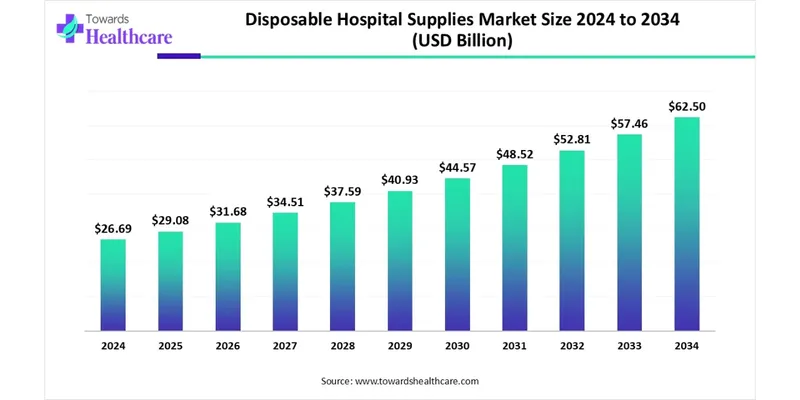
According to Towards Healthcare Research and Consulting, the global disposable hospital supplies market size is calculated at US$ 26.69 in 2024, grows to US$ 29.08 billion in 2025, and is projected to reach around US$ 62.5 billion by 2034. The market is expanding at a CAGR of 9.01% between 2025 and 2034.
What Are Nonwoven Textiles?
Nonwoven textiles are fabrics made by bonding or mechanically entangling fibers instead of weaving or knitting them together.
Materials such as polypropylene, polyester, polyethylene, and cellulose can be processed into nonwoven fabrics with properties such as filtration, fluid resistance, breathability, and strength.
This manufacturing approach also allows producers to develop different fabric structures according to the requirements of hospitals, laboratories, and other healthcare settings.
Why Are Nonwovens Important in Healthcare?
During surgery and other clinical procedures, healthcare workers can come into contact with blood, body fluids, microorganisms, and contaminated surfaces.
Nonwoven products create a physical barrier that can reduce the transfer of contaminants between healthcare workers, patients, equipment, and surrounding environments.
Their ability to combine protection with lightweight construction has made them particularly useful for disposable healthcare products.
Key Applications
Nonwoven textiles are used across several infection-control products, including:
- Surgical gowns and drapes
- Medical face masks
- Caps and shoe covers
- Patient gowns
- Sterilization wraps
- Wound-care products
- Disposable bed and equipment covers
- Protective coveralls
For example, multilayer nonwoven structures can combine different functions. One layer may provide strength, another may improve filtration, while an outer layer can provide resistance to fluids.
Role in Infection Control
One of the major advantages of medical nonwovens is their ability to act as a protective barrier.
In products such as surgical gowns and drapes, the fabric can help prevent microorganisms and contaminated fluids from passing through the material when the product is appropriately designed and used.
Nonwoven fabrics are also important in filtration products. Meltblown polypropylene, for example, is commonly used as a filtration layer in medical masks because its fine fiber structure can capture airborne particles.
Advantages of Nonwoven Textiles
Lightweight and comfortable:
Nonwoven fabrics can provide protection without adding significant weight, which is important for healthcare workers who may wear protective products for extended periods.
Customizable performance:
Manufacturers can engineer nonwovens for different levels of filtration, fluid resistance, softness, strength, and breathability.
Scalable production:
Nonwoven manufacturing can support high-volume production, making these materials suitable for widely used disposable healthcare products.
Reduced cross-contamination risk:
Single-use products can reduce the need for repeated handling, laundering, and reuse when appropriate disposal practices are followed.
Limitations and Challenges
Despite their benefits, nonwoven textiles also have limitations.
Many medical nonwoven products are designed for single use, which can contribute to healthcare waste. The environmental impact depends on the material, product design, disposal method, and healthcare waste-management system.
Performance can also vary significantly between different nonwoven structures. A fabric designed for filtration may not provide the same level of fluid protection or mechanical strength required for a surgical gown.
Sustainability Is Becoming Important
Healthcare organizations are increasingly looking at ways to reduce the environmental footprint of protective products without compromising safety.
This is creating interest in recyclable materials, bio-based fibers, improved material efficiency, and better waste-management approaches.
The challenge is to balance infection-control performance, cost, comfort, regulatory requirements, and environmental considerations.
What’s the Future?
The future of medical nonwovens is moving toward more specialized and functional materials.
Manufacturers are exploring advanced fiber structures, antimicrobial technologies, improved filtration, breathable barrier materials, and more sustainable alternatives.
As healthcare facilities continue to focus on infection prevention and operational efficiency, nonwoven textiles are likely to remain an important material platform for surgical and protective products.
Nonwoven textiles may look simple, but their role in healthcare is highly functional. They provide engineered barriers across products ranging from surgical gowns and drapes to masks and sterilization wraps.
The next phase of innovation will focus on achieving stronger protection, better comfort, efficient manufacturing, and greater sustainability. This makes medical nonwovens an important area to watch across the healthcare textile and infection-control ecosystem.
About Author

Payal Rabde is a Healthcare Market Research Analyst at Towards Healthcare Research & Consulting with over 4+ years of experience in pharmaceutical, biotechnology, medical device, and healthcare market research. She holds an MBA in Pharmaceutical-Biotechnology Management and a B.Pharm, specializing in market analysis, forecasting, competitive intelligence, and strategic healthcare insights.
About Us
Towards Healthcare Research & Consulting is a global strategy consulting firm with a presence in both Canada and India. We provide innovative solutions tailored to the healthcare sector, helping business leaders overcome challenges and accelerate growth. We specialize in delivering advanced technological solutions, clinical research services, and powerful data analytics. Our focus is on building meaningful partnerships that foster innovation and deliver actionable insights to drive success in healthcare.
Reference:
https://pmc.ncbi.nlm.nih.gov/articles/PMC7152323/
https://www.towardshealthcare.com/insights/disposable-hospital-supplies-market-sizing