The Future of Textile Machines: 2026 Industry Data and Market Opportunities
The global textile industry is undergoing rapid modernization, and textile machines have emerged as one of the most influential technologies shaping manufacturing efficiency, productivity, and cost optimization in 2026. From automated weaving and spinning systems to AI-enabled monitoring platforms, textile machinery has become central to scaling output while reducing operational losses.
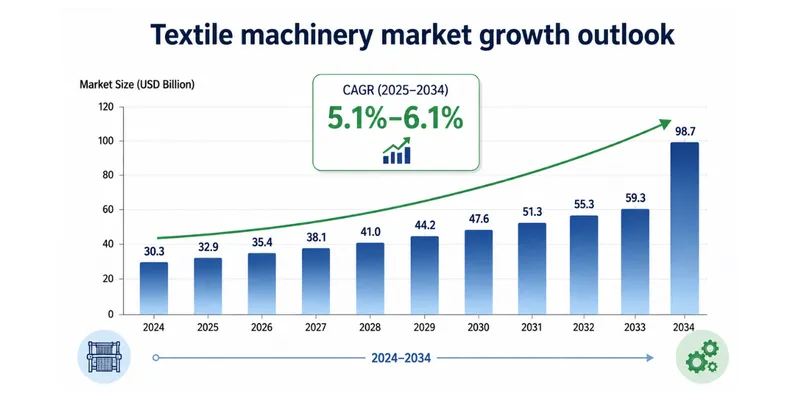
According to insights highlighted by Dataintelo, recent market estimates show the global textile machinery sector ranging between USD 32.9 billion and USD 55.3 billion in 2025, depending on market scope and segmentation methodology, with projected growth rates of 5.1%–6.1% CAGR through 2034. Growing investments in automation, smart manufacturing systems, and digital textile production continue to accelerate industry expansion worldwide.
Key Statistics at a Glance
Metric | Value |
Global Textile Machinery Market (2025) | USD 32.9–55.3 Billion |
Forecast Market Size (2034) | USD 53.8–98.7 Billion |
Expected CAGR | 5.1%–6.1% |
Asia-Pacific Market Share (2025) | 61%–72.7% |
Textile Processing Machinery Market (2023) | USD 29.49 Billion |
Textile Processing Forecast (2030) | USD 42.72 Billion |
India Textile Machinery Market (2025) | USD 1.2 Billion |
India Forecast (2034) | USD 2.1 Billion |
Estimated India CAGR | 6.02% |
Digital-Control Textile Equipment Adoption | 42%+ |
Automated Textile Operations Adoption | ~65% |
Estimated Weaving Machine Demand in India by 2030 | 450,000 Units |
Data compiled from recent industry reports and market intelligence publications. What Is a Textile Machine and Why Does It Matter?
Textile machines are industrial systems used across fiber preparation, spinning, weaving, knitting, dyeing, finishing, and fabric inspection. Modern equipment combines mechanics, automation, sensors, and digital controls to improve output and reduce production variability.
Traditional textile production often relied on labor-intensive processes. Today, automated equipment can improve throughput while lowering waste percentages and maintenance cycles.
Industry estimates indicate that more than 7.5 million textile machines are currently operating worldwide, with approximately 2.8 million units concentrated in Asia-Pacific manufacturing hubs.
5 Data-Backed Reasons Textile Machines Are Transforming Manufacturing 1. Automation Improves Output Efficiency
Around 65% of textile manufacturers are integrating automated machinery to improve productivity and maintain quality consistency. Automation reduces manual intervention and improves cycle reliability.
2. Digital Controls Reduce Quality Variation
More than 42% of textile machinery now includes digital control systems, enabling operators to monitor machine health and optimize fabric quality in real time.
3. Market Expansion Continues Through 2034
Industry forecasts estimate growth from USD 30.3 billion in 2024 to nearly USD 49.9 billion by 2034, representing sustained long-term investment in production technologies.
4. Asia-Pacific Dominates Global Production
Asia-Pacific accounts for between 61% and 72.7% of global textile machinery demand, supported by manufacturing infrastructure, export capacity, and industrial modernization initiatives.
5. India Is Accelerating Machinery Investments
India’s textile machinery market reached approximately USD 1.2 billion in 2025 and is projected to expand to USD 2.1 billion by 2034, supported by increasing domestic textile production and modernization initiatives.
2026 Performance Metrics: Modern Textile Machine Benchmarks
Performance Indicator | Typical Modern Benchmark |
Production uptime | 90–95% |
Automated defect detection | Up to 95% accuracy |
Energy optimization potential | 10–25% |
Maintenance reduction | 15–30% |
Fabric consistency improvement | 20–40% |
Setup time reduction | 25–50% |
These benchmarks vary by machine type, factory scale, and automation level.
Textile Machine Categories Driving Growth
Spinning Machines
Convert fibers into yarn with improved tension control and lower defect rates. Weaving Machines
Weaving equipment remains the leading category with approximately 28.3% market share in certain market analyses due to widespread use in apparel and industrial textiles.
Knitting Machines
Support faster garment production and reduced material waste.
Finishing Machines
Enhance texture, durability, color consistency, and final product quality. Smart Monitoring Systems
Enable predictive maintenance and continuous performance tracking.
Investment Outlook: What to Expect Through 2034
Textile machinery investment is increasingly linked to automation, sustainability, and production scale.
Industry projections estimate:
• Market value approaching USD 93–99 billion by 2034
• Annual growth exceeding 5% CAGR
• Continued expansion of intelligent manufacturing systems
• Greater demand for technical textiles and high-speed machinery
India alone may require approximately 450,000 high-speed weaving machines and around USD 15 billion in machinery investment to support projected textile industry growth through 2030.
Conclusion
Textile machines are no longer just production equipment—they are becoming strategic assets for industrial competitiveness. With global market projections reaching USD 53.8– 98.7 billion by 2034, automation adoption exceeding 65%, and digital control penetration above 42%, the sector is moving rapidly toward smarter and more measurable manufacturing outcomes. Businesses investing in modern textile machinery in 2026 are positioning themselves to achieve higher throughput, lower waste, and stronger long-term profitability.
Read A Full Report: https://dataintelo.com/report/textile-machine-market