The Effect of Colour Assortment Size on Consumer Choice Satisfaction for a Product Category (Unisex Sweatshirts)
Ms Nehasri R.G.
Postgraduate Scholar,
Dept. of Fashion Management Studies,
National Institute of Fashion Technology,
Ministry of Textiles, Govt. Of India, Daman Campus
Ms Theja Mythreyi R
Post Graduate Scholar,
Dept. of Fashion Management Studies,
National Institute of Fashion Technology,
Ministry of Textiles, Govt. Of India, Daman Campus
Dr Vidhu Sekhar P
Asst. Professor,
Dept. of Fashion Management Studies,
National Institute of Fashion Technology,
Ministry of Textiles, Govt. Of India, Daman Campus
1. Introduction
The literature surrounding colour assortment and consumer choice connects four closely related areas: assortment size, choice satisfaction and choice overload, colour preference, and apparel consumer behaviour. Research on assortment size establishes that the number of alternatives can shape perceived variety, choice satisfaction, decision difficulty, and consumer responses. Choice-overload studies further explain why additional alternatives may either support or hinder satisfaction depending on presentation and consumer involvement. Colour-preference research demonstrates that responses to colour are influenced by colour characteristics and contextual factors. Apparel studies then place these relationships within clothing consumption, where colour is a visible and meaningful product attribute. Together, these streams establish a logical foundation for examining whether different numbers of colour options affect satisfaction when consumers evaluate the product category. The literature also indicates that the relationship may not simply increase with every additional colour, creating a need to compare controlled assortment levels rather than assuming that maximum variety is always preferable.
Objectives
- To study the effect of colour assortment size on choice satisfaction.
- To compare satisfaction across 2, 5, and 8 colour options.
- To understand how colour variety affects consumers’ confidence in choosing a product category.
2. Literature review
Chapter 1: Colour Assortment Size
The review begins with colour assortment size because it represents the independent variable in the proposed study. These studies move from a broad definition of assortment size to evidence on diminishing benefits, decision costs, and perceived variety. Together, they establish why the number of colour alternatives should be manipulated rather than treated simply as a background product characteristic.
Sethuraman, et al., (2022) define assortment size as the number of distinct alternatives available to consumers, including different colours. Their review shows that larger assortments can increase perceived freedom and satisfaction, but may also create information overload and decision difficulty. This supports comparing different numbers of sweatshirt colours rather than assuming that more choices are always better.
Ouyang, et al., (2022) show that consumers’ responses can depend not only on the actual number of alternatives but also on how the assortment is perceived and presented. Their study connects assortment characteristics with post-choice satisfaction. This supports presenting colour alternatives clearly and consistently when examining the relationship between assortment size and satisfaction.
Turri & Watson (2023) highlight that larger assortments have both benefits and drawbacks. While more alternatives can help consumers find suitable options, they may also increase decision difficulty and regret. This supports comparing limited, moderate, and large colour assortments rather than assuming that more colours will always improve satisfaction.
Wang, et al., (2023) show that the benefits of increasing assortment size can decrease as more alternatives are added. Some consumers may also experience choice overload when assortments become large. This supports using different colour conditions to examine whether additional sweatshirt colours continue to improve the consumer experience.
Heger & Klein (2024) discuss assortment decisions as an important part of the consumer choice process. Their review shows that consumers select from the alternatives offered according to their preferences. This supports treating colour assortment as a consumer-facing choice variable rather than only an inventory decision.
Natan (2024) focuses on the decision costs associated with larger assortments. When consumers face many alternatives, additional comparison can create difficulty and regret. This supports examining whether a larger colour assortment produces a different satisfaction level compared with smaller assortments.
Mejía (2025) distinguishes between simply having more alternatives and actually perceiving greater variety. The study shows that perceived diversity gains become weaker as assortment size increases. This supports comparing different colour levels rather than assuming that more colours automatically provide greater consumer value.
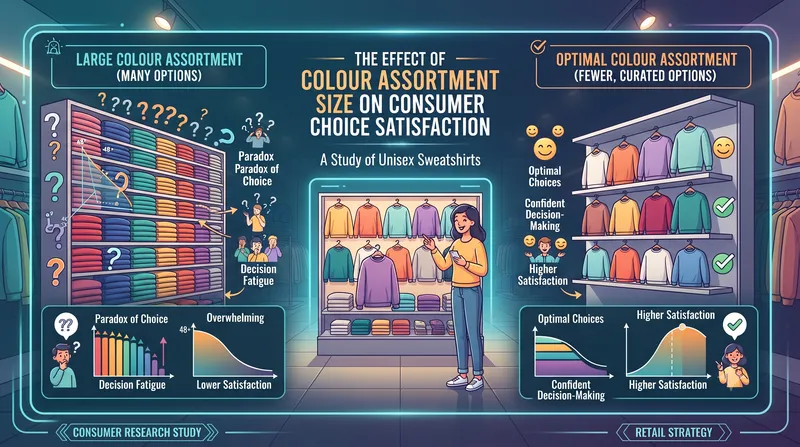
From the above literature, it suggests that while an adequate colour assortment provides consumers with sufficient choice, an excessively large assortment can increase confusion and choice difficulty. However, existing studies do not clearly establish how many colour options constitute an “adequate” assortment for a specific product category. Therefore, this research investigates the appropriate colour assortment size for a product like unisex sweatshirts that provides sufficient choice without creating choice difficulty.
Chapter 2: Choice Satisfaction
The next group focuses on the consumer outcome most directly connected to assortment size: choice satisfaction. The literature explains that satisfaction can change when consumers face larger choice sets and that overload is not automatic; presentation, involvement, and perceived information adequacy can influence the response. This provides the theoretical basis for measuring satisfaction after respondents view different colour assortments.
An, et al., (2025) directly examine the relationship between assortment size and choice satisfaction. Their findings show that larger assortments can reduce satisfaction under some conditions, while consumer involvement can influence this relationship. This supports using choice satisfaction as the dependent variable when comparing different sweatshirt colour assortments.
Jacob, et al., (2024) review 92 studies on choice overload and provide a broad understanding of how consumers respond to large choice sets. Their review shows that choice overload varies across contexts and consumer conditions. This supports clearly defining the product and choice environment in the present study.
Dar & Gul (2025) review the “less is better” phenomenon and show that too many alternatives can sometimes negatively affect decision-making. Their findings support testing different assortment levels rather than assuming maximum variety produces maximum satisfaction. They also highlight the importance of studying choice overload within a specific product context.
Kawamata & Moriguchi (2024) provide closely related evidence by examining satisfaction when consumers choose among products with different colour variations. Their findings show that the presentation of colour alternatives can influence choice difficulty and satisfaction. This supports keeping the visual presentation consistent across the different colour-assortment conditions.
The above literature suggests that choice satisfaction is not determined simply by having more options. Instead, satisfaction depends on how consumers process and evaluate the available alternatives. This indicates that increasing the number of colours may not continuously improve satisfaction. However, existing studies do not establish the point at which additional colour options stop adding value and begin creating difficulty. This creates a need to experimentally compare different assortment sizes to identify an appropriate level of colour variety.
Chapter 3: Colour Preference / Colour Choice
After establishing the assortment–satisfaction relationship, the literature turns to colour itself. These studies demonstrate that colour preference is not fixed: colour characteristics, social context, gender-related differences, and external conditions can influence responses. This stream helps explain why consumers may value different colours within an assortment and why a colour assortment can affect perceived suitability.
Zong, et al., (2022) show that colour preferences can change according to social context. Their findings demonstrate differences in preferences for warm and cool colours under different social conditions. This suggests that colour preference is not completely fixed and should be considered as an important background factor when studying consumer responses to colour assortments.
Yu, et al., (2023) examine colour-palette preferences and show that colour attributes such as lightness can influence consumer preference. Their findings highlight the importance of carefully selecting and controlling the colours used in an assortment. This supports maintaining a consistent and planned colour palette across the experimental conditions.
Luo & Shamey (2023) provide apparel-specific evidence showing that garment colour can influence perceptual judgments. Their cross-ethnic study also indicates that colour responses can differ between observer groups. This strengthens the need to study colour within an apparel context rather than relying only on general colour-preference research.
Liu, et al., (2025) identify gender-related differences in preferences for colour contrast across product categories. This is relevant because the present study includes both male and female respondents and uses a unisex product. Gender is therefore considered as a demographic variable while colour assortment size remains the main independent variable.
Overall, the literature establishes that colour preference is dynamic and influenced by colour characteristics, social context, gender, and product context. These findings indicate that consumers may respond differently to the same colour assortment, making individual and contextual differences important considerations. However, existing studies largely focus on colour preference, perception, or specific colour attributes rather than the number of colour choices available. This highlights a research gap for examining whether varying colour assortment size directly influences consumer choice satisfaction, particularly for unisex apparel products.
Chapter 4: Apparel Consumer Context
The final group brings the preceding concepts into apparel. These studies establish that colour is an important clothing-selection attribute and show that apparel consumers respond to colour in relation to product design, category, demographics, and emotional value. This provides the product-specific foundation for applying the broader assortment and colour literature to a product category.
Durrani & Niinimäki (2023) provide direct evidence on the role of colour in clothing consumption. Their focus-group study shows that clothing colour is influenced by factors such as identity, mood, body image, market availability, weather, and social context. This supports selecting a sweatshirt as the product context for studying colour assortment and consumer satisfaction.
Li, et al., (2025) show that colour relationships within clothing design can influence perceived aesthetic quality and visual experience. Although their study focuses on colour combinations rather than assortment size, it supports the importance of controlling the colour presentation of the sweatshirt. This helps isolate the effect of the number of colour options.
Sanad (2024) provides evidence that colour influences consumer choice in online clothing markets, with black and white among the more desired colours. This demonstrates that consumers have identifiable colour preferences in apparel. The present study extends this by examining the effect of offering different numbers of colour alternatives rather than focusing only on individual colour preference.
Rasim & Girija (2023) provide Indian apparel-market evidence by examining consumer preferences among Indian denim consumers. Their findings identify colour, size, and style as relevant characteristics in apparel preference and purchasing. This supports studying colour as an important apparel attribute within the Indian consumer context.
Trivedi, et al., (2023) show that demographic characteristics and apparel categories are relevant to consumer behaviour. This supports collecting demographic information from both male and female respondents in the present study. However, colour assortment size remains the main explanatory variable.
Tian, et al., (2024) show that the perceived value of clothing colour can influence emotional responses such as pleasure and arousal, which can further relate to purchase intention. This supports examining consumer responses to a set of available colours rather than only individual colour preferences.
The above literature establishes that colour is a meaningful attribute in apparel choice, influencing consumer preferences, emotional responses, perceived aesthetics, and purchase-related decisions. However, existing apparel studies largely focus on individual colour preferences, colour combinations, or demographic differences rather than the number of colour options offered for a product. This reveals a gap in understanding how the size of a colour assortment affects consumers’ evaluation of apparel choices. Therefore, the present study applies the broader assortment concept specifically to a product category, examining how different numbers of colour options influence choice satisfaction.
3. Research Methodology
3.1. Research Approach
The study adopted a quantitative research approach to examine the relationship between colour assortment size and consumer choice satisfaction for unisex sweatshirts. Quantitative data were collected through a structured questionnaire and analysed statistically to identify differences, relationships, and associations among the selected variables.
3.2. Research Design
The study followed a descriptive and analytical research design. The descriptive component was used to understand consumers’ perceptions and preferences regarding colour options in sweatshirts, while the analytical component examined whether differences in colour assortment were associated with differences in consumer choice satisfaction.
The primary focus of the study was to examine whether the size of the colour assortment influences consumers’ satisfaction when selecting a unisex sweatshirt.
3.3. Population and sampling of the Study
The population of the study consisted of consumers who purchase or are potential purchasers of fashion and casualwear products, particularly consumers who may consider colour when selecting apparel products such as sweatshirts.
A non-probability convenience sampling technique was adopted for the study. Respondents who were readily accessible and willing to participate were invited to complete the questionnaire. A total of 157 valid responses were obtained and considered for the final analysis.
The study considered a 95% confidence level, corresponding to a significance level of α = 0.05. The sample size was determined with reference to a sample-size calculation framework at the 95% confidence level, while the final usable sample obtained for the study was 157 respondents.
3.4. Sources of Data
The study used both primary and secondary data. Primary data were collected through a structured Google Forms questionnaire covering colour preferences, colour consideration, assortment expectations, perceived variety, and satisfaction. Secondary data were obtained from academic journals, research articles, and scholarly publications related to colour preference, product assortment, choice satisfaction, and apparel consumption.
3.5. Variables of the Study
For the main analysis, colour assortment size was the independent/fixed variable, while choice satisfaction was the dependent variable. Satisfaction with the available colour range was the main measure, supported by questions on choice adequacy and colour variety. Variable roles were assigned based on the research objective and statistical analysis.
3.6. Data Analysis and Tools Used
The collected data were analysed using JASP 0.98.1 statistical software. The following statistical techniques were selected according to the objectives and nature of the variables:
- Reliability Analysis
- One-Way ANOVA
- Kruskal–Wallis Test
- Correlation Analysis
- Contingency Table and Chi-Square Test
4. Data Analysis
4.1. Reliability Analysis
A reliability analysis was conducted to assess the internal consistency of the selected questionnaire items related to consumers’ perceptions and responses towards colour assortment and sweatshirt colour selection. Cronbach’s alpha (α) was used to determine the extent to which the items consistently measure the underlying construct.
Reliability
-3-300x136.webp?2026-10-11T11:51:24.120Z)
Interpretation
From the above table it is found that Cronbach’s alpha is 0.6526 and it show Internal consistency.
4.2. ANOVA
A one-way Analysis of Variance (ANOVA) was conducted to examine whether choice satisfaction differed across the selected colour-assortment groups for unisex sweatshirts. The analysis compares the mean satisfaction scores of the groups to determine whether the observed differences are statistically meaningful.
H₀ (Null Hypothesis): There is no significant difference in the importance of colour while purchasing among consumers who are primarily attracted by colour, price, or style.
H₁ (Alternative Hypothesis): There is a significant difference in the importance of colour while purchasing among consumers who are primarily attracted by colour, price, or style.
4.2.1. Importance Of Colour While Purchasing And What Attracts First
-2-800x232.webp?2026-10-11T11:52:02.487Z)
Kruskal-Wallis Test
-3-300x90.webp?2026-10-11T11:52:40.298Z)
Therefore, since the p-value (.001) is below 0.05, the null hypothesis (H₀) is rejected and the alternative hypothesis (H₁) is accepted.
4.2.2. Importance Of Colour In Buying Sweatshirt And Frequency Of Considering Colour
Hypotheses
H₀: There is no significant difference in the importance of colour when buying a sweatshirt across the different frequency-of-considering-colour groups.
H₁: There is a significant difference in the importance of colour when buying a sweatshirt across the different frequency-of-considering-colour groups.
-1-800x254.webp?2026-10-11T11:53:14.096Z)
Kruskal-Wallis Test
-2-300x106.webp?2026-10-11T11:54:00.339Z)
Therefore, since the p-value (.001) is below 0.05, the null hypothesis (H₀) is rejected, and the alternative hypothesis (H₁) is accepted and there is a significant difference in the importance of colour when buying a sweatshirt across the different frequency-of-considering-colour groups.
4.2.3. Satisfied With The Available Colour Range And Selected Colour Group Provides Enough Choice
Hypotheses
H₀: There is no significant relationship between perceived choice adequacy and satisfaction with the colour range.
H₁: There is a significant relationship between perceived choice adequacy and satisfaction with the colour range.
-2-800x233.webp?2026-10-11T11:54:33.258Z)
Kruskal-Wallis Test
-1-300x88.webp?2026-10-11T11:54:56.274Z)
Therefore, since the p-value (.001) is below 0.05, the null hypothesis (H₀) is rejected and the alternative hypothesis (H₁) is accepted and there is a significant difference in the importance of colour when buying a sweatshirt across the different frequency-of-considering-colour groups.
4.3. Correlation
4.3.1. Importance Of Colour While Purchasing And Frequency Of Considering Colour
H₀: There is no significant relationship between the importance of colour while purchasing and the frequency of considering colour.
H₁: There is a significant relationship between the importance of colour while purchasing and the frequency of considering colour.
-1-800x167.webp?2026-10-11T11:56:00.805Z)
There is a significant relationship between colour importance and frequency of considering colour. Result: Supported (ρ = .6303, p < .001).
4.3.2. Frequency Of Considering Colour And Importance Of Colour In Buying Sweatshirt
H₀: There is no significant relationship between frequency of considering colour and importance of colour when buying a sweatshirt.
H₁: There is a significant relationship between frequency of considering colour and importance of colour when buying a sweatshirt.
-2-800x161.webp?2026-10-11T11:57:00.827Z)
There is a significant positive relationship between frequency of considering colour and its importance when buying a sweatshirt. Result: Supported (ρ = .5059, p < .001).
4.3.3. Frequency Of Considering Colour And Colour Variety And Suitability
H₀: There is a significant relationship between frequency of considering colour and finding suitable colours in variety.
H₁: There is no significant relationship between frequency of considering colour and finding suitable colours in variety.
-2-800x166.webp?2026-10-11T11:57:33.779Z)
There is a significant positive relationship between frequency of considering colour and Colour variety and suitability. Result: Supported (ρ = .4479, p < .001).
4.4. Chi Square
4.4.1. Preferred Sweatshirt Colour Group And Preferred Sweatshirt Colour Assortment?
H₀: There is no significant association between preferred sweatshirt colour group and preferred sweatshirt colour assortment.
H₁: There is a significant association between preferred sweatshirt colour group and preferred sweatshirt colour assortment.
-2-800x430.webp?2026-10-11T11:58:07.813Z)
-1-800x182.webp?2026-10-11T11:58:26.073Z)
From the contingency table:
- χ² = 30.71
- df = 8
- p < .001
Since p < .001 < .05, the result is statistically significant. Therefore, the null hypothesis (H₀) is rejected, and the alternative hypothesis (H₁) is supported. This indicates that there is a statistically significant association between preferred sweatshirt colour group and preferred sweatshirt colour assortment among the respondents.
4.4.2. Importance Of Colour In Buying Sweatshirt And Colour Variety And Suitability
H₀: There is no significant association between the importance of colour in buying a sweatshirt and perceived colour variety and suitability.
H₁: There is a significant association between the importance of colour in buying a sweatshirt and perceived colour variety and suitability.
-2-800x436.webp?2026-10-11T12:01:08.837Z)
-2-800x195.webp?2026-10-11T12:01:34.944Z)
From the contingency table:
- χ² = 33.18
- df = 8
- p < .001
Since p < .001 < .05, the result is statistically significant. Therefore, the null hypothesis (H₀) is rejected, and the alternative hypothesis (H₁) is supported. This indicates that there is a statistically significant association between the importance of colour in buying a sweatshirt and perceived colour variety and suitability among the respondents.
4.4.3. Frequency Of Considering Colour And What Attracts First
H₀: There is no significant association between frequency of considering colour and what attracts consumers first.
H₁: There is a significant association between frequency of considering colour and what attracts consumers first.
Contingency Tables
-1-300x194.webp?2026-10-11T12:01:59.551Z)
-2-800x379.webp?2026-10-11T12:02:18.344Z)
Since p = .003 < .05, the result is statistically significant. Therefore, the null hypothesis (H₀) is rejected, and the alternative hypothesis (H₁) is supported. This indicates that there is a statistically significant association between the frequency of considering colour and what attracts consumers first.
Findings
- Colour is an important factor in sweatshirt purchase decisions (ρ = .630, p < .001).
- Colour consideration is significantly related to the importance of colour in sweatshirt purchase (ρ = .506, p < .001).
- Expected colour range differs significantly across the preferred colour groups (p < .05).
- Perceived sufficiency of colour choices significantly affects satisfaction (p < .001).
- Overall, satisfaction depends more on whether the colour choices are sufficient than simply on having more colours.
5. Conclusion
The study examined the effect of colour assortment size on consumer choice satisfaction for unisex sweatshirts using 157 responses. The collected data were analysed through reliability analysis, ANOVA, Kruskal–Wallis, Spearman’s correlation and Chi-square tests to identify relationships and differences in consumers’ colour preferences, purchasing behaviour and satisfaction.
The results showed that colour is an important factor in sweatshirt purchase decisions, with significant relationships found between colour consideration, colour importance and perceived colour variety. The analysis also showed that perceived adequacy of the available colour choices is significantly associated with consumer satisfaction. However, the results do not establish that simply increasing the number of colours leads to higher satisfaction. Overall, the study suggests that a suitable and sufficient colour assortment based on consumer preferences is more important than offering a larger number of colour options, providing useful insight for fashion retailers in colour assortment planning.
References
- An, X.-R., Li, A.-M., Liu, N., Sun, H.-L., & Ye, Z.-M. (2025). A benefit for maximizers: How task involvement eases maximizers’ suffering from choice overload. Journal of Pacific Rim Psychology, 19, 1–16. https://doi.org/10.1177/18344909251386469
- Chu, Y., Wang, H., & Liu, C. (2025). Beneath the colorness skies: Does weather influence consumer color preference? Journal of Retailing and Consumer Services, 82, 104154. https://doi.org/10.1016/j.jretconser.2024.104154
- Dar, A. R., & Gul, M. (2025). The “less is better” paradox and consumer behaviour: A systematic review of choice overload and its marketing implications. Qualitative Market Research: An International Journal, 28(1), 122–145. https://doi.org/10.1108/QMR-01-2024-0006
- Durrani, M., & Niinimäki, K. (2023). Color matters: An exploratory study of the role of colour in clothing consumption choices. Clothing Cultures, 8(2), 219–241. https://doi.org/10.1386/cc_00054_1
- Heger, J., & Klein, R. (2024). Assortment optimization: A systematic literature review. OR Spectrum, 46, 1099–1161. https://doi.org/10.1007/s00291-024-00752-4
- Jacob, B. M., Thomas, S., & Joseph, J. (2024). Over two decades of research on choice overload: An overview and research agenda. International Journal of Consumer Studies, 48(2), e13029. https://doi.org/10.1111/ijcs.13029
- Kawamata, H., & Moriguchi, T. (2024). The effect of product display based on color scheme on consumer satisfaction with product choice: Using analogous and complementary color scheme. The Japanese Journal of Behaviormetrics, 51(1), 1–13. https://doi.org/10.2333/jbhmk.51.1
- Li, H.-C., Wang, L.-K., Chang, Y.-K., & Huang, K.-Y. (2025). Establishing colour harmony evaluation and recommendation model for clothing colour matching based on machine learning and deep learning. Fashion and Textiles, 12, 27. https://doi.org/10.1186/s40691-025-00433-y
- Liu, Y., Ding, Y., & Yang, C. (2025). Seek for harmony or dominance? Gender differences in consumer preference for color contrast. Psychology & Marketing, 42(7), 1879–1891. https://doi.org/10.1002/mar.22207
- Luo, Z., & Shamey, R. (2023). Cross-ethnic comparison of the effect of garment color on male perception of female attractiveness. Color Research and Application, 48, 355–367. https://doi.org/10.1002/col.22858
- Mejía, V. D. (2025). Assortment management strategies that people see: Insights from a meta-analysis of experimental research on perceived assortment variety. Journal of the Academy of Marketing Science, 53(4), 1230–1259. https://doi.org/10.1007/s11747-024-01075-0
- Natan, O. R. (2024). Choice frictions in large assortments. Marketing Science, 44(3), 593–625. https://doi.org/10.1287/mksc.2023.0415
- Ouyang, J., Jia, Y., & Guo, Z. (2022). The effects of a dividing line in a product assortment on perceived quantity, willingness to buy, and choice satisfaction. Psychology & Marketing, 39(8), 1511–1528. https://doi.org/10.1002/mar.21669
- Rasim, M., & Girija, R. (2023). A product development model of denim jeans for the Indian market. Journal of Industrial Product Design Research and Studies, 2(1), 33–50. https://doi.org/10.17509/jipdrs.v2i1.55976
- Sanad, R. A. (2024). An investigation of online consumers' choices of textiles and clothing color and design. International Journal of Business and Technology Management, 6(1). https://doi.org/10.55057/ijbtm.2024.6.1.26
- Sethuraman, R., Gázquez-Abad, J. C., & Martínez-López, F. J. (2022). The effect of retail assortment size on perceptions, choice, and sales: Review and research directions. Journal of Retailing, 98(1), 24–45. https://doi.org/10.1016/j.jretai.2022.01.001
- Tian, M., Xi, Y., & Chen, J. (2024). A study on the influence of perceived value of clothing colors on purchase intention from an emotional perspective. In Proceedings of the 3rd International Conference on Financial Innovation, FinTech and Information Technology (FFIT 2024), 106–115. https://doi.org/10.2991/978-94-6463-572-0_12
- Trivedi, V., Joshi, P., Chatterjee, K. N., & Pal Singh, G. (2023). Effect of demographic factors and apparel product categories on online impulse buying behaviour of apparel consumers. Textile & Leather Review, 6, 57–77. https://doi.org/10.31881/TLR.2022.91
- Turri, A. M., & Watson, A. (2023). Product assortment, choice overload, and filtering technology across retail contexts. The International Review of Retail, Distribution and Consumer Research, 33(3), 219–239. https://doi.org/10.1080/09593969.2022.2056904
- Wang, Y., Luo, X., & Lin, Z. (2023). Estimating assortment size effects on platforms: Leveraging imperfect geographic targeting for causal inference. Production and Operations Management, 32, 3394–3412. https://doi.org/10.1111/poms.14041
- Yu, S., Wang, L., & Yang, Y. (2023). Analyzing and predicting colour preference of colour palettes. Heliyon, 9(3), e14080. https://doi.org/10.1016/j.heliyon.2023.e14080
- Zong, L., Wu, S., & Duan, S. (2022). How social exclusion affects consumers’ color preference. Frontiers in Psychology, 13, 850086. https://doi.org/10.3389/fpsyg.2022.850086