TEXTILE UPCYCLING
Dr. Mrinal Choudhari Additional Director Wool Research Association, Thane
Dr. Ashwini Patil Assistant Director Wool Research Association, Thane
Srishti Tewari Senior Scientist Wool Research Association, Thane
“Fashion shouldn’t cost the Earth.” – Stella McCartney
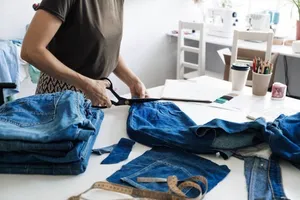
As much as textile processing is a major reason for environmental degradation, fast fashion is a significant contributor to it. Rapid production and quick turnover of consumer wardrobes is a booming industry, which also contributes to ~10% of global carbon emissions, generating approx. 92 million tons of hazardous waste that is released to landfills, and often relies on exploitative labour practices. India itself produces annually 800,000 kilotons of textile waste, which is yet to find its ultimate fate for a sustainable future. The endless loop of fast fashion, comprising overproduction, overconsumption, and disposability, is a key driver of environmental degradation. The tenets of Reduce, Reuse, and Recycle have now been revised with a new principle of ‘Repurpose’ to tackle the issue of environmental degradation caused by the textile industry. The Reduce, Reuse, Repurpose, and Recycle (4Rs) framework offers a systematic approach to advancing sustainability and circularity within the fashion sector. The reduce principle involves minimising raw material extraction and limiting overproduction by adopting slow fashion models, promoting durable designs, and optimising resource efficiency in manufacturing. Reuse aims to extend the functional lifespan of clothing through second-hand markets, garment rental services, and repair initiatives, thereby reducing the volume of discarded textiles. Repurpose, often linked with upcycling, entails the creative transformation of post-consumer and post-industrial textile waste into new products of equal or higher value, diverting materials from landfills and fostering innovation in design. Finally, recycling addresses end-of-life garments by converting textile waste into raw fibres through mechanical or chemical processes, allowing their reintegration into production cycles. While the textile industry is finding its way to green and clean processing by using natural alternatives for harmful chemicals and substituting novel materials for synthetic fibres, mostly working on the principles of recycling. The fashion industry, however, finds more relevance in repurposing, where pre-used products can be upcycled or modified for newer uses. Textile upcycling is the creative reuse and transformation of post-consumer garments, pre-consumer waste, and surplus fabrics into new products of equal or greater value without breaking down the material into its raw state. The process of textile upcycling is economical, as it utilises existing materials rather than requiring new resources. This not only reduces costs but also minimises waste. Additionally, upcycling preserves traditional crafts by integrating age-old techniques and skills into modern fashion, thereby maintaining cultural heritage. Furthermore, it empowers artisans by providing them with opportunities to showcase their creativity and craftsmanship, leading to greater social value and community engagement. Through upcycling, not only do we address environmental issues, but we also support the livelihoods of those involved in the craft. In contemporary fashion, upcycling is evident in both small-scale artisanal practices—such as patchwork clothing, repurposed saris, or denim reconstruction—and industrial-scale initiatives, where brands redesign factory offcuts or unsold stock into new collections. Beyond apparel, upcycled textiles are increasingly used in accessories, home furnishings, and technical applications, reflecting their versatility.
Success Stories of Textile Upcycling
Tonlé (Cambodia) operates with a zero-waste philosophy by sourcing garment factory offcuts and redesigning them into stylish ready-to-wear collections. Patagonia’s Worn Wear initiative in the United States has worked in the direction of extending product life cycles through repair, resale, and the ReCrafted Collection, which upcycles damaged garments into unique new items. Similarly, in Estonia, Reet Aus has developed the UpMade certification, which systematically integrates upcycling into industrial-scale garment production. By redesigning post-production textile waste, the process achieves significant environmental savings—reducing carbon emissions, energy consumption, and water use per garment—while proving the feasibility of upcycling in large-scale manufacturing contexts.
Textile Upcycling Initiatives in India
Doodlage (Delhi) has pioneered the integration of textile waste into mainstream fashion by converting factory discards, defective fabrics, and production scraps into contemporary garments, bags, and lifestyle products using patchwork. Their designs not only highlight waste minimisation but also create a distinctive aesthetic identity. Another notable example is Ka-Sha (Pune) and its “Heart to Haat” initiative, which creatively reconfigures leftover fabrics and post-consumer garments into patchwork clothing, accessories, and home goods. By blending traditional Indian craft practices with sustainable design, Ka-Sha reinforces the cultural dimension of upcycling. I Was a Sari (Mumbai) repurposes discarded saris into modern apparel and accessories while simultaneously empowering underprivileged women through skill development and livelihood generation. This model highlights how upcycling can intersect with community upliftment and gender inclusivity. Bunko Junko, Artisanns Nest, Rothy’s, and Doh tak keh are a few more initiatives that have set the tone for textile upcycling and created awareness for a sustainable future. While global initiatives have been working on systematisation and bulk processing of the textile waste, Indian startups and ventures have been a vehicle of socio-economic empowerment. The upcycled textile products market in India is expanding due to increasing environmental consciousness, government support, and rising consumer awareness for eco-friendly products. According to Business Standard, the current market is expected to reach around USD 400 million in the coming years. The government programs, such as the MITRA scheme and the National Textile Policy, promote sustainable and integrated textile practices. Despite the conceptual differences in the global and Indian approaches towards textile upcycling, it is still the most viable alternative for tackling environmental degradation. Upcycling can be taken up in all the steps of textile processing, right from industrial waste to post-consumer waste, which eventually leads to a circular fashion economy. Reutilization of resources, extension of product life cycle, and an increase in value, along with preservation of craft, are a few of the extra benefits that come with textile upcycling in the fashion industry. Sustainability is not an isolated act, but rather a regular and conscious decision that requires consistent effort in everyday choices, production systems, and consumption patterns. Within the fashion industry, this decision manifests through strategies that minimise waste, reduce resource dependency, and encourage responsible use of textiles. Textile upcycling emerges as a practical and innovative tool to execute sustainability, without the need for energy-intensive recycling or the extraction of virgin resources. This approach represents textile upcycling as a driver of sustainability from an abstract principle into a concrete, visible practice that benefits both the environment and society.