Textile Shredding Equipment Market to Reach Nearly $1.9 Billion by 2032 as Recycling Demand Surges
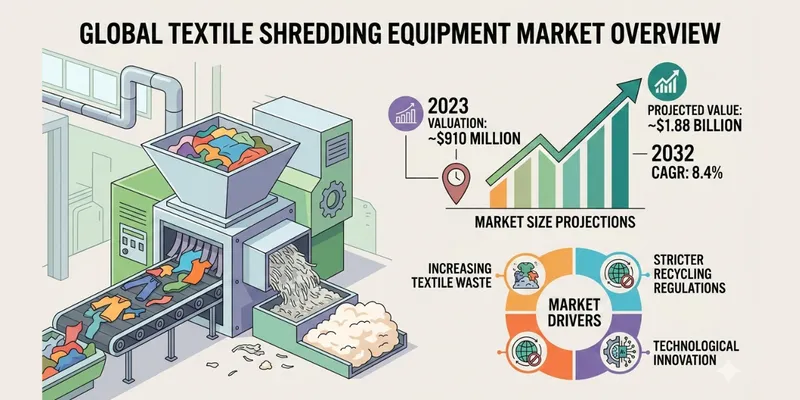
The global Textile Shredding Equipment market is expanding rapidly as governments and manufacturers accelerate textile recycling and waste reduction initiatives. According to industry estimates cited by Marketintelo, the market was valued at approximately $910 million in 2023 and is projected to reach nearly $1.88 billion by 2032, reflecting a compound annual growth rate (CAGR) of about 8.4% during the forecast period.
Globally, textile waste generation exceeds 92 million tons annually, and recycling rates remain below 15%. This massive gap is driving demand for high-capacity Textile Shredding Equipment used in pre-processing textile waste for fiber recovery, insulation material, and industrial fillers.
Governments, especially in Europe and Asia-Pacific, are implementing stricter landfill restrictions and circular economy policies, significantly boosting the installation of shredding systems in recycling facilities.
In 2024 alone, global textile recycling investments surpassed $4.2 billion, up 19% from 2022 levels. This capital influx is translating into new facilities requiring advanced Textile Shredding Equipment, particularly high-torque industrial shredders capable of processing mixed fabrics, polyester blends, and post-consumer garments.
Key Numerical Highlights Driving the Textile Shredding Equipment Market
• Global market value reached about $910 million in 2023 and is projected to exceed $1.88 billion by 2032.
• CAGR estimated at approximately 8.4% between 2024 and 2032.
• Textile waste generation globally surpassed 92 million tons in 2023. • Only 13–15% of textile waste is currently recycled worldwide.
• Europe processed roughly 6.95 million tons of textile waste in 2023. • Asia-Pacific accounts for nearly 38% of global Textile Shredding Equipment demand. • Automated shredding systems adoption increased by 27% between 2020 and 2024.
• Industrial shredders capable of processing over 3 tons per hour represent nearly 42% of equipment sales.
Historical Market Growth: 2016–2024
The Textile Shredding Equipment industry has grown steadily over the past decade due to increasing textile waste volumes and stricter waste management regulations.
Between 2016 and 2019, the global market expanded from approximately $520 million to $640 million, representing an average annual growth rate of around 7.1%. During this period, most installations occurred in Europe and North America where recycling mandates were tightening.
The pandemic caused a temporary slowdown in 2020, reducing equipment installations by nearly 6%. However, recovery was rapid.
By 2021 the market rebounded to $760 million, followed by $840 million in 2022 and $910 million in 2023. Increased textile waste from fast fashion, which rose by nearly 18% globally between 2018 and 2023, significantly contributed to the demand for Textile Shredding Equipment.
Year-wise Market Evolution
Text-based data summary:
Year | Market Size (USD Million) | Growth Rate |
2019 | 640 | 7.0% |
2020 | 602 | -5.9% |
2021 | 760 | 26.2% recovery surge |
2022 | 840 | 10.5% |
2023 | 910 | 8.3% |
2024 | 985 | 8.2% |
2025 | 1,070 | 8.6% |
This consistent expansion reflects increased global emphasis on textile recycling infrastructure.
Regional Market Breakdown
Asia-Pacific
Asia-Pacific dominates the Textile Shredding Equipment market with around 38% share in 2023. The regional market reached nearly $345 million.
China alone generated over 26 million tons of textile waste annually, while India produces approximately 7.8 million tons. Government initiatives promoting circular textile manufacturing are driving equipment adoption.
Between 2019 and 2024, Asia-Pacific installations of industrial textile shredders increased by nearly 34%. The region is projected to grow at a CAGR of around 9.2% through 2032.
Europe
Europe accounted for roughly 30% of global Textile Shredding Equipment demand in 2023, with a market value near $273 million.
The European Union’s circular textile strategy requires mandatory textile waste collection by 2025. This regulation alone is expected to increase shredding equipment installations by nearly 40% across recycling facilities.
Germany, France, and Italy collectively processed about 4.2 million tons of textile waste in 2023.
North America
North America represented approximately 22% of the market, worth about $200 million in 2023.
The United States generates over 17 million tons of textile waste annually, but recycling rates remain around 15%. As a result, recycling infrastructure investments exceeded $1.3 billion between 2021 and 2024.
Demand for automated Textile Shredding Equipment in the region has grown about 21% since 2020.
Rest of the World
Latin America and the Middle East & Africa collectively hold nearly 10% of the global market, valued around $92 million in 2023.
However, these regions are expected to record the fastest growth, with projected CAGR above 9.5% through 2032 due to emerging recycling policies and increasing industrial waste management initiatives.
Technology Trends in Textile Shredding Equipment
Technological innovation is reshaping the Textile Shredding Equipment market. Modern shredders incorporate advanced cutting systems, automated feed mechanisms, and AI driven load monitoring.
Single-shaft shredders currently represent about 46% of global installations due to their efficiency in processing mixed textiles. Dual-shaft systems account for roughly 34%, mainly used in high-volume recycling plants.
Key technological developments include:
• Smart shredding systems improving processing efficiency by up to 28%. • Energy-efficient motors reducing power consumption by nearly 17%. • Automated sorting and shredding integration boosting processing speed by 35%.
• IoT-enabled monitoring systems lowering maintenance downtime by approximately 22%.
Industrial-scale shredders capable of processing more than 2.5 tons of textiles per hour are becoming standard in large recycling facilities.
Industrial Demand and End-Use Applications
The Textile Shredding Equipment market is primarily driven by three key industries: textile recycling, waste management, and automotive insulation manufacturing.
Textile recycling plants accounted for nearly 55% of equipment demand in 2023. Waste management companies represented about 27%, while industrial fiber reuse industries held approximately 18%.
Shredded textile fibers are increasingly used for:
• Automotive insulation materials (market size around $1.6 billion globally) • Carpet underlay production (annual demand exceeding 3.1 million tons) • Construction insulation materials (growing at roughly 7.9% annually) • Industrial wiping cloth production
These downstream applications are expected to significantly expand demand for Textile Shredding Equipment over the next decade.
Government Policies and Investments
Government regulations and sustainability commitments are major drivers of the Textile Shredding Equipment market.
The European Union allocated nearly $1.2 billion between 2021 and 2025 for textile recycling infrastructure development.
In the United States, state-level recycling programs collectively invested over $420 million in textile recovery facilities between 2022 and 2024.
India launched textile waste management initiatives with funding exceeding $280 million to improve recycling capacity and reduce landfill dependency.
These investments are expected to increase global textile recycling capacity by nearly 45% by 2030.
Future Market Projections: 2025–2032
Industry forecasts indicate strong growth for the Textile Shredding Equipment market over the next decade.
Projected market trajectory:
Year | Market Size (USD Billion) |
2025 | 1.07 |
2026 | 1.16 |
2027 | 1.26 |
2028 | 1.37 |
2029 | 1.49 |
2030 | 1.62 |
2031 | 1.74 |
2032 | 1.88 |
Growth will be driven by increasing global textile waste volumes, which are projected to reach nearly 134 million tons annually by 2030.
Automated shredding technologies and large-scale recycling plants are expected to account for nearly 60% of new equipment installations by 2032.
Conclusion
The Textile Shredding Equipment market is entering a high-growth phase as the global textile industry shifts toward circular production models. Market size expanded from roughly $520 million in 2016 to about $910 million in 2023, and projections suggest it will approach $1.88 billion by 2032 at an annual growth rate near 8.4%.
Asia-Pacific leads with nearly 38% market share, while Europe’s regulatory framework is accelerating recycling infrastructure development. With global textile waste expected to
exceed 130 million tons annually by 2030, demand for efficient Textile Shredding Equipment will intensify.
Rising investments in recycling facilities, automation technologies, and sustainability initiatives will likely double market capacity within the next decade, positioning textile shredding systems as a critical component of the global circular economy.
Read A Full Report: https://marketintelo.com/report/textile-shredding-equipment-market