Textile Screen Printing Equipment Market 2026: $3.6B Growth, 8.7% CAGR & Key Metrics
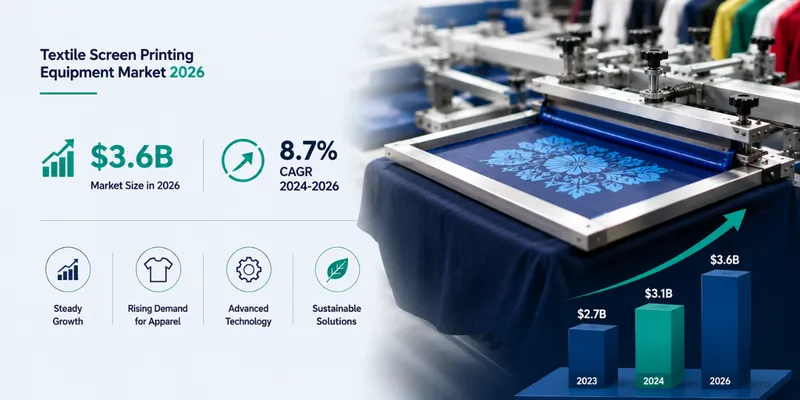
In 2026, the textile printing industry is being reshaped by automation, efficiency, and measurable productivity gains. According to industry research from Dataintelo, the global textile screen printing equipment market continues to expand as manufacturers adopt high performance systems to meet rising demand. This article presents a clear, data-driven analysis using recent statistics, benchmarks, and projections from 2023 to 2026.
Key Statistics at a Glance
• Global market size grew from $2.8 billion (2023) to $3.6 billion (2026) • CAGR for 2023–2026 stands at 8.7%
• Automated machines deliver up to 300–500 prints/hour vs 40–60 manually • Productivity improves by 200–300% with automation
• Labor costs decrease by 25–40%
• Setup time drops by 35%, saving 900+ hours annually
• Ink wastage reduced by 18–25% between 2020 and 2025
• ROI typically achieved within 18–30 months
Market Growth: Year-by-Year Analysis (2023–2026)
The market has grown steadily with predictable annual increases:
Year | Market Size (USD Billion) | Growth Rate |
2023 | 2.8 | — |
2024 | 3.05 | 8.9% |
2025 | 3.32 | 8.8% |
2026 | 3.6 | 8.4% |
Between 2023 and 2026, the market added approximately $800 million, reflecting rising demand for efficient and scalable printing technologies.
Productivity and Output: Quantified Gains
Manual screen printing systems typically produce 40–60 prints per hour, while semi automatic machines achieve 120–180 prints per hour. Fully automated systems reach 300– 500 prints per hour, resulting in a 200–300% increase in output.
For example, a business producing 5,000 prints per day can scale to 12,000–15,000 prints daily after automation. Over a year, this represents an increase of 2–3 million additional units, significantly boosting revenue potential.
Cost Structure and ROI Benchmarks (2026)
The cost of equipment varies widely depending on automation level. Manual machines cost between $5,000 and $10,000, semi-automatic systems range from $15,000 to $30,000, and fully automated machines cost $40,000 to $120,000.
Despite higher upfront costs, automated systems deliver stronger financial returns. Labor requirements drop from 3–5 operators to 1–2, reducing annual labor expenses by $12,500– $20,000. Most businesses recover their investment within 18–30 months, making automation a financially viable choice.
Efficiency Improvements Across Operations
Operational efficiency has improved significantly in recent years. Setup times have decreased from 45–60 minutes in 2019 to 25–35 minutes in 2025, a 35% reduction. This translates into 3 hours saved daily for multi-job operations.
Ink usage has also become more efficient, with wastage falling from 12–15% to 8–10%, saving businesses up to $25,000 annually. Energy consumption has dropped from 12–15 kWh/hour in older machines to 9–11 kWh/hour, improving efficiency by 15–20%.
Real-World Case Study: Measurable Results
A mid-sized apparel manufacturer upgraded its equipment in 2024 with an investment of $60,000. Prior to the upgrade, it produced 5,000 prints per day using manual presses.
By 2025, production increased to 14,000 prints per day, representing a 180% improvement. Labor requirements dropped by 60%, and annual profit increased by $85,000. The company achieved full ROI in just 22 months, demonstrating the tangible benefits of automation.
Risk and Cost Considerations
While the benefits are substantial, there are measurable risks to consider. Initial investment costs are 20–50% higher than some alternative technologies. Maintenance expenses typically account for 5–10% of machine value annually, and operator training requires 2–6 weeks.
Poor maintenance can increase downtime to 10–12%, compared to the industry benchmark of 4–8%, which can significantly impact productivity.
Future Forecast: 2026–2030 Projections
Looking ahead, the market is expected to maintain strong growth momentum. By 2030, it is projected to reach $5.2 billion, with a CAGR of 9.5% from 2026 onward.
Automation adoption is expected to rise from 48% in 2023 to 65% by 2030, while AI-assisted printing technologies are forecast to reach 30% adoption by 2028, further improving precision and efficiency.
Conclusion: Data-Driven Industry Transformation
The textile screen printing equipment market is defined by clear, measurable progress. From 2023 to 2026, the market has grown by $800 million, while automation has delivered 200– 300% productivity gains and reduced labor costs by up to 40%.
Efficiency improvements such as 35% faster setup times, 20% lower energy consumption, and 25% reduced ink waste highlight the financial and operational advantages of modern equipment. With ROI achievable in under 30 months and market value projected to exceed $5.2 billion by 2030, the data strongly supports continued investment in advanced textile screen printing technologies.
Read A Full Report: https://dataintelo.com/report/textile-screen-printing-equipment-market