Textile Recycling Market Projected to Reach $11.88 Billion by 2030
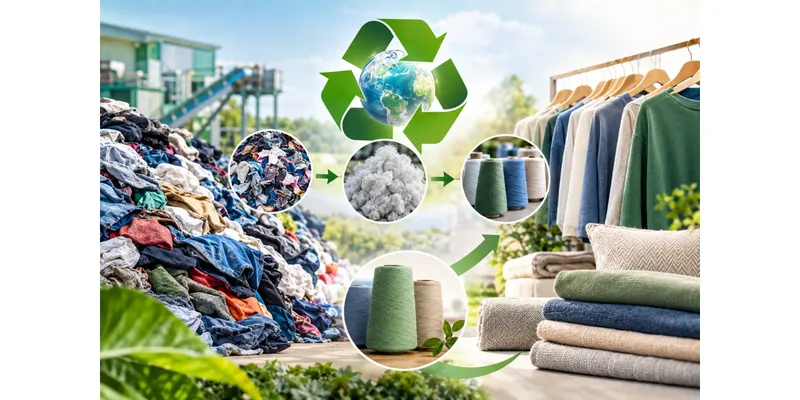
Global market expected to grow from $8.41 billion in 2025 to $11.88 billion by 2030 at a 7.2% CAGR
The global textile recycling market is projected to grow from USD 8.41 billion in 2025 to USD 11.88 billion by 2030, registering a compound annual growth rate (CAGR) of 7.2% during 2026–2030, according to a market report covering materials, textile waste, recycling processes, distribution channels, end-use industries and regions.
The report, titled Textile Recycling Market by Material (Cotton, Polyester & Polyester Fibers, Wool, Nylon & Nylon Fibers), Textile Waste, Process, Distribution Channel, End-Use (Apparel, Home Furnishing, Industrial & Institutional), and Region – Global Forecast to 2030, examines the development of textile recycling across major markets.
Textile Recycling Applications
Textile recycling involves recovering fibres, yarns or fabrics from used clothing, manufacturing waste and other textile materials and processing them into new products or raw materials.
Depending on the fibre composition and waste stream, recycling can involve mechanical shredding, chemical processing or heat-based processes.
The report identifies textile recycling as an approach to reducing textile waste sent to landfills, conserving resources and supporting circularity across the fashion and textile industries. Recycled textile materials can be used in products including new apparel, insulation and upholstery.
Asia Pacific Expected to Record Highest Growth
The Asia Pacific textile recycling market is projected to register the highest CAGR during the forecast period.
The region's position as a major textile manufacturing hub, increasing environmental awareness and availability of labour and raw materials are identified among the factors supporting market growth.
China, Bangladesh, India and Vietnam are major textile and garment production centres in the region and generate significant volumes of pre-consumer textile waste, including cutting scraps and defective fabrics. These waste streams can be processed through recycling systems to recover materials for further use.
Recent Industry Developments
The report also highlights several developments in textile and fibre recycling:
Lenzing and Diane von Fürstenberg Collaboration – June 2024
Lenzing AG and Diane von Fürstenberg collaborated to incorporate TENCEL Lyocell and LENZING ECOVERO fibres, produced from sustainably sourced wood, into DVF's fashion collections. The collaboration targeted at least 50% reductions in carbon emissions and water usage.
Birla Cellulose and Renewcell – July 2023
Birla Cellulose partnered with Renewcell to expand its circular fibre offering, Liva Reviva. The collaboration aimed to scale textile recycling production to 100,000 tonnes per year by 2024 and expand the company's presence in the Swedish market.
Lenzing Lyocell Plant in Thailand – March 2022
Lenzing AG established a Lyocell production facility in Thailand with an annual capacity of 100,000 tonnes, involving an investment of approximately USD 414.34 million.
The company also targeted a 50% reduction in carbon dioxide emissions per tonne of product by 2030 and climate neutrality by 2050.
The market outlook reflects increasing investment in textile recycling technologies and the growing focus on recovering textile waste as a source of secondary raw materials across apparel, home furnishing and industrial applications.