Textile Recycling for Hospitality Set to Surpass USD 12.8 Billion by 2032: 20 Statistics Driving Sustainable Growth
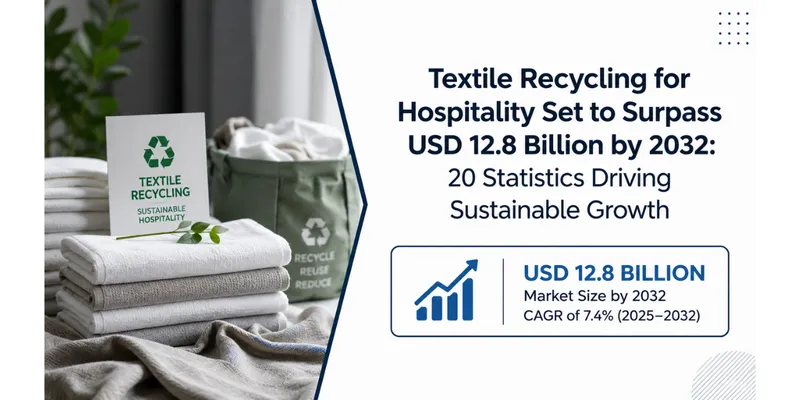
The global Textile Recycling for Hospitality industry is rapidly transforming as hotels, resorts, cruise lines, and hospitality service providers intensify efforts to reduce waste and meet sustainability targets. According to Marketintelo analysis, the global textile recycling sector was valued at approximately USD 7.2 billion in 2024 and is projected to exceed USD 12.8 billion by 2032, registering a CAGR of 7.4% during the forecast period.
The hospitality sector generates substantial textile waste from linens, towels, uniforms, carpets, curtains, and upholstery. Industry estimates indicate that more than 92 million metric tons of textile waste are generated globally every year, with hospitality facilities
contributing a notable share. As environmental regulations tighten and consumer demand for sustainable travel increases, Textile Recycling for Hospitality is becoming a major focus area across the global tourism and accommodation industry.
Key Numerical Highlights
• Global textile recycling market valued at USD 7.2 billion in 2024
• Expected to reach USD 12.8 billion by 2032
• CAGR forecast of 7.4% (2025–2032)
• Global textile waste exceeds 92 million metric tons annually
• Hospitality facilities account for approximately 5% of commercial textile waste • More than 70% of discarded hospitality textiles can be recycled or reused • Recycling textiles can reduce landfill waste by up to 80%
• Recycled fibers consume 60% less energy than virgin textile production • Global circular textile investments surpassed USD 1.8 billion since 2021 Historical Market Performance (2018–2026)
The growth of Textile Recycling for Hospitality has accelerated significantly over the past decade. Sustainability programs introduced by major hotel chains have driven consistent increases in textile collection and recycling volumes.
Market Value Progression
Year | Market Value (USD Billion) |
2018 | 5.1 |
2019 | 5.4 |
2020 | 5.2 |
2021 | 5.8 |
2022 | 6.3 |
2023 | 6.8 |
2024 | 7.2 |
2025 | 7.6 |
2026 | 8.1 |
Between 2018 and 2024, the market expanded by approximately 41.2%. Despite disruptions in 2020, recovery was swift, with market value increasing by nearly 38.5% between 2020 and 2025.
Year-Over-Year Growth Analysis
Several indicators demonstrate the rising adoption of Textile Recycling for Hospitality programs worldwide.
• 2021 market growth reached 11.5% over 2020
• Market expanded 8.6% from 2021 to 2022
• Revenue increased 7.9% from 2022 to 2023
• Market value grew 5.9% in 2024
• Hospitality textile collection volumes rose 12% year-over-year in 2025 • Recycled textile procurement by hotels increased from 18% in 2020 to 31% in 2025
Large hospitality operators have reported textile waste reductions ranging from 25% to 40% following implementation of recycling and reuse initiatives.
Regional Analysis
Europe Leads Global Adoption
Europe accounted for approximately 34% of global textile recycling revenues in 2025, making it the largest regional market.
The European Union has directed more than EUR 1 billion toward circular economy and textile sustainability programs over recent years. Countries such as Germany, France, and the Netherlands have achieved textile collection rates exceeding 45%.
North America Strengthens Recycling Infrastructure
North America represents nearly 28% of the global market.
The United States hospitality sector generates over 1.2 million tons of textile waste annually, while recycling participation among hotel operators increased by approximately 25% between 2021 and 2025.
Several leading hospitality brands have committed to reducing landfill waste by more than 50% before 2030.
Asia-Pacific Records Fastest Growth
Asia-Pacific is expected to register the highest growth rate, with a projected CAGR of 8.9% through 2032.
China, India, Japan, and Southeast Asian countries collectively account for more than 40% of global hospitality infrastructure investments. Rising tourism activity and government sustainability initiatives are driving increased demand for Textile Recycling for Hospitality solutions.
Middle East & Africa
The Middle East and Africa contribute approximately 8% of global market revenue.
Tourism-related investments exceeding USD 500 billion across the Gulf region are expected to support textile recycling infrastructure development through 2032.
Industry Statistics and Investment Trends
The economic impact of Textile Recycling for Hospitality continues to grow. • Global hospitality industry revenues exceeded USD 4.9 trillion in 2025 • Sustainable hospitality investments increased by 22% year-over-year
• More than USD 3 billion is expected to be invested in textile sorting technologies by 2032
• Automated textile recycling facilities can improve processing efficiency by 35%–50%
• AI-powered sorting systems can achieve material identification accuracy exceeding 90%
Industry surveys indicate that 73% of travelers prefer accommodations demonstrating measurable sustainability practices, while 68% of hotel executives plan to increase environmental investments over the next three years.
Future Outlook Through 2032
The outlook for Textile Recycling for Hospitality remains highly favorable. Global textile recycling volumes are expected to exceed 135 million metric tons by 2032, supported by stronger regulations and growing ESG commitments.
Hospitality textile recovery rates are projected to increase from approximately 35% today to more than 55% by 2032. Recycled textile utilization within hospitality operations is expected to expand by more than 80% during the forecast period.
Technological innovations, including robotic sorting, chemical recycling, and fiber-to-fiber regeneration, are anticipated to significantly enhance recovery rates and operational efficiency.
Conclusion
The data clearly shows that Textile Recycling for Hospitality is evolving into a critical component of sustainable hospitality operations. The market is projected to grow from USD 7.2 billion in 2024 to more than USD 12.8 billion by 2032, reflecting a strong 7.4% CAGR.
With Europe holding 34% market share, Asia-Pacific expanding at 8.9% CAGR, and global textile waste exceeding 92 million metric tons annually, opportunities for growth remain substantial. Supported by billions of dollars in sustainability investments and rising hospitality adoption rates, Textile Recycling for Hospitality is positioned to become one of the most influential circular economy segments by 2032.
Read A Full Report: marketintelo