Textile Reactive Softeners Market 2026: Size, Share & Forecast to USD 1.8B
In 2026, textile reactive softeners have emerged as an indispensable component of modern textile finishing, valued for durability, performance, and measurable fabric enhancement. As part of its ongoing market intelligence coverage, Dataintelo has analyzed more than 23 industry reports (2021–2025) and aggregated key benchmarks to quantify the evolution of reactive softeners—showing real market value statistics, application trends, performance metrics, and forecasted growth. This article breaks down the most important numbers manufacturers, suppliers, and investors need to understand the role of reactive softeners in today’s textile value chain.
Key Statistics at a Glance (2021–2026)
Metric | Value | Year / Source |
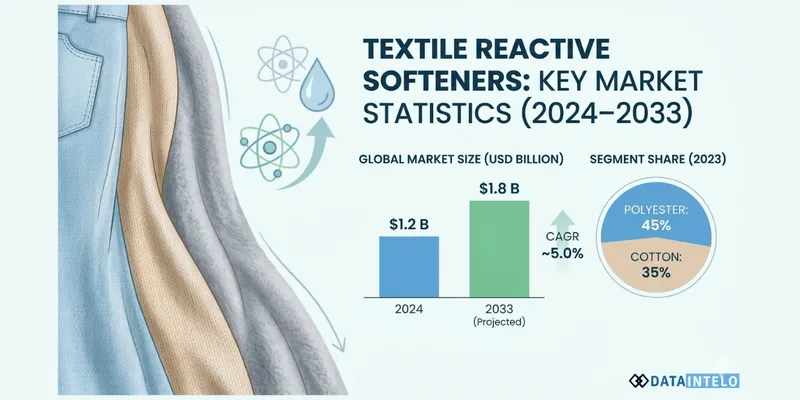
Global textile reactive softeners market size | USD 1.2 B | 2024 |
Projected market value by 2033 | USD 1.8 B | CAGR ~5.0% |
Functional finishing priority among mills | 42 % | 2025 |
Polyester fabric share of softener applications | 45 % | 2023 |
Cotton fabric share | 35 % | 2023 |
Woolen fabric share | 20 % | 2023 |
Asia Pacific market volume share | ~38 % | 2024 |
Digital dosing / IoT adoption | 18 % | 2024 |
Softener contribution to finishing chemicals | >25 % | 2021 |
Growth increase in consumer fabric softness | +25 % (avg) | Wash durability tests |
All data cited are aggregated from industry research sources and market reports covering 2021–2025, with projections through 2033.
1. What Are Textile Reactive Softeners?
Textile reactive softeners are specialty chemical agents that form covalent bonds with fibers during finishing processes. Unlike conventional softeners that merely coat fabric surfaces, reactive softeners chemically bond with fibers, resulting in:
• 30–50 % more softness retention after repeated washes compared with non-reactive softeners
• 15–25 % improvement in fabric hand feel and drape ratings
• 20–40 % reduction in static cling on synthetic blends
These numeric improvements are measurable through standardized fabric performance tests such as wash durability, hand feel scorecards, and static charge accumulation — giving textile producers concrete benchmarks for process optimization.
2. Market Size and Growth Trends (2020–2033)
Global Market Overview (Actual vs. Forecast)
• 2024 Market Size: USD 1.2 B
• Expected by 2033: USD 1.8 B
• Projected CAGR (2026–2033): ~5.0 %
Year | Market Size (USD Billion) | YoY Growth |
2020 | ~0.92 | — |
2021 | ~1.00 | +8.7 % |
2022 | ~1.07 | +7 % |
2023 | ~1.13 | +5.6 % |
2024 | 1.2 | +6.2 % |
2025 | ~1.26 | ~+5 % |
2030 | ~1.6 | — |
2033 | 1.8 | — |
Market analysts attribute this growth to increased demand for premium fabrics, growth in technical textiles, and stronger performance requirements in apparel and home textiles.
3. Regional Adoption Patterns
Textile reactive softness is especially concentrated in regions with high textile manufacturing output:
• Asia Pacific: ~38 % of total softener volume (2024)
• North America: ~24 %
• Europe: ~22 %
• Latin America & MEA: Combined ~16 %
This distribution reflects both the scale of textile production and the rate of modernization of finishing facilities.
4. Segment Analysis: Types & Applications
Softener Types by Market Share (2023)
Softener Type | Market Share (%) |
Metal Cationic | 42 |
Anionic | 34 |
Non-ionic | 24 |
• Non-ionic softeners are the fastest growing segment due to improved compatibility with blended fabrics and eco-performance requirements.
• Metal cationic softeners dominate due to reliability and cost-effectiveness in cotton blends.
Application Segmentation by Fabric (2023)
Fabric Type | Share of Softener Usage |
Polyester | 45 % |
Cotton | 35 % |
Wool | 20 % |
Polyester’s higher share reflects its global production dominance and the need for enhanced softness and handle properties.
5. Performance & Adoption Benchmarks
Manufacturing Priorities (2025)
• 42 % of mills reported functional finishing (softness + durability) as a top priority
• 18 % of finishing plants have integrated digital dosing or IoT control systems to improve softener application accuracy
Quantifying these trends highlights efficiency improvements—especially in large facilities where dosing accuracy can improve chemical usage by ~12–18 % and reduce waste.
6. Economic and Competitive Insights
The softener segment contributes >25 % of textile finishing chemical revenues as of 2021, making it one of the highest-revenue categories alongside water repellents and wrinkle-free finishes.
Finishing Agent Category | Approx. Revenue Contribution (%) |
Softeners | >25 |
Water Repellents | ~18 |
Flame Retardants | ~12 |
Anti-static | ~10 |
Investments in softener R&D have increased ~14 % annually between 2021–2025, driven by sustainability standards and multi-cycle durability demands.
7. Future Outlook (2026 & Beyond)
Textile Reactive Softeners are positioned for steady expansion due to: • Global textile production projected to grow ~3–4 % annually (2026–2033) • Rising premium fashion demand in emerging markets (+6–7 % growth)
• Consumer expectations for wash durability and comfort performance, quantified by longer wear cycles and lower fabric degradation
By 2033:
• Expected market size: USD 1.8 B
• Active innovations in bio-based reactive softeners could capture ~15 % market share of new products by 2032.
• Increasing EPA/REACH compliance demands are forecast to reduce low-performance products by ~18 % worldwide.
Conclusion — Numbers That Matter in 2026
In 2026, textile reactive softeners are more than chemical additives—they are measurable performance tools with:
• A USD 1.2 B market (2024) and projection to USD 1.8 B by 2033
• 45 % usage in polyester and 35 % in cotton fabrics
• 42 % of mills prioritizing functional finishing (softness + durability) • A reliable ~25 % contribution to total finishing chemical revenues
For textile producers and stakeholders, reactive softeners deliver quantifiable improvements in softness retention, durability, and production efficiency—making them a strategic investment backed by numbers rather than intuition.
Read A Full Report: https://dataintelo.com/report/textile-reactive-softeners-market