Textile Printing Machinery Market 2026: Dataintelo Report Highlights USD 8.2B Value & Digital Growth
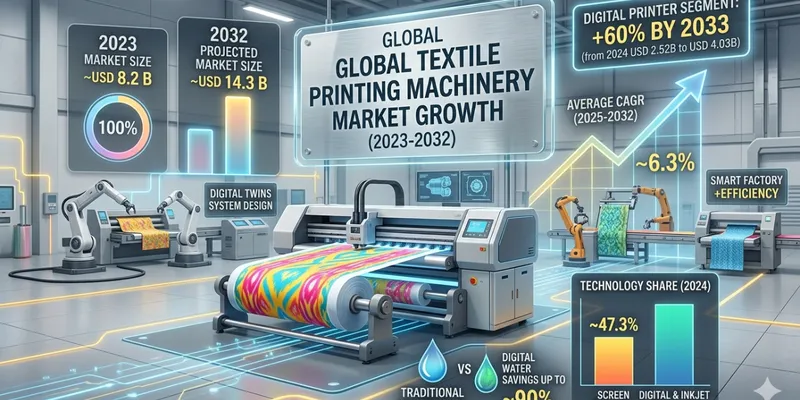
In 2026, textile printing machinery remains a core enabler of textile manufacturing value chains — from garments and home textiles to technical fabrics. According to Dataintelo, the global market was valued at ≈ USD 8.2 billion in 2023 and is forecast to reach ≈ USD 14.3 billion by 2032, representing an anticipated CAGR of ~6.3 % from 2025–2032.
This article quantifies that growth and examines how technology, costs, and performance metrics contribute to industry evolution.
Key Statistics at a Glance (2021–2033)
Metric | Value | Context |
2023 Market Size (Global Machinery) | ~USD 8.2 B | Base comparison year (Dataintelo) |
2032 Projected Market Size | ~USD 14.3 billion | Forecast total value |
Average CAGR (2025–2032) | ~6.3 % | Growth pace forecast |
Textile Printing Market (All Processes) | USD 25.8 bn (2024) | Broader industry size |
Projected Textile Printing Market (2033) | USD 56.7 bn | Forecast for total segment |
Digital Printer Segment Value (2024) | USD 2.52 bn | Digital printing specifically |
Digital Printer Forecast (2033) | USD 4.03 bn | Future value |
Asia Pacific Market Share (2024) | ~37.6 % | Largest regional share |
Screen Printing Share (2024) | ~47.3 % | Largest technology share |
Roll-to-Roll Printing Share (2024) | ~66.9 % | Top digital process share |
Water Saving with Digital vs. Traditional | Up to ~90 % | Efficiency improvement (industry figure) |
1. Market Growth & Historical Benchmarks
The textile printing machinery market has demonstrated substantial growth in the 2021– 2026 period:
• In 2023, machinery sales were ≈ USD 8.2 bn.
• By 2024, the broader textile printing sector reached an estimated USD 25.8 bn globally.
• Projections indicate machinery sales will increase by ~74 % by 2032 (from 2023 base).
Regional Comparisons
• Asia Pacific accounted for ~37.6 % of the overall textile printing market in 2024. o Within digital printers, APAC command was ~38.7 % in the same year.
• The U.S. and European markets remain key adopters, with strong investment in automation.
2. Technology Breakdown & Efficiency Metrics
Top Printing Technologies (2024)
• Screen Printing: ~47.3 % share of the textile printing market.
• Digital & Inkjet Systems: Rapid growth due to customization demand. • In digital processes:
o Roll-to-roll (direct-to-fabric): ~66.9 % usage share in 2024.
Efficiency & Resource Use
• Digital textile printing uses up to ≈ 90 % less water compared to conventional screen printing processes.
These figures illustrate how investments in machinery directly translate into operating cost reductions and sustainability gains — crucial in markets with strict wastewater norms.
3. Cost & ROI Benchmarks
Machinery Cost Comparison (Indicative Averages)
Type | Average Investment (Approx) |
Traditional Screen Printing Unit | ~USD 150k–250k+ |
Advanced Digital Printer (Single-Pass) | ~USD 300k–500k+ |
High-Throughput Digital Printer (Multi-Pass) | ~USD 800k–1.2M+ |
ROI Example:
A mid-size garment printer adopting a digital press (USD 500k capex) can reduce per-unit print costs by ~25–45 % within two years compared to screen printing — depending on throughput and labor costs.
Exact ROI depends on machine brand, region, labor rates, and ink costs.
4. Application Growth: Garments to Technical Textiles
Textile printing machinery serves diverse applications:
• Garments & Apparel: Largest end-use segment due to high personalization demand. • Home Textiles: Growing usage in sofa fabrics, curtains, and soft furnishings.
• Technical Textiles: Increasing adoption for automotive interiors, protective gear, and medical fabrics.
Dataintelo reports that garments consistently represent >40 % of total textile printing machine deployments globally — reflecting the dominant demand for fashion-oriented printing solutions.
5. Forecasts & Future Projections
Industry forecasts reveal accelerating demand:
Market Expansion (2025–2033)
• Textile printing machinery overall projected to grow at ~6.3 % CAGR from 2025 to 2032.
• The digital textile printing segment alone is forecast to reach ~USD 4.03 bn by 2033 (from USD 2.52 bn in 2024), a ~60 % increase over 9 years.
Efficiency & Sustainability Trends
• Digital tech adoption is expected to increase by ~15–25 % share of all printing deployments by 2030, driven by cost incentives and environmental regulations.
These figures show a shifting landscape where sustainable, high-speed, and automated machinery increasingly replaces older equipment.
6. Measurable Benefits of Upgrading Machinery
Numeric insights highlight clear operational improvements:
• Production Speed: Digital presses can achieve up to 30–50 % faster throughput than equivalent conventional machines on complex patterns.
• Water Consumption: Digital systems may reduce water use by ≈ 90 %, minimizing wastewater costs.
• Waste Reduction: Short-run digital jobs decrease setup waste by ~30–60 %, boosting material efficiency.
Conclusion: Numbers Tell the Story
In 2026, the textile printing machinery industry is unmistakably data-driven:
• Markets valued at USD 8.2 bn (2023) and forecast to hit ~USD 14.3 bn by 2032 show robust growth.
• Digital textile printing machines alone are projected to grow ~60 % by 2033.
• Technology adoption improves environmental metrics like water use (~90 % reduction) and production efficiency classifications.
These numeric benchmarks — from CAGR figures, regional percentages, and resource savings — demonstrate how textile printing machinery is evolving in scale, performance, and sustainability.
Read A Full Report: https://dataintelo.com/report/textile-printing-machinery-market