Textile Printing Ink Market to Cross USD 14.8 Billion by 2032 at 6.7% CAGR
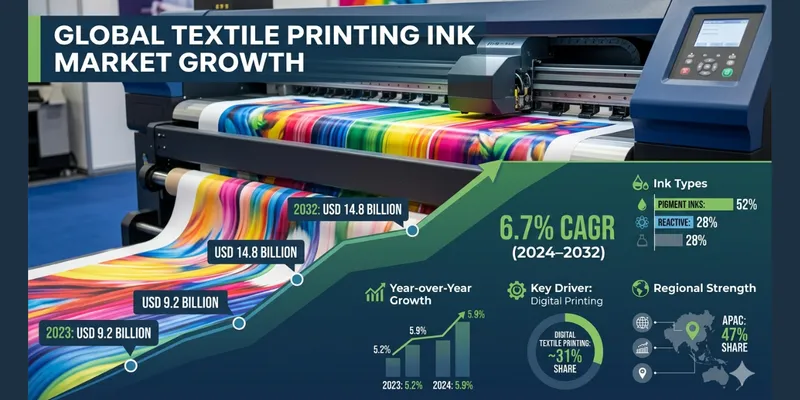
The global Textile Printing Ink market is witnessing steady expansion, driven by rapid growth in digital textile printing, sustainable ink technologies, and rising apparel demand. According to insights referenced by Marketintelo, the market was valued at approximately USD 9.2 billion in 2023 and is projected to reach USD 14.8 billion by 2032, growing at a CAGR of 6.7% between 2024 and 2032.
In 2024 alone, the market grew by 5.9% year-over-year, compared to 5.2% in 2023 and 4.8% in 2022, highlighting accelerating adoption of eco-friendly and digital printing inks.
Market Overview and Key Numerical Highlights
The Textile Printing Ink market has evolved significantly over the last decade, supported by advancements in pigment formulations and water-based inks.
Key statistics:
• Market size (2016): USD 6.1 billion
• Market size (2019): USD 7.4 billion
• Market size (2021): USD 8.3 billion
• Market size (2023): USD 9.2 billion
• Estimated 2025 value: USD 10.6 billion
• Forecast 2032 value: USD 14.8 billion
• Digital textile printing penetration: 18% in 2020 → 31% in 2025
• Share of water-based inks: 62% of total market in 2024
Between 2016 and 2023, the market expanded at an average annual growth rate of 5.8%, adding over USD 3.1 billion in value.
Year-over-Year Growth Analysis (2020–2025)
The Textile Printing Ink market demonstrates consistent annual growth with increasing momentum post-pandemic.
• 2020: USD 7.9 billion (growth: 3.5%)
• 2021: USD 8.3 billion (growth: 5.1%)
• 2022: USD 8.7 billion (growth: 4.8%)
• 2023: USD 9.2 billion (growth: 5.2%)
• 2024: USD 9.7 billion (growth: 5.9%)
• 2025 (est.): USD 10.6 billion (growth: 6.2%)
This progression reflects rising investments in textile automation and increasing global apparel exports, which grew by 7.4% in 2024.
Historical Trends and Industry Evolution (2015–2023)
Over the past decade, the Textile Printing Ink market has undergone major transformation: • Pigment inks grew from 38% market share in 2015 to 52% in 2024
• Reactive inks declined slightly from 34% to 28% due to environmental regulations • Sublimation inks increased from 12% to 17%, driven by polyester fabric demand
Global textile production increased from 92 million tons in 2015 to 109 million tons in 2023, directly influencing ink consumption volumes, which rose from 1.8 million tons to 2.6 million tons during the same period.
Market Segmentation Insights
By Ink Type (2024 Share)
• Pigment inks: 52%
• Reactive inks: 28%
• Acid inks: 8%
• Disperse/sublimation inks: 17%
• Others: 5%
By Printing Technology
• Screen printing: 54%
• Digital printing: 31%
• Others: 15%
Digital printing is expected to surpass 40% share by 2030, growing at a CAGR of 9.2%, significantly higher than traditional methods.
Regional Market Breakdown with Data
Asia-Pacific (APAC)
• Market size (2024): USD 4.6 billion
• Share: 47%
• CAGR (2024–2032): 7.4%
China and India contribute over 62% of APAC demand, supported by textile exports exceeding USD 320 billion annually.
North America
• Market size (2024): USD 1.9 billion
• Share: 19%
• Growth rate: 5.1% YoY
The U.S. accounts for 78% of regional demand, with digital textile printing adoption rising by 11% annually.
Europe
• Market size (2024): USD 1.7 billion
• Share: 17%
• CAGR: 5.5%
Germany, Italy, and Turkey collectively contribute 65% of Europe’s textile printing ink consumption.
Latin America
• Market size (2024): USD 0.8 billion
• Growth rate: 5.8%
Brazil dominates with 42% regional share.
Middle East & Africa
• Market size (2024): USD 0.7 billion
• CAGR: 6.3%
Growth is driven by textile manufacturing hubs in Turkey and Egypt.
Industry Investments and Production Data
• Global investments in textile digital printing technologies reached USD 1.4 billion in 2023, up 18% from 2022
• R&D spending by leading ink manufacturers accounts for 6–8% of annual revenue • Production capacity of textile inks increased by 9% globally in 2024
• Government textile sector incentives in Asia exceeded USD 12 billion between 2021– 2024
Sustainability investments are also rising, with eco-friendly ink production increasing by 22% year-over-year.
Key Market Drivers (Data-Backed)
• Rising demand for customized apparel: +14% annual growth in personalized clothing • Expansion of e-commerce fashion sales: USD 820 billion in 2024, +9.6% YoY • Adoption of sustainable inks: Water-based inks grew by 12% YoY
• Growth in polyester fabric usage: +6.3% annually, boosting sublimation inks
Market Challenges with Statistics
• Environmental compliance costs increased by 18% since 2020
• Volatility in raw material prices (pigments, solvents): +11% fluctuation in 2023 • Wastewater treatment costs in textile printing rose by 15% globally • Traditional screen printing decline: -2.1% annually
Table: Textile Printing Ink Market Summary (2019–2032)
Year | Market Size (USD Billion) | Growth Rate (%) |
2019 | 7.4 | 4.6% |
2020 | 7.9 | 3.5% |
2021 | 8.3 | 5.1% |
2022 | 8.7 | 4.8% |
2023 | 9.2 | 5.2% |
2024 | 9.7 | 5.9% |
2025 | 10.6 | 6.2% |
2030 | 13.5 | 6.8% (avg) |
2032 | 14.8 | 6.7% (avg) |
Competitive Landscape and Company Statistics
The Textile Printing Ink market is moderately consolidated, with top players accounting for 45–50% of global revenue.
• Top 5 companies revenue share: ~48%
• Average EBITDA margin: 14–18%
• Annual production volume (top players): >1 million tons combined
Leading manufacturers are expanding digital ink portfolios, with digital ink sales growing 2.3x faster than traditional inks.
Future Outlook and Forecast (2025–2032)
The Textile Printing Ink market is expected to experience robust growth driven by digital transformation and sustainability.
Forecast highlights:
• Market CAGR (2024–2032): 6.7%
• Digital ink segment CAGR: 9.2%
• Eco-friendly inks share: 62% → 74% by 2032
• Global consumption volume: 2.6 million tons (2023) → 3.9 million tons (2032)
Asia-Pacific will continue dominating, while North America and Europe will see increased adoption of high-value specialty inks.
Conclusion: Data-Driven Market Trajectory
The Textile Printing Ink market is on a clear upward trajectory, expanding from USD 9.2 billion in 2023 to USD 14.8 billion by 2032, backed by consistent 6.7% CAGR growth. Over the past decade, the market has added more than USD 8 billion in incremental value, reflecting strong industrial demand.
Year-over-year growth has strengthened from 3.5% in 2020 to over 6% in 2025, driven by digital printing adoption, sustainability trends, and rising textile production. With Asia-Pacific holding nearly 47% market share and digital inks expected to exceed 40% penetration by 2030, the industry is undergoing a structural shift.
Overall, increasing investments, technological innovation, and eco-friendly regulations will ensure sustained expansion of the Textile Printing Ink market through 2032 and beyond.
Read A Full Report: https://marketintelo.com/report/textile-printing-ink-market