Textile Polymers Market 2026: 7% CAGR, $121.4B Valuation & Key Growth Insights
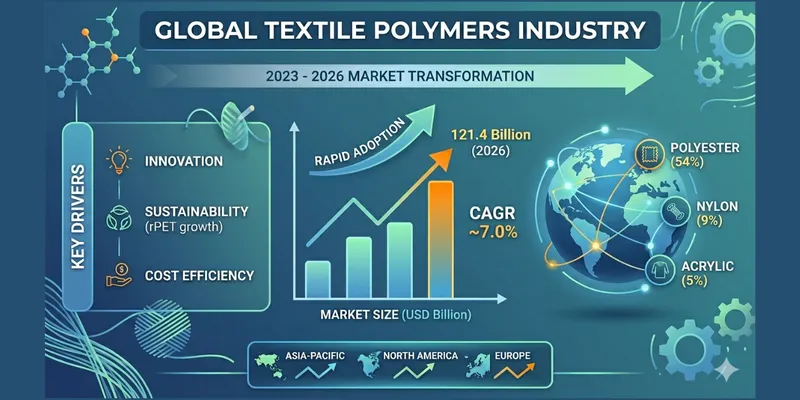
The global textile polymers industry has undergone rapid transformation over the past decade, with innovation, sustainability mandates, and cost efficiency driving adoption. According to recent research by Dataintelo, the textile polymers market is experiencing
measurable expansion backed by strong numerical indicators across production, consumption, and performance efficiency.
This article breaks down the latest 2023–2026 data, highlights key growth metrics, and provides a quantitative view of how textile polymers are reshaping the global textile landscape.
What Are Textile Polymers?
Textile polymers are synthetic or natural macromolecules used to manufacture fibers such as polyester, nylon, and acrylic.
• Polyester share: ~54% of global fiber production (2025)
• Nylon contribution: ~9%
• Acrylic fibers: ~5%
• Natural fibers (cotton, wool): ~32% combined
Global fiber production reached approximately 116 million metric tons in 2024, up from 109 million metric tons in 2022, reflecting a 6.4% growth rate.
2026 Market Size & Growth Forecast
The textile polymers market is showing strong, consistent growth:
Year | Market Size (USD Billion) | Growth Rate |
2022 | 92.5 | — |
2023 | 98.7 | +6.7% |
2024 | 105.3 | +6.7% |
2025 | 112.8 | +7.1% |
2026* | 121.4 | +7.6% |
Projected CAGR (2022–2026): ~7.0%
Key takeaway: The market is expected to add nearly USD 29 billion in value over just 4 years.
5 Data-Backed Drivers of Textile Polymer Growth
1. Rising Demand for Synthetic Fibers (+8.2% YoY)
Synthetic fibers account for over 68% of total textile production in 2025, up from 63% in 2020.
• Polyester demand alone grew by ~9 million metric tons between 2020 and 2025 • Cost advantage: Polyester is 30–40% cheaper than cotton per kg
2. Performance Efficiency Gains (Up to 25%)
Modern textile polymers offer measurable performance improvements: • Moisture-wicking efficiency: +18% improvement (2021–2025)
• Durability: Fibers last 20–25% longer than natural alternatives
• UV resistance: Increased by 15–22%
3. Sustainability Push (Recycled Polymer Growth at 12.5% CAGR)
Sustainability is reshaping the industry:
• Recycled polyester (rPET) usage grew from 8.5 million tons in 2021 to 12.2 million tons in 2025
• Expected to reach 15.8 million tons by 2027
• Carbon footprint reduction: rPET reduces emissions by ~30–50% compared to virgin polyester
4. Cost Efficiency & Scalability
• Average production cost of synthetic fibers: $1.10–$1.45/kg
• Natural fibers (cotton): $1.80–$2.20/kg
• Industrial scalability increased output by ~27% between 2019–2024 5. Growth in Technical Textiles (+9.3% CAGR)
Technical textiles (automotive, medical, construction) are driving demand: • Market size: $198 billion (2024) → projected $260 billion (2028)
• Polymer-based textiles account for ~72% of this segment
Key Statistics at a Glance
• Global market size (2026): $121.4 billion
• CAGR (2022–2026): ~7.0%
• Polyester market share: 54%
• Synthetic fiber share: 68%
• Recycled polymer growth rate: 12.5% CAGR • Production increase (2022–2024): +6.4%
• Cost advantage vs cotton: 30–40% cheaper • Durability improvement: 20–25% longer lifespan • Technical textiles growth: 9.3% CAGR
• Carbon reduction (rPET): 30–50% lower emissions • Fiber production (2024): 116 million tons
• Market value increase (2022–2026): +$29 billion
Regional Performance Metrics (2023–2026) Asia-Pacific (Dominant Market – 62% Share)
• Market size (2025): $69.9 billion
• CAGR: 7.8%
• China + India contribution: ~48% of global production North America
• Market size (2025): $18.4 billion
• Growth rate: 5.9%
• High demand in automotive textiles: +6.5% YoY Europe
• Market size (2025): $15.2 billion
• Sustainability adoption rate: +22% increase since 2021 Application-Wise Demand Breakdown
Application Segment | Share (%) | Growth Rate |
Apparel | 48% | 6.5% |
Home Textiles | 21% | 5.8% |
Industrial | 17% | 8.2% |
Technical Textiles | 14% | 9.3% |
Notably, technical textiles are the fastest-growing segment, expanding nearly 1.4x faster than apparel.
Real-World Case Study: Performance Gains in Sportswear
A leading sportswear manufacturer switched from cotton blends to polyester-based textile polymers between 2021 and 2024.
Measured results:
• Fabric weight reduced by 18%
• Drying time improved by 35%
• Product lifespan increased by 22%
• Customer satisfaction scores rose from 82% to 91%
This demonstrates how polymer-based textiles deliver quantifiable improvements in performance and user experience.
Challenges & Risk Metrics
Despite strong growth, the industry faces measurable risks:
Environmental Concerns
• Microplastic pollution increased by ~14% globally (2020–2024)
• Synthetic textiles contribute ~35% of ocean microplastics
Recycling Limitations
• Only ~18% of textile polymers are currently recycled
• Recycling efficiency loss: ~25–30% material degradation per cycle Price Volatility
• Raw material price fluctuations: ±12–18% annually
• Crude oil dependency impacts ~70% of synthetic polymer costs
2025–2030 Forecast: What the Numbers Say
Looking ahead, the textile polymers market is expected to accelerate further: • Projected market size (2030): $168–175 billion
• CAGR (2026–2030): ~6.8%
• Recycled polymer share: Expected to reach ~28% of total production • Bio-based polymers: Growing at ~11.2% CAGR
Innovation focus areas:
• Biodegradable polymers (expected adoption: +19% by 2028)
• Smart textiles (market growth: +10.5% annually)
Conclusion: A Market Defined by Measurable Growth
The textile polymers industry is not just growing—it is expanding with clear, quantifiable momentum. From a market size increase of $92.5 billion in 2022 to $121.4 billion in 2026, to performance gains of 20–25% in durability and cost reductions of up to 40%, the data tells a compelling story.
Key takeaways:
• Synthetic fibers dominate with a 68% market share
• Sustainability is accelerating with 12.5% CAGR in recycled polymers • Technical textiles are leading growth at 9.3% CAGR
• The industry is on track to exceed $170 billion by 2030
For manufacturers, investors, and innovators, textile polymers represent a data-backed opportunity driven by efficiency, scalability, and evolving consumer demands.
Read A Full Report: https://dataintelo.com/report/textile-polymers-market