Textile Industry Encouraged to Leverage PLI Scheme for Technical Textiles and MMF
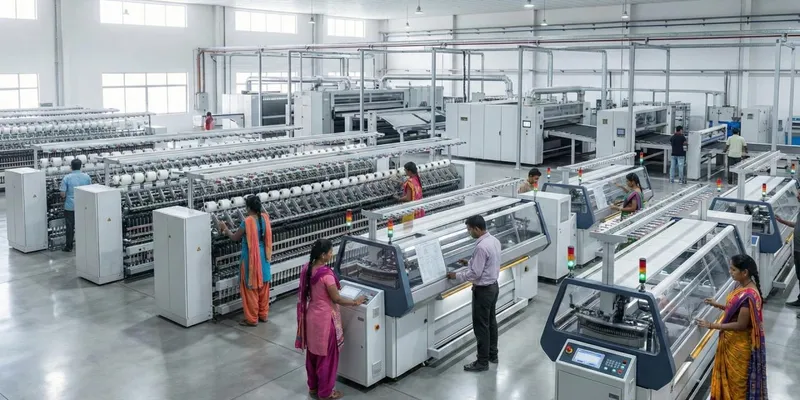
Union Textile Minister Giriraj Singh calls for higher investments, expansion of indigenous machinery and stronger textile exports during Tiruppur visit
The textile and apparel industry in Tamil Nadu should utilise the Production Linked Incentive (PLI) scheme for the technical textiles and manmade fibre (MMF) sector, for which the Union government has allocated ₹11,000 crore, Union Textile Minister Giriraj Singh said while addressing a meeting organised by the Tiruppur Exporters Association (TEA) in Tiruppur on Sunday.
Speaking at the event, the Minister said the Centre has relaxed the norms under the PLI scheme to encourage greater investment in the technical textiles and MMF segments.
“As for the new schemes planned by the Ministry, some have gone to the Cabinet, and others will follow - they are designed to be pro-industry. We have factored in everything - machinery, employment, and other aspects. I hope that the State and the Centre will work together,” he said.
The Minister also urged the industry to consider investments in States where labour is available.
Referring to silk production, he said that when Prime Minister Narendra Modi assumed office in 2014, annual silk production stood at 26,000 tonnes. It has now reached 43,000 tonnes, and is expected to increase to 60,000 tonnes by 2030. He added that India should export more silk-based garments blended with other fibres.
A. Sakthivel, chairman of the Apparel Export Promotion Council, said the Textile Ministry is introducing new initiatives every two months and that all the seven PM MITRA parks are now operational.
According to K.M. Subramanian, president of TEA, the government should consider early implementation of the Textile Expansion and Employment Scheme (TEEM) and extend benefits under the Rebate of State and Central Taxes and Levies for three more years.
Later, the Minister interacted with textile machinery manufacturers and met officials of the South India Textile Research Association (SITRA) in Coimbatore. Responding to the industry's request to extend the TEEM scheme to the spinning and cotton ginning machinery segment, he asked the industry to provide details so that the Ministry could study the proposal.
The Minister said the textile industry in Tamil Nadu should aim to triple exports and called for investments in indigenous machinery for the knitting, weaving and processing sectors.
During the visit, he also inaugurated a GM Testing Laboratory for cotton and cotton-derived materials at SITRA. The laboratory is intended to support traceability, quality assurance and compliance requirements in the global cotton trade. It will help exporters meet the requirements of organic standards such as GOTS and OCS, which mandate qualitative GM cotton screening. The laboratory has received NABL accreditation in its recent assessment.