Textile Dyes Market in 2025: Data-Driven Insights, Growth Statistics, and Future Opportunities
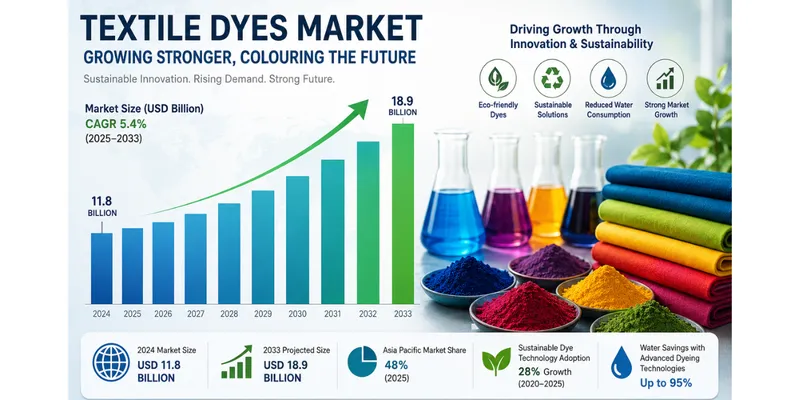
The global textile industry continues to evolve rapidly, and textile dyes remain a critical component of fabric manufacturing. According to Dataintelo, the textile dyes market was valued at approximately USD 11.8 billion in 2024 and is projected to reach USD 18.9 billion by 2033, expanding at a CAGR of 5.4% during the forecast period. The market's future growth is being driven by rising global textile production, increasing demand for technical and performance fabrics, expanding apparel consumption, and accelerating adoption of sustainable dyeing technologies.
By 2030, global textile fiber production is expected to surpass 145 million metric tons, creating substantial demand for advanced coloring solutions across apparel, home textiles, automotive textiles, and industrial applications.
In 2025, textile manufacturers are increasingly investing in low-water and eco-friendly dye technologies to improve efficiency, reduce environmental impact, and comply with stricter sustainability regulations. These trends are expected to generate significant growth opportunities for dye manufacturers over the next decade.
Key Statistics at a Glance
Metric | Value |
Global Textile Dyes Market Size (2024) | USD 11.8 Billion |
Expected Market Size (2033) | USD 18.9 Billion |
CAGR (2025–2033) | 5.4% |
Share of Reactive Dyes Segment | 32% |
Asia Pacific Market Share | 48% |
Textile Industry Water Usage in Dyeing | Up to 20% of Industrial Water Pollution |
Polyester Textile Share in Global Fiber Production | 57% |
Average Dye Fixation Rate (Reactive Dyes) | 70%–85% |
Sustainable Dye Technology Adoption Growth (2020–2025) | 28% |
Global Apparel Consumption Growth (2020–2025) | 18% |
5 Data-Backed Reasons Driving Textile Dyes Demand
1. Rising Global Textile Production
Global textile fiber production exceeded 124 million metric tons in 2024, compared to approximately 109 million metric tons in 2020, representing a growth of nearly 13.8%. Every additional ton of textile production directly increases demand for dyes and colorants.
The apparel sector alone accounts for more than 60% of textile dye consumption, making fashion trends a major market driver.
2. Growth of Polyester-Based Fabrics
Polyester remains the world's most widely used textile fiber, accounting for approximately 57% of total fiber production in 2024. Disperse dyes are heavily utilized for polyester fabrics, creating consistent demand across sportswear, home furnishings, and industrial textiles.
Between 2020 and 2025, global polyester production increased by nearly 15%, significantly boosting dye consumption volumes.
3. Expansion of Technical Textiles
Technical textiles used in automotive, healthcare, construction, and protective clothing applications are growing at an estimated 6.8% CAGR through 2030.
For example:
• Automotive textiles increased by 7.2% in production during 2024.
• Medical textile demand rose by approximately 9% between 2022 and 2024. • Protective workwear textile production expanded by 6.1% annually.
These segments require specialized dyes with enhanced durability and performance characteristics.
4. Increasing Urbanization and Fashion Consumption
Global apparel sales surpassed USD 1.8 trillion in 2024, up from approximately USD 1.5 trillion in 2020.
The average consumer now purchases 60% more garments than two decades ago while keeping them for nearly half as long, creating continuous demand for dyed fabrics and innovative color solutions.
5. Sustainable Dye Technologies Gaining Momentum
Environmental concerns are accelerating investment in eco-friendly dyeing technologies. Recent industry data shows:
• Waterless dyeing technologies can reduce water consumption by up to 95%.
• Advanced digital printing reduces dye waste by approximately 30%–50%.
• Low-liquor-ratio dyeing machines decrease water use by 40% compared with conventional systems.
• Adoption of sustainable dyeing technologies increased by nearly 28% between 2020 and 2025.
2025 Performance Metrics Across Dye Categories
Dye Type | Market Share |
Reactive Dyes | 32% |
Disperse Dyes | 24% |
Direct Dyes | 15% |
Vat Dyes | 11% |
Acid Dyes | 10% |
Others | 8% |
Reactive dyes dominate because they offer fixation rates between 70% and 85%, making them highly effective for cotton and cellulose-based textiles.
Asia Pacific Leads with 48% Market Share
Asia Pacific remains the largest textile dyes market, accounting for nearly 48% of global consumption in 2025.
Key production hubs include:
• China: Approximately 35% of global textile output
• India: Around 8% of global textile exports
• Bangladesh: More than USD 47 billion in garment exports annually • Vietnam: Textile export growth exceeding 10% year-over-year
Meanwhile, Europe is experiencing rising demand for environmentally compliant dyes due to stricter sustainability regulations.
Future Outlook: Market Forecast Through 2033
Industry forecasts indicate the textile dyes market could grow from USD 11.8 billion in 2024 to approximately USD 18.9 billion by 2033, reflecting a CAGR of 5.4%.
Key growth opportunities include:
1. Bio-based dye development
2. Digital textile printing expansion
3. Smart and functional textiles
4. Waterless dyeing systems
5. Recycled fiber coloration technologies
Manufacturers investing in sustainable production methods could reduce wastewater generation by up to 70%, while improving operational efficiency and regulatory compliance.
Conclusion
The textile dyes market is entering a phase of steady and measurable growth. With the industry projected to expand from USD 11.8 billion in 2024 to USD 18.9 billion by 2033, supported by a 5.4% CAGR, opportunities remain strong across apparel, technical textiles, and sustainable dyeing solutions. Factors such as 48% regional dominance by Asia Pacific, 95% water savings from advanced dyeing technologies, and 28% growth in sustainable dye adoption highlight the industry's transformation. As textile production continues to rise beyond 124 million metric tons, demand for innovative, efficient, and environmentally responsible textile dyes is expected to remain robust throughout the forecast period.
Read A Full Report: https://dataintelo.com/report/textile-dyes-market