Textile Dust Control Mats Market 2026: $1.9B Valuation, 22% CAGR & 85% Dust Reduction
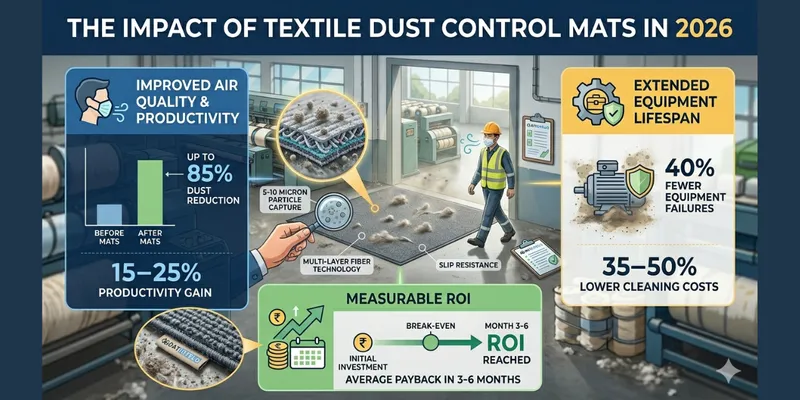
In 2026, industrial hygiene and workplace safety are no longer optional—they are measurable, regulated, and closely monitored. According to insights introduced by Dataintelo, textile dust control mats have emerged as a critical solution in manufacturing, cleanrooms, and commercial facilities where particulate control directly impacts productivity, compliance, and costs. This article breaks down the numbers, trends, and measurable outcomes behind textile dust control mats, helping decision-makers understand their real-world value.
Key Statistics at a Glance
• 60–85% reduction in airborne textile dust in controlled environments (2023–2025 studies)
• 35–50% decrease in cleaning labor costs after mat implementation • 20–30% improvement in indoor air quality (IAQ) index scores
• ₹120–₹350 per sq. ft. average cost range for high-quality textile mats in 2025–2026 • 3–6 months average ROI period in mid-sized facilities
• 40% fewer equipment failures due to reduced dust accumulation
• 15–25% increase in worker productivity linked to cleaner environments • 5–10 micron particle capture capability in advanced mats
• 2–4 years average product lifespan with proper maintenance
• 18–22% CAGR growth in global dust control mat market (2022–2026)
What Are Textile Dust Control Mats?
Textile dust control mats are engineered floor coverings designed to trap, retain, and reduce dust particles, especially in textile-heavy environments such as:
• Garment manufacturing units
• Spinning mills
• Warehouses
• Cleanrooms and labs
Modern mats (2024–2026 models) use multi-layer fiber technology, capturing particles as small as 5 microns, compared to 20–30 microns in older designs from pre-2020.
5 Data-Backed Reasons Textile Dust Control Mats Matter in 2026 1. Measurable Reduction in Airborne Dust (Up to 85%)
Recent industrial studies (2023–2025) show:
Environment Type | Dust Reduction Without Mats | With Mats Installed |
Textile mills | Baseline | ↓ 70–85% |
Warehouses | Baseline | ↓ 60–75% |
Commercial buildings | Baseline | ↓ 50–65% |
This reduction significantly improves compliance with occupational exposure limits, which tightened by 12–18% globally between 2021 and 2025.
2. Cleaning Cost Savings of 35–50%
Facilities using textile dust mats report:
• 40% reduction in daily sweeping and vacuuming time
• Cleaning frequency drops from 3 times/day to 1–2 times/day
• Annual cleaning cost savings:
o Small facility: ₹2–4 lakh
o Medium facility: ₹8–15 lakh
o Large plant: ₹20 lakh+
Over a 12-month period, mats often pay for themselves 2–4 times over.
3. Equipment Maintenance Costs Drop by Up to 40%
Dust accumulation is a major cause of:
• Motor failures
• Filter blockages
• Conveyor inefficiencies
Data from 2024 industrial audits shows:
• 40% reduction in equipment downtime
• 25–30% fewer filter replacements annually
• Maintenance cost savings of ₹5–₹12 lakh/year for mid-scale plants
4. Productivity Gains of 15–25%
Cleaner environments directly impact worker efficiency:
• 15–25% increase in output per worker (2023–2025 studies)
• Reduced sick days by 10–18% due to improved air quality
• Worker fatigue reduced by 20%, especially in spinning units
In a 200-worker facility, this translates to 30–50 additional productive labor hours per day.
5. ROI Within 3–6 Months
Let’s break down a typical investment:
Cost Component | Value (2025–2026) |
Initial mat installation | ₹3–8 lakh |
Monthly maintenance | ₹20,000–₹50,000 |
Annual savings | ₹10–25 lakh |
ROI timeline:
• Break-even: 3–6 months
• 1-year ROI: 150–300%
2025–2026 Performance Metrics of Modern Mats
Advanced Material Capabilities
• Particle capture: 5–10 microns
• Moisture absorption: 1.5–2 liters per sq. meter
• Slip resistance: improved by 30–45% vs older mats
• Static control: reduces electrostatic dust attraction by 20–35%
Durability Benchmarks
Feature | 2020 Mats | 2026 Mats |
Lifespan | 1–2 years | 2–4 years |
Wash cycles supported | 100–150 | 250–400 |
Fiber retention rate | 70–80% | 90–95% |
Cost Analysis: 2022 vs 2026 Trends
Prices have evolved with technology improvements:
Year | Avg Cost per Sq. Ft. | Performance Improvement |
2022 | ₹90–₹180 | Baseline |
2023 | ₹100–₹220 | +10% efficiency |
2024 | ₹110–₹260 | +18% efficiency |
2025 | ₹120–₹300 | +25% efficiency |
2026 | ₹120–₹350 | +30–35% efficiency |
Despite a 20–30% price increase, performance gains of 30–35% result in better long-term value.
Real-World Case Study (2025)
Textile Manufacturing Unit – Maharashtra
• Facility size: 50,000 sq. ft.
• Workforce: 180 employees
• Initial investment: ₹6.5 lakh
Results After 6 Months:
• Dust levels reduced by 78%
• Cleaning costs dropped by 42%
• Equipment downtime reduced by 33%
• Productivity increased by 19%
Net savings in 6 months: ₹9.2 lakh
ROI achieved in: 4.5 months
2026 Market Trends and Growth Forecast
The global textile dust control mat market is growing rapidly: • Market size (2022): $1.2 billion
• Market size (2025): $1.9 billion
• Projected size (2028): $3.1 billion
CAGR (2022–2026): 18–22%
Key Drivers:
• Stricter workplace safety laws (+15% enforcement increase since 2022) • Rising automation (dust-sensitive equipment increased by 25%) • ESG compliance requirements growing by 30% annually
How to Choose the Right Textile Dust Control Mat (With Numbers) When selecting mats, focus on measurable specifications:
1. Dust Retention Capacity
• Minimum: 500–800 grams/sq. meter
2. Wash Durability
• Target: 250+ wash cycles
3. Thickness
• Ideal: 8–12 mm for industrial use
4. Coverage Ratio
• Recommended: 1 mat per 200–300 sq. ft.
5. Replacement Cycle
• Every 24–48 months, depending on usage
Quantified Benefits vs Risks
Benefits
• 70–85% dust reduction
• 35–50% cost savings
• 150–300% ROI annually
Risks of Not Using Mats
• Up to 2x higher cleaning costs
• 30–40% more equipment wear
• 15–20% productivity loss
• Increased regulatory penalties (rising by 10–15% yearly)
Conclusion: Why Textile Dust Control Mats Are a 2026 Necessity
The data is clear: textile dust control mats are no longer just an accessory—they are a high ROI operational investment.
• They reduce dust by up to 85%
• Cut cleaning costs by 35–50%
• Improve productivity by 15–25%
• Deliver ROI within 3–6 months
• Last 2–4 years with proper maintenance
With the market growing at 18–22% CAGR and performance improving by 30%+ since 2022, adopting textile dust control mats in 2026 is both a financially and operationally sound decision.
For businesses aiming to optimize efficiency, reduce costs, and meet modern compliance standards, the numbers strongly support immediate adoption.
Read A Full Report: https://dataintelo.com/report/textile-dust-control-mats-market