Textile Commissioner Highlights Export Growth, Sustainability and Policy Support at TEXPROCIL Export Awards
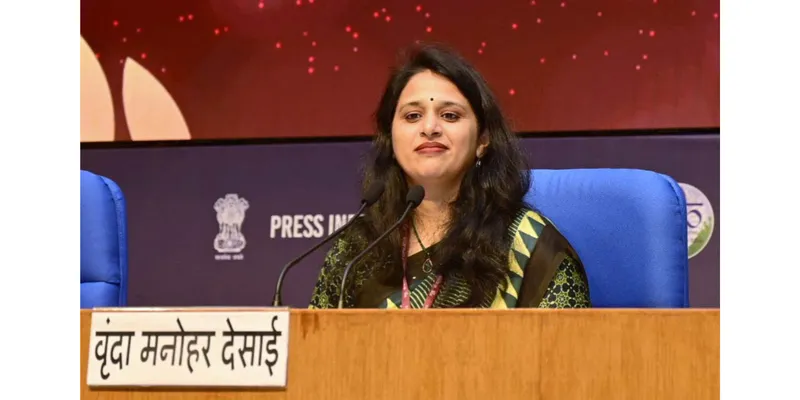
Ms Vrunda Manohar Desai outlines Government initiatives, export opportunities and industry priorities for India’s textile sector at TEXPROCIL Export Awards Function
Speaking at the TEXPROCIL Export Awards Function, Textile Commissioner Ms Vrunda Manohar Desai (IRS) highlighted the role of India’s textile and apparel sector in manufacturing, exports, employment and rural livelihoods. She also outlined key Government initiatives aimed at strengthening comtepetitiveness, sustainability, technology adoption and export growth across the textile value chain.
At the TEXPROCIL Export Awards Function, Textile Commissioner Ms Vrunda Manohar Desai (IRS) addressed exporters, industry leaders and stakeholders, highlighting the importance of the textile and apparel sector in India’s economy and its contribution to employment, manufacturing and exports.
Addressing the gathering in the presence of Hon’ble Union Minister of Finance and Corporate Affairs Nirmala Sitharaman and TEXPROCIL Chairman Shri Vijay Agarwal, Ms Desai congratulated TEXPROCIL for its role in promoting Indian cotton textiles globally and strengthening collaboration between industry and Government.
She referred to initiatives such as the Kasturi Cotton Bharat programme, stating that they have supported branding, traceability and global positioning of Indian cotton while reinforcing India’s image as a reliable and sustainable sourcing destination.
Ms Desai noted that the textile and apparel industry remains one of the strongest pillars of the Indian economy, supporting millions of farmers, workers, artisans and MSMEs across the country. She stated that India continues to be the world’s largest producer of cotton and jute and among the leading textile manufacturing nations globally.
Highlighting the vision of Hon’ble Prime Minister Narendra Modi, she referred to the “5F” framework — Farm to Fibre, Fibre to Factory, Factory to Fashion, Fashion to Foreign — as a representation of India’s integrated textile value chain.
The Textile Commissioner stated that India’s textile and apparel market is projected to grow substantially by 2030, with textile exports expected to reach USD 100 billion. She added that the Government has been implementing policy reforms and strategic interventions to support this growth.
She acknowledged the Union Budget announcements related to textile expansion and employment, fibre development, sustainable manufacturing, skilling, handloom and handicrafts, and PM MITRA Parks. According to her, these initiatives are expected to support technology upgradation, integrated manufacturing ecosystems, skilled workforce development and globally competitive manufacturing.
Ms Desai also said that evolving global supply chains are increasing demand for reliability, transparency, sustainability and diversified sourcing. She highlighted India’s strengths in raw material availability, entrepreneurship, skilled manpower, manufacturing capabilities and textile heritage.
At the same time, she stated that higher export growth would require stronger focus on scale, quality, innovation, branding, speed and value addition to position India as a producer of high-value and design-led textile products.
She informed that the Ministry of Textiles is working with States and Union Territories on State Export Action Plans and District Export Action Plans to improve export readiness, identify district-specific strengths and strengthen market linkages.
According to Ms Desai, these efforts are expected to help exporters utilise opportunities emerging from India’s Free Trade Agreements and ongoing international trade engagements.
The Textile Commissioner further stated that the Ministry continues to work with industry stakeholders on logistics, sustainability compliance, technology upgradation, quality improvement, market access and trade facilitation.
She also referred to the establishment of pilot Textile Export Facilitation Centres by the Textiles Committee in major textile clusters to provide export guidance, compliance support, FTA awareness, market development assistance and information on Government schemes.
Ms Desai acknowledged the resilience shown by the textile industry in managing supply chain disruptions, freight volatility, geopolitical uncertainties and fluctuating demand conditions.
Concluding her address, she congratulated the award winners and reiterated the Ministry of Textiles’ commitment to supporting the growth and modernisation of the textile sector through continued engagement with industry bodies and exporters.