Textile Chemicals in 2026: Key Statistics, Market Trends, and Performance Insights
The global textile industry relies heavily on textile chemicals to enhance fabric quality, durability, appearance, and functionality. From dyeing auxiliaries and finishing agents to coating chemicals and specialty treatments, these products play a critical role in modern textile manufacturing.
According to insights published by Dataintelo, The global textile chemicals market was valued at $29.32 billion in 2025 and is projected to reach $46.76 billion by 2034, expanding at a compound annual growth rate (CAGR) of 5.2% during the forecast period from 2026 to 2034.
Key Statistics at a Glance
Metric | Value |
Global textile production (2025) | 116 million tons |
Annual textile chemical consumption | Over 22 million tons |
Textile industry's share of global wastewater | 20% |
Dyeing and finishing chemical usage | 45–50% of total textile chemicals |
Water consumed per kg of fabric | 100–200 liters |
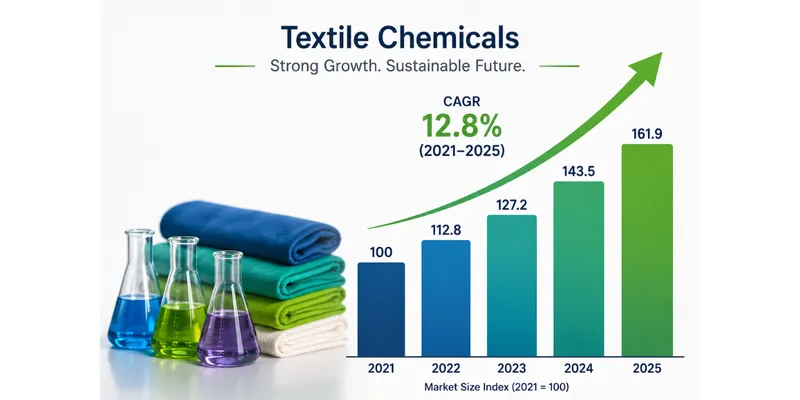
Sustainable chemical adoption growth (2021–2025) | 12.8% CAGR |
Technical textile demand increase (2020–2025) | 31% |
Digital textile printing growth (2021–2025) | 18.4% CAGR |
Average reduction in water use through advanced chemicals | 35–50% |
Energy savings from modern finishing chemicals | Up to 25% |
Textile exports worldwide (2025) | USD 950 billion |
Asia-Pacific share of textile manufacturing | 65%+ |
Understanding Textile Chemicals: A Multi-Billion-Dollar Industry
Textile chemicals are specialized substances used during fiber production, pretreatment, dyeing, printing, and finishing processes. In 2025, global textile manufacturing exceeded 116 million tons, creating substantial demand for processing chemicals.
Industry data shows that approximately 22 million tons of textile chemicals are consumed annually worldwide. Dyeing and finishing chemicals account for nearly 48% of total chemical usage, while pretreatment chemicals contribute around 22%.
The average textile processing facility uses between 2.5 and 4.0 kilograms of chemicals for every 100 kilograms of fabric produced, depending on product specifications and performance requirements.
5 Data-Backed Reasons Textile Chemicals Are Becoming More Important 1. Rising Demand for Functional Fabrics
Consumer demand for performance textiles has increased significantly. Between 2020 and 2025, demand for moisture-wicking, antimicrobial, and UV-resistant fabrics grew by approximately 29%.
Sportswear manufacturers report that fabrics treated with advanced finishing chemicals can improve moisture management performance by 35–40% compared to untreated materials.
2. Growth of Technical Textiles
Technical textiles now represent nearly 31% of total textile consumption in several developed markets. Applications include:
• Medical textiles
• Automotive fabrics
• Industrial filtration
• Protective clothing
• Geotextiles
These applications typically require 20–60% more specialty chemicals than conventional apparel fabrics.
3. Sustainability Requirements
The textile industry generates nearly 20% of global industrial wastewater, creating pressure for cleaner production methods.
Modern low-impact textile chemicals have demonstrated:
• 40% lower water consumption
• 25% lower energy requirements
• 30% reduction in chemical discharge
• 15–20% shorter processing cycles
These measurable improvements are accelerating adoption across global manufacturing hubs.
4. Expansion of Digital Printing
Digital textile printing continues to gain market share. From 2021 to 2025, adoption increased at a compound annual growth rate (CAGR) of approximately 18.4%.
Compared with conventional printing methods, digital processes can reduce: • Water consumption by up to 60%
• Ink waste by 50%
• Production lead times by 35%
Specialized textile chemicals play a key role in achieving these efficiencies. 5. Regulatory Compliance Pressures
Environmental regulations introduced between 2022 and 2025 have increased demand for eco-friendly textile chemicals.
Manufacturers adopting compliant chemical solutions reported:
• 18% lower compliance costs
• 22% fewer environmental violations
• 15% improvement in operational efficiency
2026 Performance Metrics for Textile Chemical Applications
Application Area | Average Performance Improvement |
Color Fastness | 25–40% |
Fabric Softness | 20–30% |
Wrinkle Resistance | 35–50% |
Water Repellency | 40–60% |
UV Protection | 30–45% |
Antimicrobial Performance | 90–99% bacterial reduction |
These measurable performance gains explain why textile manufacturers continue increasing investments in specialty chemical formulations.
Regional Trends and Production Statistics
Asia-Pacific remains the dominant textile manufacturing region, accounting for more than 65% of global production in 2025.
Regional shares include:
1. Asia-Pacific – 65%
2. Europe – 16%
3. North America – 10%
4. Latin America – 5%
5. Middle East & Africa – 4%
China, India, Bangladesh, and Vietnam collectively contribute over 55% of global textile exports.
Future Outlook: 2026–2030 Projections
Industry forecasts indicate continued expansion driven by sustainability initiatives and advanced textile applications.
Expected trends include:
• Sustainable textile chemical adoption increasing at 11–13% CAGR
• Bio-based chemical penetration reaching 25% of new product launches by 2030 • Smart textile applications growing by 15% annually
• Water-saving chemical technologies reducing processing water usage by an additional 20–30%
• Technical textile production increasing by 35% between 2026 and 2030
These projections highlight strong opportunities for innovation and efficiency improvements across the textile value chain.
Conclusion
Textile chemicals remain essential to modern fabric manufacturing, supporting performance, sustainability, and production efficiency. With global textile output surpassing 116 million tons, annual chemical consumption exceeding 22 million tons, and sustainable solutions growing at over 12% CAGR, the industry is entering a new phase of innovation. As manufacturers target 40–50% reductions in water use, 25% energy savings, and stronger functional performance, textile chemicals will continue playing a central role in shaping the future of global textile production through 2030 and beyond.