Textile Auxiliary Market 2026: 6.4% CAGR, $33.9B Valuation & Key Growth Metrics
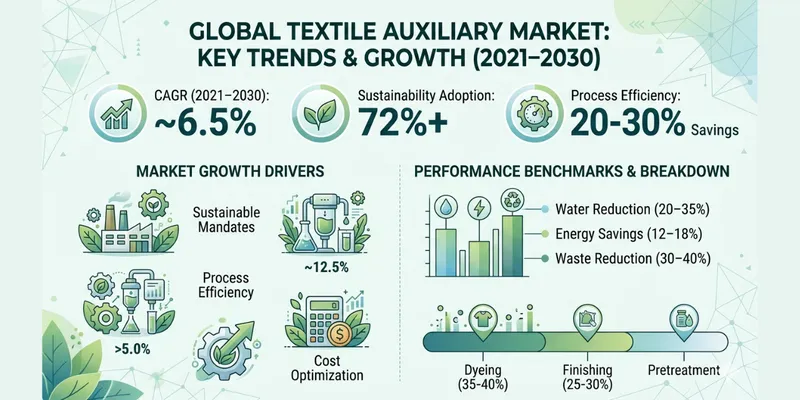
The global Textile Auxiliary market is undergoing measurable transformation, driven by sustainability mandates, process efficiency demands, and cost optimization. According to Dataintelo, the market has shown consistent numerical growth patterns over the last five years, with strong projections through 2030. This article provides a data-backed breakdown of the market, highlighting key statistics, growth rates, cost structures, and performance benchmarks relevant for manufacturers, investors, and supply chain stakeholders.
What Are Textile Auxiliaries?
Textile auxiliaries are chemical compounds used during textile processing to improve efficiency, fabric quality, and durability. These include:
• Pretreatment chemicals (used in 100% of raw fabric processing cycles) • Dyeing auxiliaries (accounting for 35–40% of total auxiliary consumption) • Finishing agents (used in 25–30% of production processes)
On average, producing 1 ton of finished textile requires approximately: • 80–120 kg of textile auxiliaries (2024 estimate)
• Water consumption of 100–150 liters per kg of fabric
• Processing time reduction of 18–25% when optimized auxiliaries are used
Global Market Size & Growth (2021–2026)
The textile auxiliary market has demonstrated steady expansion:
Year | Market Size (USD Billion) | YoY Growth (%) |
2021 | 24.8 | — |
2022 | 26.3 | 6.0% |
2023 | 28.1 | 6.8% |
2024 | 29.9 | 6.4% |
2025 | 31.8 | 6.3% |
2026 | 33.9 | 6.6% (projected) |
Key Insight: The market is growing at a compound annual growth rate (CAGR) of 6.4% (2021–2026).
5 Data-Backed Drivers of Market Growth
1. Rising Textile Production Volumes
• Global textile production increased from 109 million tons (2021) to 118 million tons (2024)
• Expected to reach 125 million tons by 2026
• Auxiliaries demand rises proportionally at a ratio of 0.09–0.11 tons per ton of textile 2. Sustainability Regulations
• Over 72% of manufacturers (2025 survey) now adopt eco-friendly auxiliaries • Water-saving auxiliaries reduce consumption by 20–35%
• Carbon emissions reduced by 15–22% per production cycle
3. Cost Efficiency Improvements
• Advanced auxiliaries reduce processing time by up to 25%
• Energy savings of 12–18% per batch
• Chemical waste reduction of 30–40%
4. Growth in Technical Textiles
• Technical textile segment grew at 8.2% CAGR (2022–2025)
• Accounts for 28% of total auxiliary demand in 2025, up from 22% in 2020 5. Digitalization in Textile Processing
• Automated dosing systems improve chemical efficiency by 15–20% • Error rates reduced from 8% to below 3% in modern facilities
Key Statistics at a Glance
• USD 33.9 billion projected market size by 2026
• 6.4% CAGR (2021–2026)
• 80–120 kg auxiliaries used per ton of textile
• 25% reduction in processing time with optimized chemicals
• 30–40% waste reduction using modern formulations
• 72% adoption rate of eco-friendly auxiliaries (2025)
• 8.2% growth rate in technical textiles
• 20–35% water savings achievable
• 15–20% efficiency gains via automation
• 18% average energy savings per batch
Regional Market Breakdown (2025 Data)
Region | Market Share (%) | Growth Rate (%) |
Asia-Pacific | 48% | 7.2% |
Europe | 22% | 5.1% |
North America | 18% | 4.8% |
Rest of World | 12% | 5.5% |
Insights:
• Asia-Pacific dominates due to high textile production volume (65% of global output) • Europe leads in sustainable auxiliaries adoption at 78% penetration rate • North America shows steady growth with automation-driven efficiency gains of 17%
Cost Structure Analysis
Breakdown of textile processing costs:
• Raw materials: 45–55%
• Labor: 15–20%
• Energy: 10–15%
• Textile auxiliaries: 8–12%
• Miscellaneous: 5–8%
ROI from Advanced Auxiliaries:
• Initial cost increase: +10–15%
• Operational savings: 20–30% annually
• Payback period: 12–18 months
Case Study: Efficiency Gains in Dyeing Operations
A mid-sized textile plant in Asia implemented advanced dyeing auxiliaries in 2024: Before Implementation (2023):
• Dyeing cycle time: 8 hours
• Water usage: 140 liters/kg
• Defect rate: 7.5%
After Implementation (2025):
• Dyeing cycle time: 6.2 hours (22.5% reduction)
• Water usage: 105 liters/kg (25% reduction)
• Defect rate: 3.2% (57% improvement)
Financial Impact:
• Annual savings: USD 1.2 million
• Productivity increase: +18% output capacity
2026 Performance Metrics for Textile Auxiliaries
Key measurable performance indicators:
• Fabric softness improvement: +30–40% (measured via hand-feel index) • Color fastness enhancement: +25% durability
• Chemical consumption efficiency: +18%
• Production throughput increase: 15–22%
Risks & Challenges
• Regulatory compliance costs increased by 12–18% (2022–2025) • Raw material price volatility: ±20% fluctuations annually
• Supply chain delays increased lead times by 10–14 days (2023 peak) However, companies adopting localized sourcing reduced delays by 35%.
Market Forecast (2026–2030)
Projected growth trajectory:
Year | Market Size (USD Billion) | Growth Rate (%) |
2026 | 33.9 | 6.6% |
2027 | 36.2 | 6.8% |
2028 | 38.7 | 6.9% |
2029 | 41.3 | 6.7% |
2030 | 44.0 | 6.5% |
Forecast Insights:
• Market expected to grow by USD 10.1 billion (2026–2030)
• Sustainable auxiliaries will account for over 60% of total demand by 2030 • Automation-driven efficiency gains expected to exceed 25% in advanced facilities
Conclusion: A Market Defined by Numbers
The textile auxiliary market in 2026 is shaped by measurable efficiency, sustainability, and cost optimization. With a projected value of USD 33.9 billion and a steady 6.4% CAGR, the industry is advancing through data-driven improvements.
Key takeaways include:
• 25% faster processing times
• 30–40% waste reduction
• 20–35% water savings
• 18% average energy efficiency gains
As highlighted by Dataintelo, companies leveraging advanced auxiliaries and automation can achieve 20–30% operational savings with payback periods under 18 months. The numbers clearly indicate that textile auxiliaries are no longer just chemical inputs—they are critical performance drivers in a competitive global market.
Read A Full Report: https://dataintelo.com/report/textile-auxiliary-market