Textile Auxiliaries Market to Reach USD 45 Billion by 2032: Growth Driven by Sustainability & Innovation
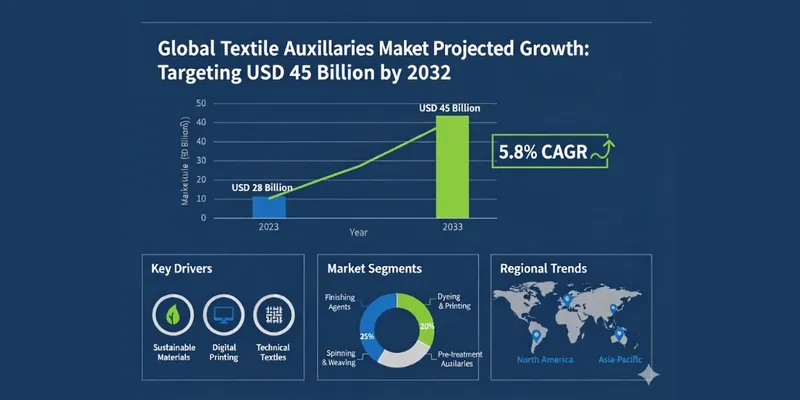
The global Textile Auxiliaries market is steadily expanding, supported by rising textile production, increasing demand for high-performance fabrics, and stricter environmental regulations. According to Marketintelo, the market was valued at around USD 28.6 billion in 2024 and is expected to reach approximately USD 45 billion by 2032, growing at a CAGR of about 6–7%.
Textile auxiliaries are essential chemicals used across processes such as pre-treatment, dyeing, printing, and finishing. Nearly 70% of textile processing operations depend on auxiliaries to enhance efficiency and fabric quality. In recent years, demand has been increasingly influenced by sustainability trends, with eco-friendly chemicals gaining notable traction.
Historical Market Trends
The Textile Auxiliaries market has shown stable growth over the past decade, driven by increasing global textile consumption.
Between 2016 and 2019, the market expanded gradually as textile production rose across Asia-Pacific. In 2020, growth slowed due to supply chain disruptions, but the market still maintained resilience. By 2021, recovery had begun, supported by rising exports and increased apparel demand.
From 2022 to 2024, the market recorded consistent improvement, reaching close to USD 28 billion. Over the entire period, the market maintained a moderate growth pace, with stronger recovery observed after 2021.
Recent Growth Patterns
The Textile Auxiliaries market has maintained a positive trajectory in recent years, with steady annual growth supported by industrial recovery.
Between 2022 and 2023, the market experienced moderate expansion, while 2023 to 2024 saw improved growth due to increased textile manufacturing activity. Sustainable auxiliaries, in particular, have grown at a faster pace, with adoption rising by over 30% in the past five years.
Looking ahead, the market is expected to maintain stable growth, supported by ongoing innovation and demand for environmentally friendly solutions.
Market Segmentation Insights
The Textile Auxiliaries market is segmented based on function and application, with dyeing and finishing auxiliaries accounting for the largest share. These segments contribute to a significant portion of total demand due to their critical role in improving fabric properties.
Pre-treatment and printing auxiliaries also hold considerable shares, supporting essential stages of textile processing. In terms of application, apparel textiles dominate the market, accounting for more than half of total consumption, followed by home textiles and technical textiles.
Technical textiles are emerging as a high-growth segment, with increasing use in industries such as automotive, healthcare, and construction, where performance and durability are key requirements.
Regional Market Overview
Asia-Pacific continues to lead the Textile Auxiliaries market, accounting for nearly half of global demand. China remains the largest producer and consumer, while India is witnessing strong growth due to expanding textile manufacturing capacity and government support.
Europe holds a significant share of the market, driven by stringent environmental regulations and a strong focus on sustainable chemicals. Approximately 40–45% of textile auxiliaries used in Europe are now eco-friendly or bio-based.
North America represents a stable market, supported by demand for technical textiles and advanced materials. The region continues to invest in innovation and high-performance textile solutions.
Other regions, including Latin America and the Middle East, are gradually growing, supported by increasing industrialization and textile exports.
Investment and Industry Developments
The textile sector continues to attract investments aimed at modernization and sustainability. Globally, textile-related investments exceeded USD 150 billion in recent years, with a growing portion directed toward eco-friendly chemical processing.
Countries such as India and China are investing heavily in textile infrastructure and sustainable technologies. Government initiatives supporting textile manufacturing and exports are further strengthening the market outlook.
Additionally, a large share of new investments is focused on reducing water consumption and improving energy efficiency in textile processing.
Sustainability and Innovation Trends
Sustainability is a key driver shaping the Textile Auxiliaries market. The adoption of bio based auxiliaries has increased significantly over the past few years, with many manufacturers shifting away from traditional chemical formulations.
Technologies such as waterless dyeing and digital printing are gaining popularity, helping reduce environmental impact while improving efficiency. Currently, around 10–15% of textile manufacturers are adopting advanced low-water or waterless processing techniques.
Consumer demand for sustainable products is also influencing brands, with a majority now prioritizing environmentally friendly production practices. This trend is expected to further boost demand for green textile auxiliaries in the coming years.
Competitive Landscape
The Textile Auxiliaries market is moderately competitive, with a mix of global and regional players. The top companies collectively account for a notable share of the market, focusing on innovation and product development.
Research and development activities have increased in recent years, with companies investing in advanced formulations that offer better performance and lower environmental impact. Many players are also expanding their production capacities and entering strategic partnerships to strengthen their market presence.
Textile Auxiliaries Market Data Summary
Category | 2024 Estimate | 2032 Forecast | Growth Trend |
Global Market | USD 28.6 Bn | USD 45 Bn | Steady Growth |
Asia-Pacific | ~48% Share | Leading Region | High Growth |
Europe | ~20–22% Share | Moderate Growth | Sustainability Driven |
North America | ~15–17% Share | Stable Growth | Innovation Focus |
Sustainable Segment | Rising Share | Strong Potential | Fastest Growth |
Future Outlook
The future of the Textile Auxiliaries market remains promising, supported by sustainability trends and technological advancements. The market is expected to cross USD 32 billion by the mid-decade, with continued expansion toward 2032.
Eco-friendly auxiliaries are likely to gain a larger share, driven by regulatory pressures and consumer preferences. Digital textile technologies and smart fabrics will also contribute to market growth, creating new opportunities for innovation.
Conclusion
The Textile Auxiliaries market is on a steady growth path, projected to expand from USD 28.6 billion in 2024 to around USD 45 billion by 2032. Historical trends indicate stable development, while recent years highlight stronger momentum driven by sustainability and technological progress.
Asia-Pacific will remain the dominant region, supported by large-scale textile production, while Europe and North America will focus on eco-friendly solutions and innovation. With increasing investments, evolving regulations, and rising demand for advanced textiles, the
Textile Auxiliaries market is set to play a critical role in the future of the global textile industry.
Read A Full Report: https://marketintelo.com/report/textile-auxiliaries-market