Textile Automation Market to Reach $15.2 Billion by 2032: Robotics, AI, and Smart Manufacturing Driving 7.2% CAGR
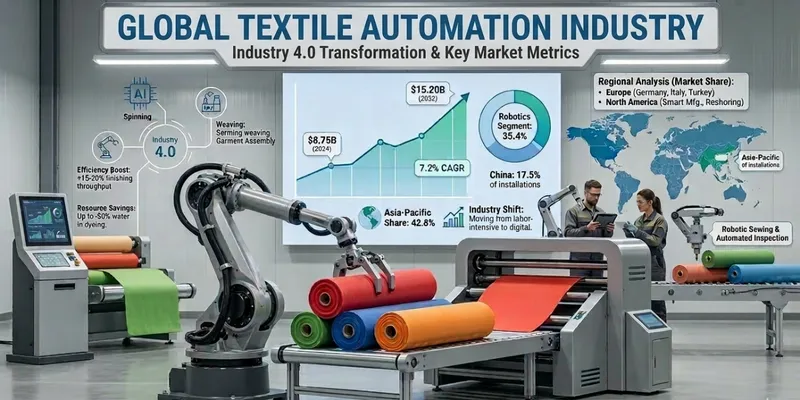
The global Textile Automation industry is undergoing a major transformation as manufacturers integrate robotics, artificial intelligence, and Industry 4.0 technologies into textile production lines. According to industry insights and analysis referenced by Marketintelo, the global textile automation market was valued at USD 8.75 billion in 2024 and is projected to reach USD 15.20 billion by 2032, expanding at a 7.2% CAGR during the forecast period.
Automation is increasingly adopted across spinning, weaving, knitting, dyeing, finishing, and garment assembly processes. Rising labor costs, demand for high-precision fabrics, and global competition are accelerating investment in automated textile equipment.
Over the past decade, the textile sector has shifted from labor-intensive operations toward digitally integrated manufacturing. The broader textile machinery market reached USD 49.7 billion in 2023 and is projected to reach USD 73.42 billion by 2030, indicating steady growth in automation-related technologies across the industry.
Key Numerical Highlights of the Textile Automation Market • Global Textile Automation market value: $8.75 billion (2024)
• Forecast market size: $15.2 billion by 2032
• Expected CAGR (2025–2032): 7.2%
• Asia-Pacific market share: 42.8%
• Robotics segment share in automation systems: 35.4%
• Textile machinery market: $47.19 billion (2022) → $73.42 billion (2030) • Textile processing machinery market: $40.7 billion forecast by 2030 • Semi-automatic machinery share in 2025: 43.05%
• Apparel manufacturing share of automation installations: 61.92%
These numbers indicate strong technological adoption as manufacturers shift toward high efficiency textile production.
Historical Growth Trends (2015–2024)
Over the past decade, Textile Automation has expanded steadily due to rapid industrial modernization and global apparel demand.
Between 2015 and 2020, automation investments grew as labor shortages emerged in textile manufacturing hubs such as China, India, and Vietnam.
Year-wise Growth Snapshot
Year | Estimated Textile Automation Market |
2016 | USD 5.1 Billion |
2018 | USD 6.2 Billion |
2020 | USD 7.1 Billion |
2022 | USD 8.0 Billion |
2024 | USD 8.75 Billion |
Growth accelerated particularly after 2020 as companies adopted automated inspection, robotic material handling, and AI-based quality control.
Advanced sewing automation systems, for example, can reduce manual labor time by over 90%, cutting production cycles from 117 seconds to around 33 seconds per garment piece.
This dramatic improvement in productivity explains the increasing shift toward automated textile manufacturing.
Automation Across Textile Manufacturing Stages
Textile automation technologies are being implemented across the entire production chain. 1. Spinning and Fiber Processing
Automated spinning machines dominate the machinery market with 44.02% share in 2025. These systems include automated yarn feeders, quality sensors, and predictive maintenance algorithms.
2. Weaving and Knitting
Robotic looms and smart knitting machines improve consistency and reduce defect rates. Automated knitting technologies are expected to grow at over 7% CAGR as manufacturers scale production.
3. Dyeing and Finishing
Digital dyeing systems reduce water consumption by 30–50%, while automated finishing lines improve throughput by 15–20%.
4. Garment Assembly
Robotic sewing and automated cutting machines are becoming increasingly common in large-scale apparel factories.
The garments and apparel segment accounts for 61.92% of textile machinery applications, highlighting its strong reliance on automation.
Regional Market Analysis
Asia-Pacific
Asia-Pacific dominates the global Textile Automation market with over 42.8% share due to massive manufacturing capacity and technology adoption.
China, India, Bangladesh, and Vietnam lead automation investments. Key regional statistics:
• China holds 17.5% of global textile automation installations
• Asia-Pacific accounted for 55.1% of textile machinery revenue in 2025
• China installed 295,000 industrial robots in factories in 2024, representing 54% of global robot installations
These numbers highlight Asia’s dominance in automated manufacturing infrastructure.
Europe
Europe accounts for roughly 20–22% of global textile automation investments, led by Germany, Italy, and Turkey.
European textile manufacturers prioritize:
• sustainable automated dyeing systems
• AI-driven fabric inspection technologies
• robotics-based textile handling systems
Industry 4.0 adoption has increased automation density across European textile plants.
North America
North America holds approximately 15–18% market share in textile automation. The region focuses heavily on:
• smart manufacturing
• digital twin technologies
• automated quality inspection systems
U.S. textile manufacturers are investing in advanced robotics to counter higher labor costs and reshore apparel production.
Middle East & Africa
The Middle East and Africa represent emerging markets for Textile Automation, with growth projected at over 6.3% CAGR through 2031.
Countries such as Turkey, Egypt, and Ethiopia are expanding automated textile production to attract global apparel manufacturing contracts.
Industry Investment and Government Initiatives
Automation investment is accelerating globally as governments support modernization of textile industries.
For example:
• India’s textile industry is projected to expand from $165 billion to $350 billion by 2030.
• Achieving this growth may require 450,000 high-speed weaving machines and $15 billion in machinery investments.
Government programs promoting technical textiles, smart factories, and robotics are expected to drive adoption of Textile Automation technologies across emerging economies.
Competitive Landscape and Industry Players
The textile automation ecosystem includes robotics companies, textile machinery manufacturers, and industrial software providers.
Key technology areas include:
• robotic material handling
• automated cutting systems
• digital fabric inspection
• AI-driven production analytics
• smart weaving and knitting machines
Major textile machinery markets are highly competitive, with equipment manufacturers continuously launching new automation solutions to increase production efficiency.
Automation is also expanding into textile recycling and sorting systems, where AI-based robotic platforms can achieve up to 87.9% classification accuracy in garment sorting operations.
Future Market Forecast (2025–2032)
The next decade will see rapid technological advancement in Textile Automation as manufacturers integrate AI, robotics, and digital manufacturing platforms.
Forecast Data
Metric | Value |
Market size (2024) | USD 8.75 Billion |
Market size (2028 est.) | USD 11.9 Billion |
Market size (2032 forecast) | USD 15.20 Billion |
CAGR | 7.2% |
Robotics segment share | 35.4% |
Asia-Pacific share | 42.8% |
Industry experts expect automation penetration in textile manufacturing to rise from approximately 38% in 2024 to nearly 60% by 2032.
Key technologies driving growth include:
• AI-powered quality inspection
• digital twin textile factories
• automated cutting and sewing systems
• robotic fabric handling
• IoT-based predictive maintenance
Conclusion: Automation Will Define the Next Era of Textile Manufacturing
The global Textile Automation industry is entering a new phase of technological transformation driven by robotics, AI, and Industry 4.0 manufacturing systems. From $8.75 billion in 2024 to a projected $15.2 billion by 2032, the market is expected to expand steadily at a 7.2% CAGR.
Historical data shows continuous growth over the past decade as automation improved productivity, reduced labor costs, and enhanced product quality. Asia-Pacific leads global adoption with more than 42% market share, while North America and Europe focus on smart manufacturing technologies.
Looking ahead, the integration of robotics, intelligent sensors, and AI-driven analytics will reshape textile factories worldwide. As global apparel demand continues rising and manufacturers seek efficiency, Textile Automation will remain a critical investment area, potentially driving multi-billion-dollar industry growth through 2035 and beyond.
Read A Full Report: https://marketintelo.com/report/textile-automation-market