TEXPROCIL 72nd AGM Highlights India’s Cotton Textile Export Priorities, Trade Challenges and Policy Support
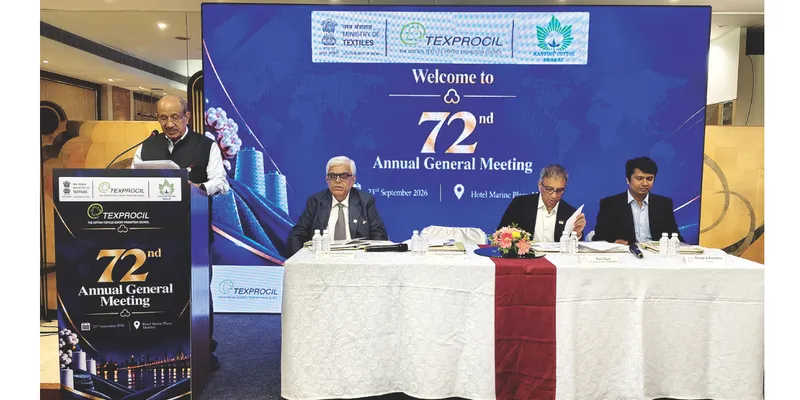
Chairman Vijay Agarwal outlines global trade trends, export performance, government initiatives and the sector’s priorities for competitiveness and market diversification
The Cotton Textiles Export Promotion Council (TEXPROCIL) held its 72nd Annual General Meeting (AGM) on 23 September 2026 in Mumbai, where Chairman Shri Vijay Agarwal presented an overview of the global trading environment and India’s cotton textile export sector. His address covered global textile trade, India’s export performance, government support measures, sustainability and traceability requirements, and the Council’s engagement with policymakers.
The meeting also included a vote of thanks by Shri Ravi Sam, Vice Chairman, who highlighted TEXPROCIL’s capacity-building initiatives and the progress of the Kasturi Cotton Bharat programme.
TEXPROCIL Reviews Global Trade Environment at 72nd AGM
As TEXPROCIL approaches the completion of its 72nd year on 4 October 2026, the Council continues to pursue the governance framework of “Reform, Perform, Transform, and Inform”, with a focus on strengthening India’s cotton textile export ecosystem.
Chairman Vijay Agarwal said the Council has continued to work with the Ministry of Textiles, Ministry of Commerce & Industry, Finance Ministry and DGFT on initiatives aimed at strengthening competitiveness, expanding exports and supporting India’s position in global cotton textile trade.
Global Trade Outlook
The global trading environment in FY 2025–26 was significantly influenced by the United States’ announcement of reciprocal tariffs in April 2025. According to the address, the measures increased uncertainty and disrupted established supply chains while also accelerating sourcing diversification as global buyers looked for more resilient and diversified sourcing bases.
The WTO projects global merchandise trade growth of 1.9% in 2026, supported by AI-driven demand and resilient supply chains. However, geopolitical tensions, changing trade policies and economic uncertainty remain important factors for the global outlook.
Against this backdrop, market diversification and stronger regional trade partnerships were highlighted as increasingly important for the textile industry.
India’s Textile Opportunity
The IMF projects India’s GDP growth at 6.4% in FY 2026–27 and 6.7% in FY 2027–28, supported by domestic demand and investment.
The address noted that investment in infrastructure, manufacturing, digitalisation and innovation could support the textiles and apparel sector in scaling up, improving competitiveness, attracting investment and integrating further with global value chains.
FY 2026–27 was described as an important stage towards Vision 2030, which envisages a US$350 billion textiles and apparel industry, including US$100 billion in exports. Greater scale, productivity, value addition and global market integration were identified as important requirements for achieving this ambition.
Global Textile and Clothing Trade
In 2025, world merchandise trade increased 7.17% to US$26.26 trillion, compared with US$24.50 trillion in 2024. The recovery followed the contraction recorded in 2023 and was supported by improving economic activity, easing inflation, supply-chain normalisation and resilient demand across major markets.
However, the share of textiles and clothing in global merchandise trade declined from 3.61% to 3.39%.
Global trade in textiles and clothing reached US$890 billion in 2025, representing growth of 0.57% over the previous year. Clothing accounted for 58% of this trade, while textiles represented the remaining 42%.
India recorded US$36.95 billion in textile and clothing exports in 2025, registering growth of 0.67% over the previous year. India's share of global textile and clothing exports stood at 4.15%.
Cotton Textile Trade Records Marginal Decline
Global textile trade covering yarns, fabrics and made-ups across all fibres declined marginally by 0.60% during January–December 2025, reaching US$319.75 billion.
Within this, global trade in cotton textiles declined 2.69% to US$118.04 billion.
Cotton made-ups remained the largest segment, accounting for US$53.84 billion or 45.62% of global cotton textile trade. Cotton fabrics accounted for US$52.19 billion or 44.22%, while cotton yarn contributed US$12.00 billion or 10.16%.
Industry Faces Multiple Global Pressures
The address highlighted subdued consumer demand in the US and Europe, lower orders from international fashion brands and pressure on factory margins as major challenges for the global textile and clothing industry.
Geopolitical conflicts have also affected shipping routes and logistics costs. At the same time, evolving regulations in Western markets are increasing requirements for digital documentation and traceability covering where and how garments are produced.
The address stated that India’s domestic supply chain, spanning cotton production through textile and garment manufacturing, provides a base for responding to these challenges. Government initiatives including the Production Linked Incentive (PLI) Scheme and upcoming Free Trade Agreements were also highlighted.
Structural Drivers for India’s Textile Sector
India’s textile industry, valued at US$190 billion, was described as entering a multi-year growth phase supported by its domestic “fibre-to-fashion” value chain.
The country’s spinning, weaving and processing capacities, together with domestic raw material availability, form part of this ecosystem. Local cotton production is projected to reach 7.2 million tonnes by 2030.
India’s domestic market is also expected to provide support against fluctuations in international demand, with the e-commerce market targeted to reach a US$30 billion footprint by 2027.
Policy interventions such as the ₹10,683 crore PLI scheme and PM-MITRA Mega Textile Parks are aimed at expanding high-value textile production capacities.
The address also highlighted potential Free Trade Agreements with markets including the UK and EU, alongside digital traceability initiatives, as factors influencing India's international competitiveness.
Government Initiatives Supporting the Textile Value Chain
The Government of India has undertaken several initiatives aimed at strengthening the textile value chain. These include:
- PM MITRA Parks
- Production Linked Incentive (PLI) Scheme
- National Technical Textiles Mission (NTTM)
- Textiles Expansion and Employment (TEEM) Scheme
- National Fibre Mission
- Raw Material Support Scheme (RMSS)
The address said these initiatives are supporting investment, technology adoption, innovation, sustainability and export growth.
The Government has also launched the Cotton Productivity Mission to address cotton yield and quality, while measures relating to cotton imports are aimed at ensuring adequate raw material availability for the domestic textile industry.
Export Promotion Mission
A major policy initiative highlighted during the year was the Export Promotion Mission (EPM), announced in the Union Budget 2025–26 and approved by the Union Cabinet.
The Mission has an outlay of ₹25,060 crore for 2025–26 to 2030–31 and includes two integrated components.
NIRYAT PROTSAHAN provides financial support through measures such as interest subvention, export factoring and credit guarantees.
NIRYAT DISHA focuses on market access, quality compliance, branding, logistics and export capacity building.
The Mission is expected to particularly support MSMEs, first-time exporters and labour-intensive sectors such as textiles by improving access to finance and strengthening global competitiveness.
Focus on Technology and Innovation
The Council also highlighted increasing attention to research, innovation, incubation and industry–academia collaboration.
These efforts are aimed at strengthening a technology-driven textile ecosystem and supporting higher productivity, greater value addition and sustained global competitiveness.
India’s Next Phase of Textile Growth
India’s textile sector enters its next phase with a US$36.95 billion export base in 2025–26 and a US$190 billion domestic market.
The address identified greater scale, value addition, technology adoption and market diversification as key areas for the sector.
Government and industry are also working towards the vision of “Farm to Fibre to Factory to Fashion to Foreign”, with the objective of developing a more integrated textile value chain.
The approach covers areas ranging from raw materials and manufacturing to innovation, branding and international market access.
TEXPROCIL’s Engagement with Government
TEXPROCIL continued its engagement with the Government, RBI, DGFT, CBIC and other stakeholders on policy and procedural matters affecting exporters.
Representations covered export incentive schemes, customs facilitation, banking issues, GST refunds, Authorised Economic Operator (AEO) procedures, market access and implementation of Free Trade Agreements.
The Council also continued trade promotion activities, policy dissemination, capacity-building programmes and engagement with its members.
Union Budget 2026–27 Measures
Based on member feedback, TEXPROCIL submitted proposals for the Union Budget 2026–27 focused on competitiveness and trade facilitation.
Among the measures highlighted was the extension of the export-obligation period for textile garments manufactured from duty-free imported inputs from six to twelve months.
The address also referred to measures supporting TReDS-based receivables financing and the ₹10,000 crore SME Growth Fund, aimed at improving access to finance and supporting the emergence of future “Champion SMEs.”
The Government has also approved the Mission for Cotton Productivity for FY 2026–27 through FY 2030–31, focusing on cotton yields, quality and competitiveness.
Sustainability and Market Access
Sustainability is increasingly influencing global competitiveness, with cleaner technologies, safer chemicals, recycling, traceability, eco-labelling and circular manufacturing becoming important factors in market access and sourcing decisions.
The Council highlighted these areas alongside scale, technology adoption and market diversification as part of the sector’s future direction.
RoDTEP and RoSCTL
TEXPROCIL made representations concerning the RoDTEP and RoSCTL schemes.
Following these submissions, the Government approved the extension of RoSCTL for garments and made-ups and RoDTEP up to 30 September 2026, providing policy continuity for exporters.
GST-Related Developments
The Council continued to assist members on GST-related matters and made representations to the GST Policy Wing and Commissionerates.
The address highlighted the Government’s introduction of GST 2.0, effective 22 September 2025, as a major reform.
According to the address, the revised regime is expected to address tax distortions, reduce production costs, improve demand and export competitiveness, ease working-capital pressures, support domestic consumption and employment, and strengthen the development and global competitiveness of India’s textile and apparel sector.
Vote of Thanks Highlights TEXPROCIL Initiatives
At the AGM, Shri Ravi Sam, Vice Chairman, delivered the vote of thanks and acknowledged Vijay Agarwal’s two-year tenure as Chairman.
He highlighted TEXPROCIL’s knowledge and capacity-building initiatives, including the Advanced Certificate Programme in International Trade (ACPIT) and the Generative AI Masterclass Series.
Ravi Sam also highlighted the Council’s efforts to advance the Kasturi Cotton Bharat programme, noting that over 2 lakh bales of Kasturi Cotton have now been certified.
He said sustainability, traceability, digital documentation and responsible sourcing are increasingly becoming prerequisites for accessing major international markets.
Ravi Sam also acknowledged the support of the Ministry of Commerce, Ministry of Textiles, Shri Piyush Goyal, Shri Giriraj Singh, Smt. Neelam Shami Rao, Ms. Vrunda Desai and officials from DGFT, along with the TEXPROCIL team.
As Vijay Agarwal completed his two-year tenure as Chairman, Ravi Sam expressed confidence that the Council and the cotton textile industry would continue to benefit from his experience and counsel.